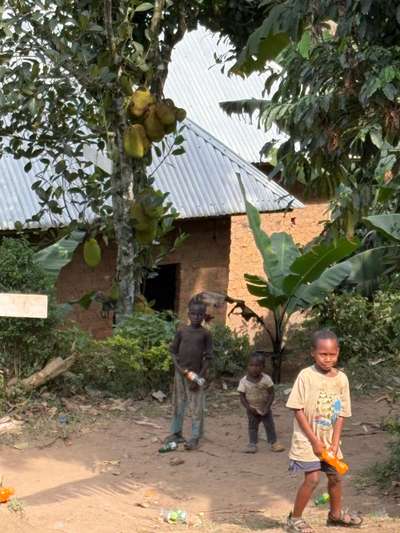
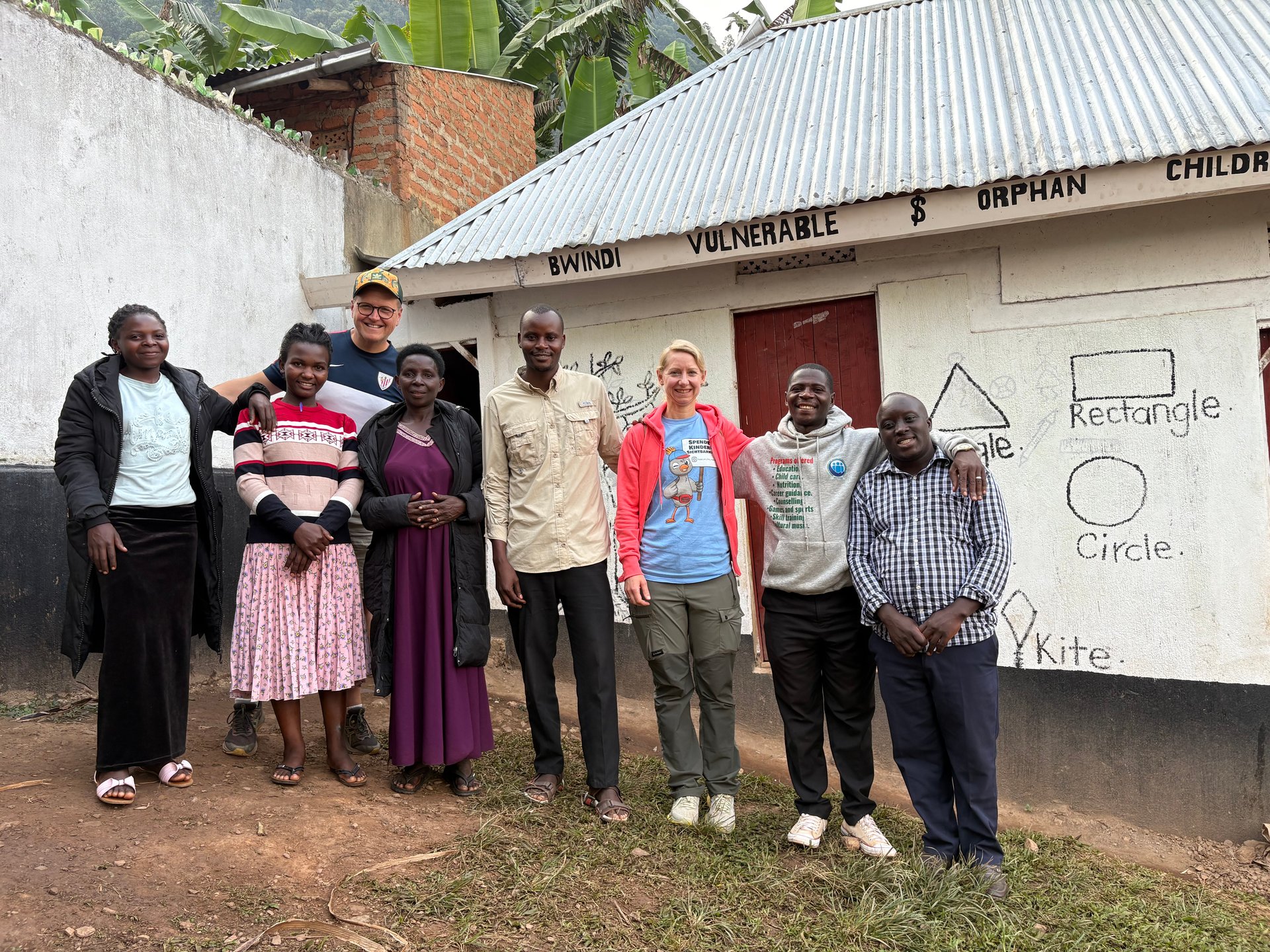
During my visit to Buhoma in June 2026, three children from the neighbourhood near the orphanage appeared at the edge of the compound. They were visibly shy, their clothing worn thin, their body language cautious in the way children become when circumstances have been difficult for a while. We invited them to eat with us immediately — there was no question about it. That meal, shared under a corrugated-iron roof at GPS coordinates −0.9617°N, 29.6109°E, was photographed on 21 June 2026 as part of a series documenting the direct relationship between tourism revenue and community welfare in the Bwindi Impenetrable National Park corridor.
The reason that meal exists — the reason there is food, a functioning orphanage, a farmer selling chicks up the road — is that lodges operate in Buhoma. Every lodge that fills a room sends money into a local economy where a shared chicken dinner counts as a significant event. But how many of these lodges exist across Uganda? How many hotels, guesthouses, safari camps, and community rest camps make up the country’s accommodation sector? The answer, it turns out, is harder to pin down than you might expect — and the reasons for that difficulty tell you as much about Uganda’s tourism economy as the numbers themselves.
Across fourteen documented visits to Uganda between October 2024 and June 2026 — totalling fifty-nine days on the ground, with GPS-verified photography throughout — I have stayed in lodges, guesthouses, and hotels from Kampala to Kidepo, from Lake Bunyonyi to Murchison Falls. What follows draws on the Uganda Bureau of Statistics’ (UBOS) annual Statistical Abstract series, the national accommodation facilities census, and what I observed firsthand in communities where the accommodation sector is not an abstract economic category but a visible, tangible lifeline.
Uganda’s Accommodation Landscape — What the Statistical Abstract Reveals
The most authoritative source for understanding Uganda’s accommodation sector is the Statistical Abstract, an annual government publication produced by the Uganda Bureau of Statistics (UBOS) that documents tourism, wildlife, antiquities, and related economic data alongside broader national statistics. The Statistical Abstract 2014, which provides the most detailed accommodation methodology description in the series, establishes the framework through which Uganda counts and classifies its hotels and lodging facilities.
According to the Statistical Abstract 2014, the last comprehensive national accommodation facilities census was conducted in 2011. That census attempted to count every establishment in Uganda that provides overnight accommodation to travellers — a definition that encompasses hotels, lodges, guesthouses, motels, campsites, and serviced apartments. An update to this census was scheduled in connection with the 2014 national housing census. The accommodation facility survey data, which UBOS publishes in subsequent editions of the Statistical Abstract, covers 20 districts distributed nationally, including Kampala. This is a sample-based approach: it captures the main tourism corridors and the capital but does not survey every district in a country that now contains more than 135 administrative districts.
The distinction between a census (which attempts to count everything) and a survey (which samples a subset) matters enormously for understanding the numbers. A 20-district survey will reliably capture the large hotels in Kampala, the established safari lodges around Bwindi and Queen Elizabeth, and the mid-range properties along the main highway corridors. What it will not capture — and what I encountered repeatedly during my visits — are the small, unregistered guesthouses in trading centres, the community rest camps that open and close with the trekking seasons, and the informal homestay arrangements that exist in villages like Buhoma without any formal registration or reporting structure.
Hotels, as a category within Uganda’s accommodation statistics, show a moderate occupancy rate across various classifications. This places them below lodges — which achieve the highest occupancy rate of any accommodation type, driven by permit-constrained demand in gorilla trekking and game drive corridors — but above the broader guesthouse and hostel segments, where supply often exceeds demand outside peak season.
Hotels and the Economy — GDP Contribution and Growth Trajectory
The economic significance of Uganda’s accommodation sector extends well beyond room revenue. According to the Statistical Abstract 2014, the contribution of hotels and restaurants to Uganda’s gross domestic product rose from 2,768 billion Ugandan shillings in 2012 to 3,110 billion shillings in 2013 — an increase of 12.4 percent in a single year. The Statistical Abstract further documents that hotels and restaurants have been a consistent contributor to GDP since at least 2008, reflecting the sector’s steady growth through a period that included global financial turbulence, regional political instability, and significant domestic infrastructure investment.
That 12.4 percent annual growth rate is worth contextualising. Uganda’s broader economy — an East African nation of approximately 46 million inhabitants, with Kampala as its capital — depends on a diverse mix of agriculture, services, and an emerging industrial sector. Agriculture remains the dominant employer, with rainfed crop production being the largest single water user in the country, followed by livestock farming, forestry, and a growing irrigated agriculture sector. The energy sector, anchored by the Kiira and Nalubaale hydropower complex and supplemented by newer projects including the Tillenga Gas Power Project (80 MW, Bulisa district) and the Kingfisher Gas Power Project (53.7 MW, Kikuube district), provides the electricity infrastructure that hotels depend on — though many properties outside Kampala still rely on generators and solar systems.
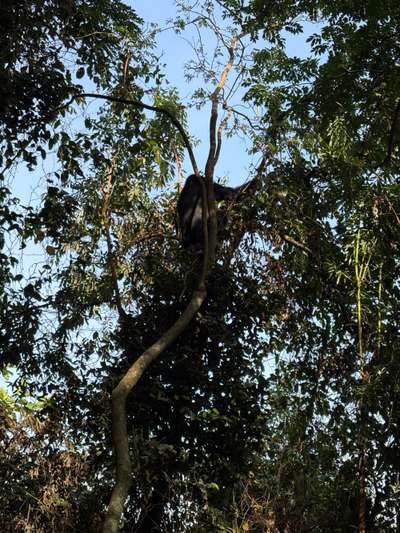
The accommodation sector’s GDP contribution is inseparable from the wildlife tourism that fills its rooms. During our gorilla trekking in January 2026, we encountered our first gorilla family after roughly an hour of hiking — a magnificent individual sitting high in a tree, calmly eating leaves while our group watched from below. That single encounter, photographed at GPS coordinates −0.9735°N, 29.6281°E, represents the economic engine that supports hundreds of lodges, guesthouses, and camps across southwestern Uganda. Each gorilla trekking permit costs $800 in peak season, and the travellers who purchase them need somewhere to sleep, eat, and recover — generating the accommodation revenue that flows into UBOS statistics as part of the hotels and restaurants GDP line.
Uganda’s water resources — its surface and groundwater systems, including the great lakes and the Nile basin — underpin both the agriculture sector and the scenic landscapes that attract tourists. Water supply, sewerage, and waste management constitute their own economic sector in the national accounts, and their quality directly affects the accommodation experience. A lodge that can offer reliable running water, functioning sanitation, and clean surroundings in a remote location is delivering infrastructure that the national statistics capture as economic activity but that the visitor experiences as the difference between a comfortable stay and a difficult one.
Beyond Kampala — Where Uganda’s Accommodation Facilities Concentrate
Uganda is a landlocked country in eastern Africa, bordered by Kenya to the east, Rwanda and Tanzania to the south, the Democratic Republic of Congo to the west, and South Sudan to the north. The equator crosses the southern third of the country. Most of the land consists of a rolling highland plateau at 1,000–1,500 metres elevation, with the western border defined by the Albertine Rift Valley and its chain of lakes — Edward, George, and Albert. This geography directly shapes where accommodation concentrates: the national parks along the rift valley, the lake shores, and the capital city Kampala.
Kampala, with approximately 1.7 million inhabitants, dominates the accommodation statistics. The city’s hotels serve business travellers, conference delegates, and the transit traffic of tourists arriving at Entebbe International Airport before dispersing to safari destinations. Approximately 77 percent of Uganda’s population still lives in rural areas, predominantly in scattered settlements, but the accommodation sector is overwhelmingly urban and peri-urban — concentrated in Kampala, the regional towns of Jinja, Mbale, Mbarara, and Masaka, and the gateway towns serving national parks.
The southwestern highlands — particularly the Kigezi region around Kabale, Kisoro, and Kanungu — represent the densest cluster of tourism-oriented accommodation outside Kampala. Population density in the Kigezi region reaches over 300 inhabitants per square kilometre, and the accommodation sector here is dominated by safari lodges, eco lodges, and community rest camps serving the Bwindi Impenetrable National Park gorilla trekking market. The northern and northeastern regions, particularly Karamoja with population densities below 40 per square kilometre, have the thinnest accommodation infrastructure — though properties like Kidepo Savannah Lodge, opened in 2017 by Nature Lodges at the Kalokudo Gate of Kidepo Valley National Park, are gradually filling that gap.
Gulu, the economic centre of northern Uganda with approximately 150,000 inhabitants, serves primarily as a transit stop on the way to Murchison Falls National Park or Kidepo Valley. Its accommodation sector caters more to international aid workers and NGO staff — a reflection of the region’s history of conflict and humanitarian operations — than to the leisure tourism market that drives accommodation demand in the southwest. Several organisations operate in Uganda’s development and humanitarian space, including Stichting SYPO, a Dutch NGO with a social enterprise arm (SYPO Uganda Ltd.) providing microfinance in remote areas, and various graduation programmes that combine social protection with economic empowerment, financial inclusion, and social strengthening. The SUPREME project, a youth empowerment initiative, and the Rural Finance Initiative, a cross-border microfinance institution serving refugees and local communities in Uganda and South Sudan, also contribute to the economic ecosystem in which accommodation facilities operate.
Counting Accommodation — Census Methodology and Its Limitations
The definition of an accommodation facility, as applied in Uganda’s statistical framework, follows international standards: an accommodation establishment is a local unit that provides overnight lodging to guests travelling for private or business purposes. This definition, consistent with the formulation used in the Statistisches Jahrbuch 2019 and applied in the UBOS methodology, is intentionally broad — it covers everything from a five-star hotel in Kampala to a single-room guesthouse in a rural trading centre.
The practical challenge is that breadth of definition does not translate into breadth of coverage. The 2011 accommodation census was the last attempt at a comprehensive national count. Subsequent data in the Statistical Abstract series relies on the 20-district sample survey, which captures the main nodes of the accommodation network but leaves significant gaps in between. When I visited Buhoma in January 2026 — an eleven-day stay during which I observed the accommodation sector at close range — I counted properties along the road that I could not find in any official listing. Small lodges that open for the trekking season, close when demand drops, and reopen under a different name the following year are a feature of Uganda’s tourism economy that no annual statistical survey can reliably track.
[QUOTE: local guide on first impressions]
The Uganda Tourism Board’s grading programme provides a complementary data source, but it faces its own coverage limitations. In FY2023/24, the programme targeted 100 hotels, lodges, apartments, hostels, and campsites for star-rating assessment. Only 35 were actually graded, because many establishments were found unprepared for inspection. This 35-percent completion rate suggests that even among properties the government is actively trying to assess, a significant proportion either cannot or will not meet the minimum threshold for participation in the formal grading system.
The gap between formal statistics and ground-level reality is not unique to Uganda — it is common across East Africa and reflects the challenges of surveying a fast-moving sector in a country where new properties can open without formal registration. What makes Uganda’s case distinctive is the sheer diversity of accommodation types: from ultra-luxury safari lodges charging $740 per person per night to community rest camps at $35 for a camping pitch, the range spans two orders of magnitude in price and an even wider range in service standards. Any single number claiming to represent “how many hotels Uganda has” necessarily obscures this diversity.
What the Statistics Don’t Capture — Observations from 59 Days on the Ground
Statistics describe a sector. They do not describe the experience of arriving at a lodge after eight hours on the Kampala–Kabale highway, or the sound of elephants feeding behind the kitchen at night, or the face of a child who has just been invited to share a meal they did not expect. Across fourteen visits to Uganda between October 2024 and June 2026 — including a twelve-day trip in October 2024, an eleven-day stay in January 2026 with photographer Susanne Suer, and a thirteen-day visit in May 2026 — I documented the accommodation sector from the inside, sleeping in properties ranging from basic community guesthouses to established safari lodges.
What I observed consistently is that the accommodation sector in Uganda operates on two parallel tracks. The first track is visible to statistics: formally registered properties with star ratings (or at least the aspiration of one), listed on booking platforms, captured in the UBOS 20-district survey. The second track is invisible to statistics but tangible on the ground: the small lodge that a family built from savings, the guesthouse behind a petrol station in a highway town, the community rest camp that a parish maintains with revenue from gorilla permit revenue-sharing. Both tracks serve travellers, both contribute to local economies, and both exist in numbers that no single census has reliably captured.
The energy infrastructure that underpins the accommodation sector illustrates the complexity. Uganda’s electricity generation, anchored by the Kiira and Nalubaale hydropower stations and supplemented by projects like the Lisimba power generation project (180 MW capacity), the Tillenga Gas Power Project in Bulisa district (80 MW, planned commissioning 2025), and the Kingfisher Gas Power Project in Kikuube district (53.7 MW), is expanding but has not yet reached many remote tourism corridors. Off-grid energy providers like Winch Energy Uganda, which operates 31 sites in Bunjako and Lamwo, represent the kind of decentralised infrastructure that enables accommodation facilities to operate in areas the national grid does not yet serve. When I stayed at lodges near Bwindi in June 2026, several relied entirely on solar panels and backup generators — functional, reliable enough for guest comfort, but invisible in the kind of infrastructure statistics that describe the electricity sector at national level.
The accommodation sector also intersects with Uganda’s water economy. The country’s surface and groundwater resources support agriculture (the dominant economic sector), household consumption, industrial use, and the tourism infrastructure that lodges depend on. A lodge in the Bwindi corridor that can offer clean running water, reliable sewerage, and a functioning waste management system is delivering a service that the national accounts capture under “Water Supply, Sewerage and Waste Management Activities” — but that the visitor experiences simply as a comfortable room with a working shower.
The question “how many hotels and accommodation facilities exist in Uganda?” does not have a single clean answer. The 2011 census attempted one. The 20-district survey provides an ongoing estimate. The UTB grading programme reaches a fraction. And on the ground, the sector is larger, more diverse, and more dynamic than any of these data sources fully capture. What the data does confirm is that the sector is growing — a 12.4 percent increase in GDP contribution in a single year is not a marginal trend — and that it matters, economically and socially, to communities across Uganda in ways that the statistics can quantify but that only a visit can make real.