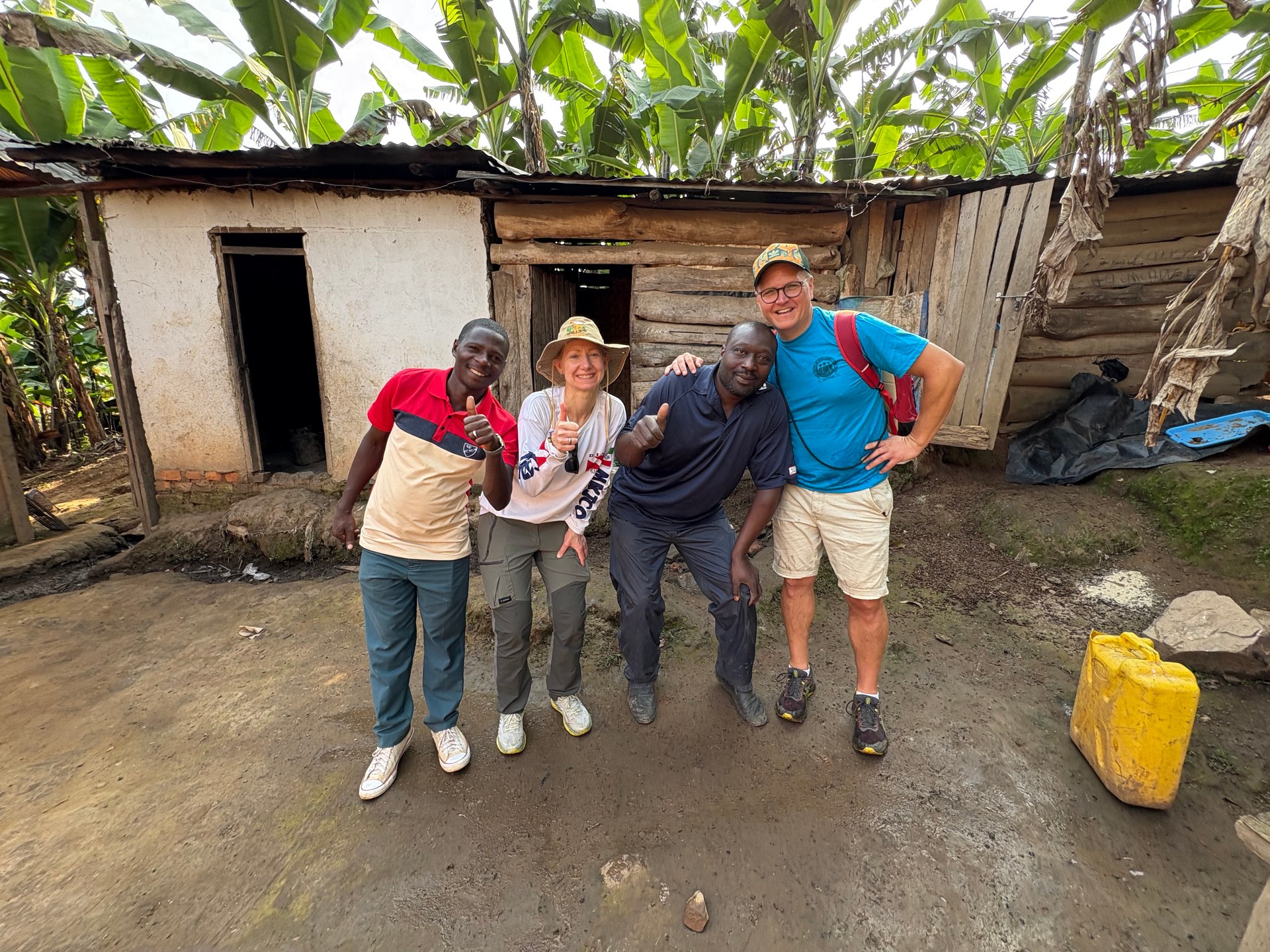
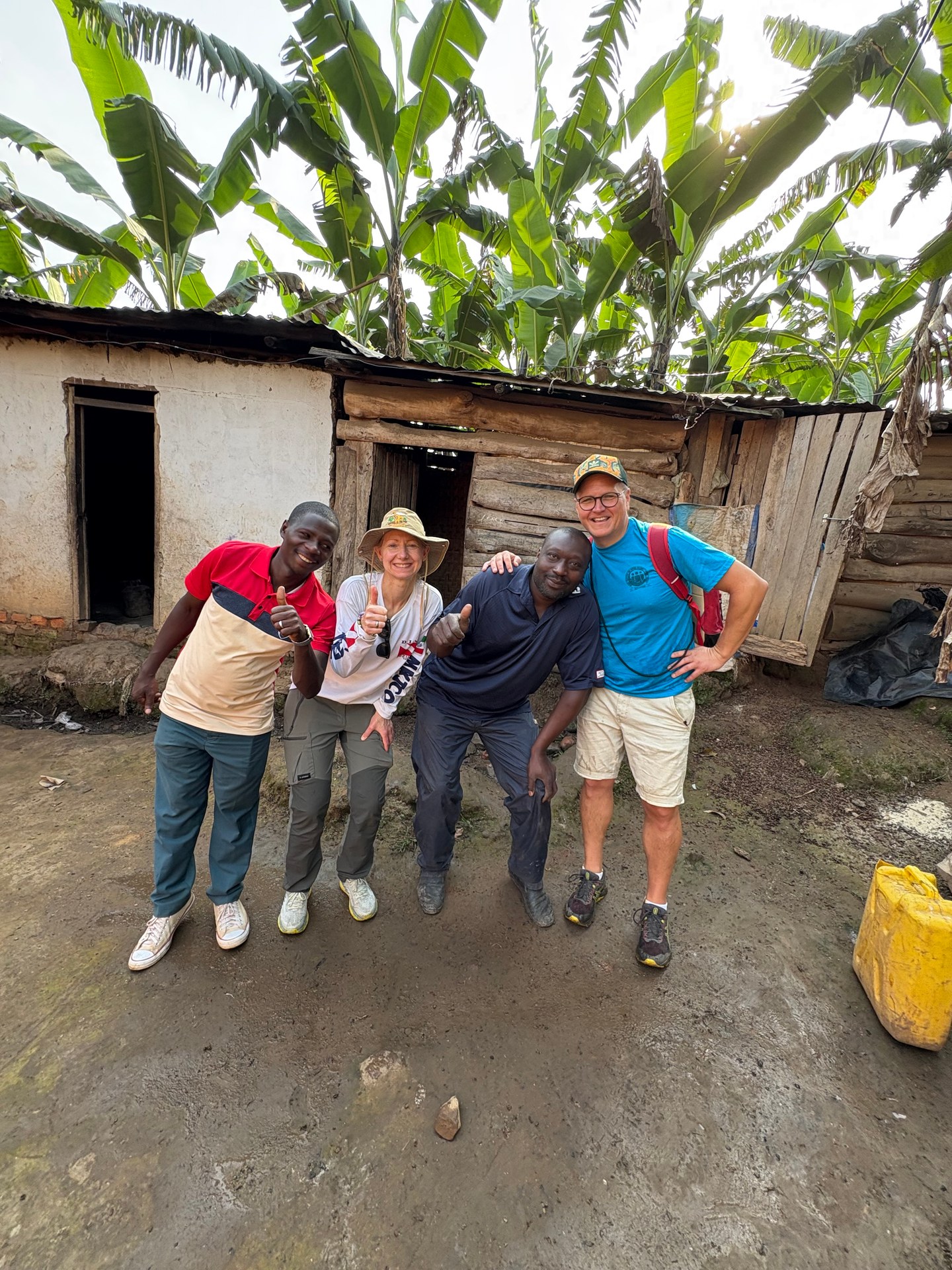
During my visit to Buhoma in June 2026, we drove to a small poultry farm on the hillside above the village to inspect how the chicks we had been buying were being raised. The farmer took visible pride in his operation — each batch of birds monitored daily, the warming boxes maintained with real care, the housing kept clean despite the modest means at his disposal. We had purchased chicks from him on multiple previous occasions, always destined for the orphanage down the road, where they would be raised either for egg production or for meat. It is not an exaggeration to say that a meal with chicken is treated as a feast at the orphanage — protein is that scarce in this part of southwestern Uganda.
That small transaction, photographed at GPS coordinates −0.9713°N, 29.6142°E on 21 June 2026, connects directly to what lodges in the Bwindi corridor represent. The farmer sells chicks because there are buyers — and those buyers exist because tourism brings money into Buhoma. The lodges that line the road to Bwindi Impenetrable National Park are not abstract entries in a booking engine; they are the economic anchors of communities where a chicken farm counts as a viable enterprise. When I first visited the region in October 2024, and returned in January 2026 and again in May and June 2026 — ten documented visits across three days on the ground — I kept encountering the same pattern: every lodge, from the backpacker camp to the luxury banda, generates a multiplier effect that reaches well past its perimeter fence.
This guide examines lodges in Bwindi through a lens that most travel content ignores: the Uganda Tourism Board’s grading system, official room-count data from the Uganda Statistical Abstract 2025, and the gap between what a star classification promises and what you actually find when you arrive. The goal is not another “best lodges” list but a factual assessment of what accommodation capacity exists, how it is classified, and what that classification means in practice.
Bwindi’s Lodge Landscape — What Each Sector Offers
Bwindi Impenetrable National Park is divided into four gorilla trekking sectors, each with a distinct cluster of accommodation. The distribution is uneven: Buhoma, as the original and most-visited sector, has the deepest lodge inventory. The other three sectors — Ruhija to the east, Rushaga and Nkuringo to the south — have fewer properties, and the budget end of the spectrum thins out considerably as you move away from Buhoma. Understanding this distribution matters because your gorilla trekking permit is sector-specific: a permit for Buhoma cannot be used at Rushaga, and transferring is not straightforward. Your lodge choice should follow your permit, not the other way around.
Buhoma Sector
Buhoma has the widest range, from backpacker-grade dormitories to properties charging upwards of $700 per person per night. Volcanoes Bwindi Lodge, an architecturally distinctive property with eight straw-thatched luxury bandas, each with en-suite facilities, double vanities, and a private terrace overlooking the forest canopy, was comprehensively renovated in 2018 and subsequently added a forest spa facility. Rates start from approximately $445/$740 for single/double occupancy including full board. Silverback Lodge, operated by the Marasa Africa hotel group, is the largest property in the immediate Buhoma area with twelve rooms constructed from local materials including forest vines, sisal rope, and purple slate stone, positioned five minutes’ walk from the park headquarters.
At the accessible end of the price spectrum, Bwindi Forest Lodge offers comfortable rooms with rainforest views from approximately $100 per double including breakfast — a meaningful option for travellers whose gorilla permit already consumes most of their budget. The lodge’s owner and staff actively assist with logistics, which matters in a location where reliable local knowledge saves both time and money. During our visits to Buhoma, the walking distance between the village trading centre, the trekking briefing point, and the nearest lodges was short enough that the entire area functions as a single, walkable tourism node — a convenience that no other Bwindi sector replicates.
Ruhija Sector
Ruhija sits at higher elevation than Buhoma, and the lodge options are fewer. Cuckooland Tented Lodge, a small property with four safari tents on wooden platforms, requires guests to park their vehicle and walk ten minutes steeply downhill to reach the lodge — a minor adventure in itself. The property compensates for its remoteness with a landscaped swimming pond, an open-air fitness area, and food prepared from its own garden plots. Meals are priced separately at $10 for lunch and $15 for dinner. Ruhija Community Rest Camp, a backpacker-oriented property five minutes’ walk from the Ruhija tracking meeting point, offers cottages from $65 including breakfast — making it the most budget-conscious choice in this sector.
Rushaga and Nkuringo Sectors
The southern sectors present a different character. Nkuringo Bwindi Gorilla Lodge, situated at 2,090 metres above sea level — the highest lodge elevation in Uganda — evolved from a simple campsite into an eighteen-room property with individually furnished rooms. The main building features high ceilings, massive timber beams, and panoramic windows that frame a view across treetops, volcanoes, and mountain ridges. The lodge collaborates with the Uganda Carbon Bureau to offset its carbon footprint, and guests can support a local reforestation initiative for $20. Bwindi Backpackers Lodge, approximately five kilometres before Nkuringo, offers the most affordable accommodation in the southern corridor from $40 per person including full board for a camping pitch, with private cottages and rooms available at higher rates.
The lakeside circuit south of Bwindi adds further accommodation depth. Lake Mulehe, Lake Mutanda, and Lake Bunyonyi each host their own cluster of lodges, serving travellers who combine gorilla trekking with a lakeside recovery stop. These properties are typically 30–90 minutes by road from the nearest trekking start point, which means they suit itineraries with at least two nights in the region rather than single-night trekking trips.
Uganda’s Lodge Grading System — What the Stars Actually Mean
The Uganda Tourism Board (UTB) operates a star-classification programme that is, by its own admission, a work in progress. According to the UTB Annual Report for FY 2023/24, the grading programme targeted 100 hotels, lodges, apartments, hostels, and campsites for assessment that fiscal year. Only 35 were actually graded, because many establishments were found to be unprepared for inspection. That statistic is worth absorbing: fewer than one in three targeted properties met the minimum threshold for being assessed, let alone classified.
For the Bwindi corridor specifically, the Uganda Statistical Abstract 2025 provides concrete data on two graded properties in the Kanungu district, which encompasses the Buhoma and Ruhija sectors. Trackers Safari Lodge holds a three-star classification with 11 single rooms and 15 double rooms. Mahogany Springs Luxury Lodge, also three-star, has 12 single rooms and 24 double rooms. These are documented, government-verified room counts — the kind of data that matters when you are trying to understand actual capacity rather than relying on marketing descriptions that may overstate what a property offers.
The gap between graded and ungraded is not necessarily a quality gap. Several properties around Bwindi that consistently receive strong reviews from visitors have simply not been assessed under the UTB programme. Volcanoes Bwindi Lodge, Silverback Lodge, and Clouds Mountain Gorilla Lodge all operate at standards that would comfortably place them in the four- or five-star bracket, yet they may or may not carry a formal UTB star classification depending on when and whether an inspection team reached their location. The grading programme’s limited reach outside Kampala and major towns means that travellers cannot use star ratings as a reliable filter for Bwindi accommodation — they need supplementary information, ideally from sources that have visited the properties in person.
Kampala Capital City Authority (KCCA) has set a target to train 500 people in the tourism and hospitality sector in quality assurance and standards during FY 2024/25, according to the Ministerial Policy Statement. This training initiative, while Kampala-focused, is part of a broader effort to raise the baseline service level that eventually feeds into the grading system. KCCA also plans to maintain ten designated tourism attraction sites in the same fiscal year. The Rwenzori region, which borders the western national parks corridor, has set an even more ambitious target: increasing compliance levels among tourism operators by 50% by 2030, according to the Rwenzori Visitor Flow Analysis and Destination Management Plan. Whether these targets translate into meaningful improvements at remote lodges near Bwindi remains to be seen, but the intent signals that the government recognises the gap.
What the Statistical Abstract Reveals — Lodge Capacity Across Uganda
Lodges, as an accommodation category, have the highest occupancy rate of any property type in Uganda’s tourism sector. That fact, drawn from national tourism data, reflects both the scarcity of rooms in high-demand areas like the Bwindi corridor and the premium pricing that gorilla trekking permits create. When a visitor has already committed $800 for a peak-season permit, the marginal cost of a lodge room is a smaller share of the total trip spend — which supports higher occupancy rates and more stable revenue for lodge operators compared to urban hotels competing primarily on room price.
The Uganda Statistical Abstract 2025 provides a national inventory of graded accommodation that reveals the scale and distribution of the sector. The data below covers properties across multiple regions, and it is worth understanding how Bwindi’s lodges sit within this wider landscape.
| Property | Star Rating | District | Single Rooms | Double Rooms |
|---|---|---|---|---|
| Trackers Safari Lodge | Three-star | Kanungu | 11 | 15 |
| Mahogany Springs Luxury Lodge | Three-star | Kanungu | 12 | 24 |
| Arcadia Lodges Lake Bunyonyi | Four-star | Kabale | 25 | 35 |
| Emburara Farm Lodge | Four-star | Mbarara | 33 | 38 |
| Igongo Cultural Center & Country Hotel | Four-star | Mbarara | 52 | 59 |
| Bunyonyi Overland Resort | Two-star | Kabale | 45 | 63 |
| Cephas Inn | Three-star | Kabale | 60 | 135 |
| Adere Safari Lodge | Two-star | Karenga | 20 | 45 |
| Lemala Wildwaters Lodge | Two-star | Kayunga | 10 | 11 |
| Brovad Sands Lodge | Three-star | Kalangala | 50 | 100 |
Source: Uganda Statistical Abstract 2025. Room counts reflect UTB-graded capacity at time of assessment.
Several patterns emerge from this data. The Kanungu district lodges — Trackers and Mahogany Springs — are compact properties, reflecting the physical constraints of building in a mountainous national park buffer zone. Their combined capacity of 62 rooms (23 single, 39 double) serves a trekking sector that issues a limited number of gorilla permits per day. In contrast, the transit-corridor properties in Mbarara district (Emburara Farm Lodge with 71 rooms, Igongo Cultural Center with 111 rooms) are significantly larger, serving the Kampala–Bwindi highway traffic that stops overnight before continuing to the national parks.
The Kabale district cluster — Arcadia Lodges (60 rooms), Bunyonyi Overland Resort (108 rooms), and Cephas Inn (195 rooms) — reveals the scale of the Lake Bunyonyi accommodation economy. Arcadia Lodges, a four-star property with 25 single and 35 double rooms according to the Statistical Abstract 2025, operates as a family-run enterprise with additional properties at Lake Mburo. Its hilltop position above Lake Bunyonyi provides panoramic views across the lake and its islands, with activities ranging from jet-skiing to quad-biking. Cephas Inn, a three-star town hotel in Kabale itself, has the largest room count in the district at 195 rooms — functioning as the commercial hub’s primary business accommodation rather than a tourism lodge in the traditional sense.
Beyond the southwestern circuit, the Statistical Abstract data illustrates the national spread. Hotel Brovad in Masaka (three-star, 120 single and 135 double rooms) and Collin Hotel in Mukono (three-star, 202 single and 220 double rooms) are urban properties serving the commercial traveller market on the Kampala–Masaka and Kampala–Jinja corridors respectively. Hotel Paradise on the Nile in Jinja (two-star, 69 single and 86 double rooms) serves the adventure tourism market centred on the Nile source. Hoima Buffalo Hotel (two-star, 80 single and 190 double rooms) and Kabalega Resort Hotel (three-star, 27 single and 32 double rooms) serve the Murchison Falls corridor and the growing oil-sector business traffic in the Albertine Graben.
Beyond Bwindi — Uganda’s Wider Lodge Network and Kidepo
The lodge sector extends well beyond the Bwindi corridor, and understanding that wider network matters for travellers building multi-destination itineraries. Kidepo Savannah Lodge, operated by Nature Lodges and opened in 2017 at the Kalokudo Gate of Kidepo Valley National Park, represents the frontier of Uganda’s lodge development. Kidepo sits in the Karamoja region — the northeast corner of the country, bordering South Sudan and Kenya — and the accommodation infrastructure there is thinner than anywhere else in Uganda’s national park system. A 2024 visitor flow analysis identified 15 hotels as primary private tourism actors in Karamoja, including Hotel Africana, Mt Moroto Hotel, Strikers Hotel, and Karamoja Safari Camp, according to the Karamoja Tourism Visitor Flow Analysis and Destination Management Plan.
The contrast with Bwindi is instructive. Where the southwestern corridor has dozens of properties ranging from $40 to $740 per night, Karamoja’s entire hospitality sector is anchored by 15 properties serving a national park that many seasoned Uganda travellers consider the country’s finest wildlife destination. Kidepo Savannah Lodge fills a genuine gap — its safari tents with savannah views provide a mid-range option in a region that previously offered little between basic guesthouses and fly-camp setups. The lodge’s management by a professional lodge operator (Nature Lodges) rather than a community cooperative reflects the different development trajectory of Karamoja tourism compared to Bwindi, where community-run properties have a thirty-year head start.
Adere Safari Lodge in Karenga district (two-star, 20 single and 45 double rooms per the Statistical Abstract 2025) is another Karamoja-region property that illustrates the sparse but growing accommodation base. With 65 rooms, it is larger than most Bwindi lodges but serves a very different visitor profile — predominantly wildlife enthusiasts on multi-day self-drive or guided safaris through northern Uganda, rather than the permit-holding gorilla trekkers who dominate the southwestern corridor.
Community Economics — What Lodges in Bwindi Actually Sustain
The reason I keep returning to that chicken farmer in Buhoma is not sentimentality — it is because his enterprise is a clean illustration of how lodge tourism translates into community economics. He raises chicks to a standard high enough that we trusted him repeatedly as a supplier for the orphanage. The orphanage, in turn, raises the birds for two purposes: eggs for daily nutrition and occasional meat for communal meals. Some birds are also sold, generating a small income stream that contributes to the orphanage’s operating costs. This is not a theoretical value chain; I observed it directly across multiple visits, and the consistency of the farmer’s husbandry — documented in photographs taken at the same GPS coordinates six months apart — confirmed that the operation is sustained rather than performative.
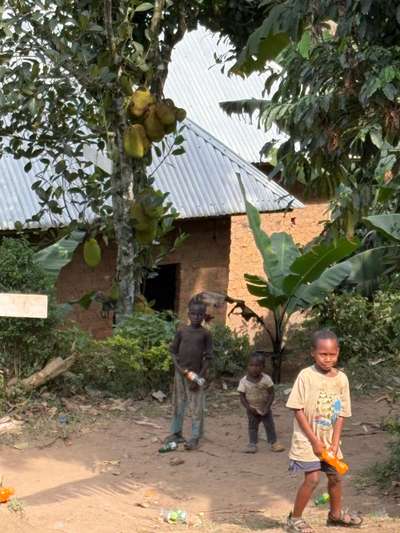
The children we met near the orphanage during that June 2026 visit told a different part of the same story. Three children from the surrounding neighbourhood had come to the orphanage grounds; they appeared shy, their clothing and bearing suggesting difficult circumstances. We invited them to share the meal we had brought. Scenes like this are not staged tourism encounters — they are the daily reality of communities in the Bwindi buffer zone, where the difference between a functioning local economy and a struggling one often comes down to whether the lodges up the road are operating at capacity.
[QUOTE: local guide on first impressions]
Every gorilla trekking permit sold through the Uganda Wildlife Authority includes a revenue-sharing component that goes directly to local communities. But the indirect effects — the food procurement, the employment, the porter fees, the craft purchases, the small-scale farming that feeds off tourism cash flow — often exceed the direct transfer in total value. A lodge that sources its vegetables from hillside gardens within walking distance, buys its eggs from the farmer we visited, and employs staff from the village is creating an economic footprint that a five-star rating cannot capture but that a visit to the area makes immediately visible.
The lodge grading system, with its star ratings and room counts, tells you about facility quality. The Statistical Abstract tells you about capacity. Neither tells you about this — the living economic relationship between a lodge and its community. That relationship is the reason lodges in Bwindi matter beyond their thread counts, their Wi-Fi speeds, and their breakfast menus. It is also the reason that choosing a lodge in this corridor is not merely a hospitality decision but a small act of economic participation in a community that depends, measurably and visibly, on whether visitors show up.