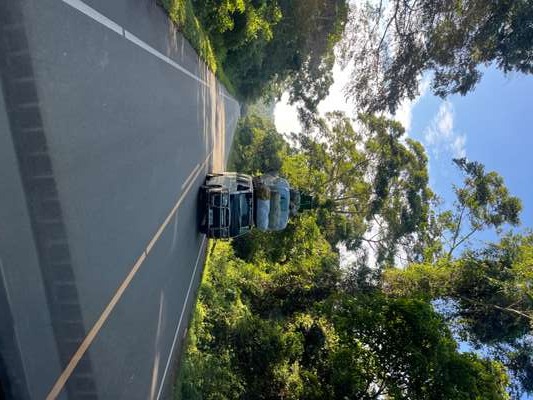
Somewhere between the town of Butiru and the southern gate of Murchison Falls National Park, our driver slowed behind a white minibus that looked as though it had grown a second storey overnight. Mattresses, rolled bedding, and bundled household goods rose from the roof rack to roughly twice the height of the vehicle itself, secured by a web of ropes that seemed to hold through sheer optimism. It was October 2024 — my first visit to Uganda — and the scene felt surreal. Our local guide laughed: “That is completely normal. He will deliver those to a lodge up the road.” In that single image, the two forces shaping lodges in Uganda became visible at once: the creative resourcefulness of the people who build and supply them, and the infrastructure that determines how goods and guests actually reach the door.
Over three visits between October 2024 and May 2026 — covering routes from Entebbe Airport through Kampala to Bwindi, Lake Bunyonyi, and Murchison Falls — I documented what travellers rarely read about in lodge brochures: the environmental regulations that every operator must navigate, the road-building programmes that are redrawing Uganda’s travel map, and the gap between what a lodge advertises and what happens behind the scenes in waste management, water sourcing, and community partnership. All photographs in this article are GPS-verified originals taken on location by the author.
This guide is not a list of the best lodges in Uganda — we publish those separately. Instead, it explains the regulatory and infrastructural context that determines whether a lodge operates sustainably, whether a guest can reach it without a twelve-hour ordeal, and what the Ugandan government is investing to change both of those things in the years ahead.
Environmental Audits: What Every Lodge in Uganda Must Prove
Uganda’s National Environment (Audit) Regulations, enacted as Statutory Instrument No. 47 of 2020, introduced a formal audit framework for businesses operating in environmentally sensitive zones. For the lodge industry, the practical effect is significant: any property situated inside a national park, bordering a forest reserve, or occupying land near wetlands must submit to periodic environmental audits covering waste disposal, water extraction, energy consumption, and ecological impact on surrounding habitats.
The regulations apply most strictly to the lodges that travellers value most — those deep in Bwindi Impenetrable Forest, perched on the rim of Queen Elizabeth’s Kazinga Channel, or tucked into the savannah of Murchison Falls. A luxury lodge serving forty guests per night generates substantial waste, consumes water from sources shared with wildlife, and imports diesel or solar hardware into fragile ecosystems. The audit process examines each of these pressure points and compares the lodge’s actual practices against a compliance standard that accounts for the sensitivity of the location.
[QUOTE: local lodge manager on the audit process and what it changed in daily operations]
What does this mean in practice? During my January 2026 visit, I observed lodges in the Bwindi area managing waste through on-site composting, burning non-recyclable materials in controlled pits, and separating glass and metal for periodic collection by a regional recycler based in Kabale. Water came from a combination of borehole extraction and rainwater harvesting — some lodges had invested in large ferro-cement tanks that collected runoff during the wet season. Solar panels were visible on the roofs of several mid-range properties, though diesel generators remained the backup for overcast stretches. None of these systems appeared in marketing materials. They were simply the cost of operating legally in a protected area.
The audit regulations distinguish between lodges by location and scale, not by star rating. A small community-run guesthouse at the edge of a wetland faces the same legal obligations as a five-hundred-dollar-a-night luxury camp inside the park boundary. The difference lies in enforcement resources: larger operators with international booking platforms tend to maintain documented compliance records, while smaller properties may struggle with the administrative burden despite genuinely low-impact operations. This gap between regulation and reality is one of the tensions shaping the future of lodges in Uganda.
What Travellers Can Check Before Booking
Ask the lodge directly about its environmental audit status. Properties that have completed a recent audit will typically know the date and scope. Look for concrete indicators rather than vague sustainability claims: solar panels visible in photographs, mention of rainwater harvesting, composting programmes, or partnerships with community conservation projects. Lodges that employ staff primarily from surrounding villages and source food from local farms are often the same ones investing in compliance, because community partnership and environmental responsibility tend to reinforce each other.
The Uganda Tourism Board does not yet publish a public registry of environmentally audited lodges, which makes direct enquiry the most reliable method. Tour operators with long-standing relationships in specific regions — particularly around Bwindi and Murchison Falls — can usually confirm which properties meet compliance standards, because they visit regularly and see the operations first-hand.
The GKMA Programme: How New Roads and Markets Reshape Access to Lodges Across Uganda
The Greater Kampala Metropolitan Area Urban Development Program — referred to as GKMA-UDP — is a World Bank-funded initiative coordinated by the Ugandan government through KCCA and eight local governments that together form the metropolitan area encompassing Kampala, Wakiso, and Mukono. The programme rests on three pillars: mobility and connectivity, environmental resilience, and job creation. Its estimated total cost stands at UGX 494 billion, approximately USD 130 million, according to the KCCA Strategic Plan 2025. As of early 2025, the programme had reached roughly five percent completion.
For travellers, the numbers translate into tangible changes. The GKMA-UDP includes the reconstruction and improvement of 81.87 kilometres of strategic connectivity roads, installation of traffic signalling at three major junctions, street lighting on three additional roads, and drainage improvements at 17 identified problem spots (KCCA Strategic Plan 2025). Each of these interventions addresses a specific pain point that anyone who has driven through Kampala will recognise: flooded intersections during rain, unlit roads after dark, and bottleneck junctions where boda-bodas, trucks, and pedestrians compete for the same unmarked space.
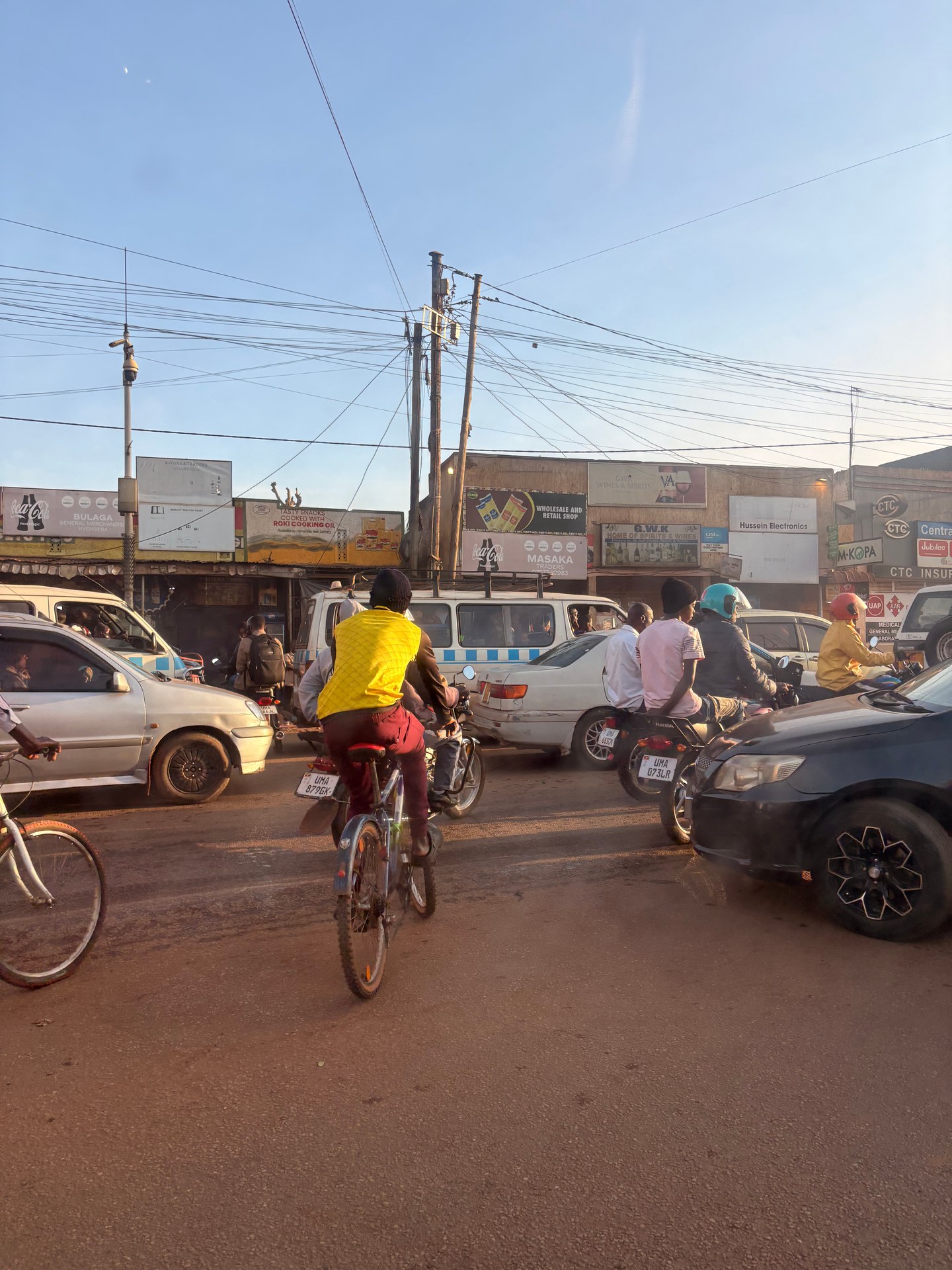
I experienced these conditions first-hand. Arriving at Entebbe Airport in May 2026, our vehicle joined the flow into Kampala within minutes. The streets were enormously busy — cars, boda-boda motorcycles, and bicycles appeared to cross in every direction simultaneously. There is no gentle introduction; the city absorbs you immediately. Roadside stalls lined every available metre of pavement, and the sheer density of movement made it clear why road reconstruction is not merely an urban planning exercise but a precondition for tourism to function at scale. Most travellers heading to lodges in Uganda pass through Kampala, and the transfer experience sets the tone for the entire trip.
Tourism-Specific Infrastructure: A UGX 6 Billion Investment
Beyond general road reconstruction, KCCA has allocated a dedicated UGX 6 billion budget for the construction of tourism infrastructure and facilities across the Greater Kampala Metropolitan Area. Running from the 2025/26 to the 2029/30 financial year, the project encompasses visitor information centres, designated rest areas along tourist corridors, improved access roads to heritage sites, and upgraded public spaces near cultural attractions (KCCA Strategic Plan 2025). The programme is part of KCCA’s broader strategy to position Kampala as a preferred tourism destination — not merely a transit point between the airport and the national parks.
The strategic intent is clear: Kampala currently functions for most safari travellers as a place to pass through as quickly as possible. Lodges in Uganda’s capital tend to serve transit guests — arrivals staying one night before an early morning departure to Bwindi or Queen Elizabeth. By investing in tourism-grade infrastructure, KCCA aims to turn overnight stays into multi-day visits, which would benefit Kampala lodges, restaurants, and cultural sites alike. The development of the so-called GKMA Heartland Circuit, connecting historical sites, markets, and cultural landmarks within the metropolitan area, is designed to give travellers a reason to stay.
Three new markets within the GKMA-UDP — Ggaba, Kamwokya, and Usafi — are projected to create over 20,000 jobs and improve the commercial environment around central Kampala (KCCA Strategic Plan 2025). For lodges, the secondary effect matters: better market infrastructure means cleaner streets, more reliable supply chains for fresh food, and a more appealing urban environment for guests who venture beyond their hotel compound.
Beyond Kampala: The Roads That Connect Lodges in Uganda to the Rest of the Country
The condition of Uganda’s trunk roads determines not only travel time but travel willingness. A lodge in Bwindi that is seven hours from Kampala on a sealed road becomes a ten-hour ordeal when sections collapse into gravel and dust. The Masaka Highway, one of Uganda’s primary north-south corridors, illustrates this perfectly.
When I drove the Masaka Highway in January 2026, large sections were under active reconstruction. The road alternated between freshly asphalted stretches and long sandy diversions where trucks, cars, jeeps, and boda-bodas competed for space in clouds of red dust. Visibility dropped to a few metres behind each heavy vehicle. The scale of the construction was impressive — heavy machinery, grading equipment, and worker camps lined the corridor — but the immediate reality for travellers was a slow, dusty grind that added hours to the journey south toward Bwindi and Lake Bunyonyi. Every lodge operator along this route knows that road conditions directly affect booking patterns: when the road is bad, cancellation rates rise.
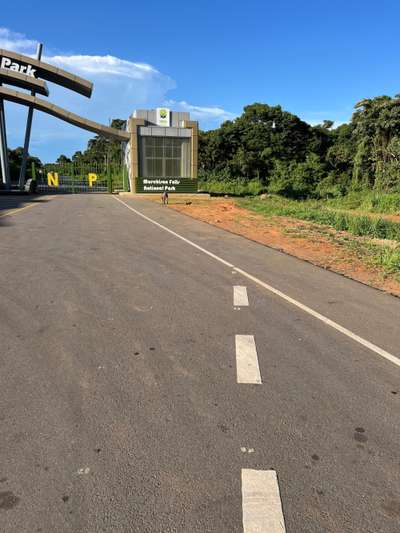
By contrast, the access road to Murchison Falls National Park had already been completed when I visited in October 2024. The entrance gate featured a brand-new asphalted surface with painted lane markings — a striking contrast to the surrounding rural roads. We stopped briefly at the gate, and the quality of the road was immediately apparent. This kind of targeted infrastructure investment — paving the final kilometres to a major national park — has an outsized effect on the lodges inside. Guests arrive in better condition, transfers run on schedule, and the overall perception of the destination improves. The lodges in Uganda that benefit most from road investment are often not the ones closest to Kampala but the ones at the end of the longest drives.
Boda-Bodas: The Informal Transport Network That Lodges Depend On
No account of infrastructure and lodges in Uganda is complete without acknowledging the boda-boda — the motorcycle taxis that form the backbone of short- and medium-distance transport across the country. On a rural road in October 2024, we passed a boda-boda rider carrying several large water jerry cans strapped to his motorcycle. He wore no helmet and rode in sandals — entirely standard practice in East Africa. The image was striking to European eyes but unremarkable to our Ugandan companions: boda-bodas carry everything from people to produce to building materials, and they reach places that no car or truck can access.
For lodges in remote locations, boda-bodas are often the only way staff commute to work, the quickest method to transport small emergency supplies, and occasionally the vehicle that delivers a guest’s forgotten luggage from the nearest town. In Kampala, boda-boda riders dominate every intersection, weaving through traffic with a fluency that initially alarms visitors and gradually becomes background rhythm. The City Road Safety Steering Committee, which includes representatives from KCCA, the Ministry of Works and Transport, Uganda National Roads Authority, and Uganda Police Force Traffic, among others, coordinates road safety management that directly affects boda-boda regulation (Kampala Road Safety Strategy 2021–2030). Balancing the economic necessity of boda-boda transport with safety standards remains one of Uganda’s most visible policy challenges.
Kampala Lodges and KCCA’s Strategy to Keep Travellers Longer
Kampala is home to a diverse range of lodges, hotels, and guesthouses, yet most international visitors treat the capital as an overnight waypoint. The pattern is well-established: arrive at Entebbe, transfer to Kampala, sleep, leave for the parks at dawn. KCCA’s Tourism Development Programme, outlined in its 2025 Strategic Plan, explicitly targets this behaviour by developing Kampala as a destination in its own right — not just a gateway.
The strategy involves four interconnected elements: physical infrastructure (roads, public spaces, visitor facilities), promotion of local businesses (markets, restaurants, craft producers), engagement with communities to ensure tourism benefits are shared, and positioning Kampala within the Greater Kampala Metropolitan Area as a base for day trips and cultural experiences. Seventeen tourism-related events have been promoted in Kampala in recent years, including the Rolex Festival, World Tourism Day, and Miss Tourism Uganda (KCCA Ministerial Policy Statement 2024/25). These events aim to build Kampala’s identity as a city worth exploring, which would directly benefit Kampala lodges through extended stays.
From a traveller’s perspective, the argument is not yet compelling. During my May 2026 visit, Kampala’s energy was undeniable — the boda-boda hubs, the street vendors, the sheer density of life pressed into every block — but the infrastructure for comfortable walking, safe cycling, or leisurely exploration was not yet in place. The GKMA-UDP’s road reconstruction, drainage improvements, and street lighting are precisely the interventions that could change this over the next three to five years. Until then, Kampala lodges serve primarily as comfortable staging points for travellers en route to the national parks.
[QUOTE: Kampala lodge owner on how road construction has affected their guest mix]
The Landscapes That Lodges in Uganda Call Home
The environmental regulations, road programmes, and urban strategies discussed above exist because of what lies at the end of Uganda’s roads: some of the most biodiverse landscapes in Africa. Lodges in Uganda operate across an extraordinary range of ecosystems — from the montane rainforest of Bwindi at 2,300 metres elevation to the Nile riverbanks of Murchison Falls at 600 metres, from the crater lakes of Kibale to the savannah plains of Kidepo Valley in the far northeast.
During a boat safari on the Nile within Murchison Falls National Park in October 2024, we spotted a massive Nile crocodile resting on the riverbank. Even from a safe distance aboard the boat, the animal’s size and stillness were striking — a reminder that the ecosystems surrounding Uganda’s lodges are not decorative backdrops but active, functioning habitats with apex predators. The lodges that operate successfully in these environments do so by respecting the boundary between guest comfort and ecological integrity. The environmental audit framework, whatever its enforcement gaps, exists because these landscapes are not replaceable.
This context matters when choosing a lodge. Properties that invest in environmental compliance are not simply ticking a regulatory box; they are maintaining the conditions that make their location valuable in the first place. A lodge in Bwindi that degrades its surrounding forest degrades its own product. A camp on the Nile that pollutes the river undermines the boat safaris its guests paid to experience. The alignment between environmental responsibility and commercial interest is unusually direct in Uganda’s lodge industry, which is why the audit regulations — however imperfect in practice — represent an important structural safeguard.
Uganda’s Women Entrepreneurship Programme, implemented through various KCCA initiatives, supports female-led businesses in the hospitality and craft sectors (KCCA Strategic Plan 2025). Several lodges across the country are managed or co-owned by Ugandan women, and community lodges frequently channel a percentage of revenue into women’s cooperatives, health centres, and education programmes. These connections between lodges, communities, and government programmes are often invisible to the booking guest but fundamental to the sustainability of Uganda’s tourism sector.