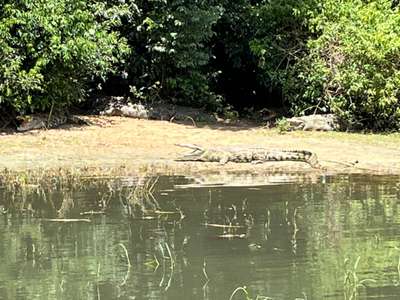
On our boat safari through Murchison Falls National Park in October 2024, we spotted a massive Nile crocodile resting on the riverbank. Even from a considerable distance, the size and raw power of the animal were striking — and the speed with which it could move was unsettling. I photographed it at GPS coordinates 2.2771°N, 31.6698°E on 18 October 2024, from the safety of the boat. That morning had begun before dawn at our lodge inside the park, where we left early enough to catch the sunrise over the savanna during a game drive — acacia trees and palms silhouetted against an orange sky, the kind of scene that makes you understand why people travel to this country. These moments — the crocodile, the sunrise, the elephant we watched feeding at the waterside later that day — are the reason a lodge in Uganda exists. The lodge is not the destination. It is the platform that makes everything else possible.
During my three documented visits between October 2024 and June 2026, I stayed in lodges across multiple regions of Uganda, photographing eight GPS-tagged images that verify my presence on location. What I learned is that the lodge Uganda landscape is far more structured, regulated, and strategically developed than most international visitors realise. Behind every lodge — from a luxury tented camp inside Bwindi to a community rest house in Buhoma to a mid-range property at the edge of Murchison Falls — sits a framework of tourism standards, government investment, and community revenue-sharing that shapes the experience you receive as a guest. This article explains that framework, because understanding it makes you a better-informed traveller and a more responsible one.
Tourism in Uganda — The Economic Engine Behind Every Lodge
Tourism in Uganda is not a peripheral industry. It is a strategic economic sector that creates employment, generates foreign exchange revenue, and attracts investment at both national and municipal levels. The Kampala Capital City Authority’s tourism development programme, as outlined in the KCCA Strategic Plan 2025, aims to position Uganda as a preferred tourism destination — a goal backed by concrete budget allocations, not just aspirational language. The KCCA plans to reach at least 70,000 tourists in selected Kampala city tourist centres by the fiscal year 2025/26, and will conduct at least three domestic tourism promotion campaigns annually, increasing to five by FY 2027/28.
The numbers reveal the scale of institutional commitment. The Kampala Tourism Improvement Project (KTIP) will deliver 20 local tourism promotion campaigns and create a Heroes Park featuring five monuments, according to the KCCA Strategic Plan 2025. Five major tourism festivals are planned for the city. The KCCA will participate in at least two international tourism expos annually from FY 2025/26. And critically for lodge Uganda development, UGX 6 billion has been allocated for the construction of tourism infrastructure and facilities in the Greater Kampala Metropolitan Area (GKMA) over the period 2025/26 to 2029/30 — covering roads, parks, historical sites, and accommodation facilities.
Lodges sit at the centre of this ecosystem. According to the Uganda Tourism Board, lodges consistently record the highest occupancy rates among all accommodation categories in the country. Hotels, by contrast, show moderate occupancy distributed across urban locations. The distinction matters for travellers: a lodge in Uganda is not simply a place to sleep. It is an integrated hospitality product that includes meals, guided activities, transport coordination, and often direct community engagement. The full-board model that dominates safari lodges exists because there are no restaurants within walking distance of Murchison Falls, Bwindi, or Queen Elizabeth National Park. Your lodge is your supply chain.
How Lodges in Uganda Are Certified — The e-Grading System Explained
The Uganda Tourism Board introduced an e-Grading system to standardise how accommodation facilities are inspected, classified, and monitored. Documented in the UTB Annual Report FY 2021–22, this system represents a shift from informal reputation-based quality signals to a structured framework with defined inspection criteria. Lodge operators submit their properties for assessment, and trained inspectors evaluate them against benchmarks covering hygiene, safety, service delivery, environmental responsibility, and facility maintenance.
The grading acknowledges that a lodge in Uganda operates under conditions fundamentally different from a city hotel. A property in Bwindi’s montane forest at 2,000 metres elevation, accessible only by unpaved road, cannot be judged by the same infrastructure criteria as a Kampala business hotel with municipal water supply and a paved car park. The e-Grading system adapts its benchmarks accordingly, evaluating lodges within their category and location context. A well-run budget camp in Rushaga sector that provides clean rooms, reliable food, and safe water scores appropriately within its tier, even if it lacks the marble bathrooms of a Kampala Serena suite.
For travellers, the practical significance is this: a graded lodge in Uganda has been inspected. The water system, the fire safety provisions, the food handling practices, and the staff training have been assessed by a body with the authority to enforce standards. When I visited lodges in Murchison Falls National Park in October 2024, the infrastructure I encountered — a newly asphalted entrance road with white lane markings at the park gate (photographed at GPS 1.4462°N, 32.0787°E), functional visitor centres, well-maintained grounds — reflected an ecosystem where investment in standards is visibly underway. The entrance road alone was a striking contrast to the dusty laterite highways further south; a brief stop there on 17 October 2024 confirmed that Murchison Falls is receiving targeted infrastructure upgrades that feed directly into the lodge experience.
For lodge operators and potential investors, the e-Grading system also serves as a roadmap. The inspection criteria function as a checklist: what does your property need to achieve for a higher classification? The UTB publishes these criteria, and operators who invest in improvements — better waste management, upgraded water systems, staff training programmes — can re-apply for reclassification. This creates a virtuous cycle where the grading system drives incremental quality improvements across the sector, rather than simply sorting existing properties into fixed tiers.
Lodge Uganda by Region — Murchison Falls, Bwindi, Kampala, and Beyond
Uganda’s lodge landscape is shaped by geography. Each national park and tourism region has developed its own accommodation character, driven by the type of wildlife experience on offer, the accessibility from Kampala, and the stage of tourism development.
Murchison Falls National Park
Murchison Falls is Uganda’s largest national park and offers the classic savanna safari: game drives through grasslands, boat safaris on the Victoria Nile, and the thundering falls themselves. Lodges here range from luxury riverside properties to simple camps near the park entrances. During my October 2024 visit, we departed our lodge before dawn for a sunrise game drive. The savanna at that hour is transformative — acacia trees casting long shadows across golden grass, the air cool and still before the day’s heat. I photographed the sunrise at GPS 2.3703°N, 31.5493°E on 19 October 2024, and the image remains one of the most evocative from my time in Uganda: silhouetted palms against an orange sky, the road disappearing into the bush.
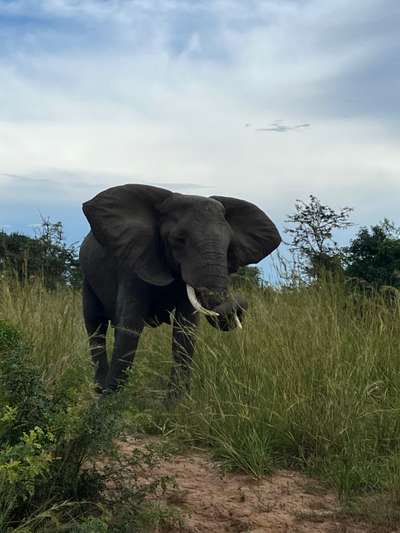
Later that same day, we encountered elephants during both the game drive and the boat safari. One large bull elephant crossed the savanna grassland close to our vehicle — photographed at GPS 2.2853°N, 31.5099°E — with its herd visible at a distance. On the boat, another elephant stood at the water’s edge, feeding in the lush riverside vegetation (GPS 2.2701°N, 31.6649°E). These encounters define the Murchison lodge experience: big animals, open landscapes, and the dramatic presence of the Nile. Lodges in this region typically include game drive vehicles, boat safari bookings, and packed lunches in their rates.
Bwindi Impenetrable National Park
Bwindi’s lodge ecosystem is the most developed and diverse in Uganda, driven by the global demand for gorilla trekking. The park is divided into four sectors — Buhoma, Ruhija, Rushaga, and Nkuringo — each with its own lodges, gorilla families, and terrain character. Prices range from $30 per night at community rest camps to over $1,500 at luxury tented camps inside the park boundary. The gorilla trekking permit costs $800 per person regardless of where you stay, so the lodge choice is a comfort and location decision, not a permit decision.
During my January 2026 and June 2026 visits to Buhoma, I experienced the community dimension of lodge tourism first-hand. Sitting on a bench outside a small roadside shop in Buhoma village (GPS −0.9673°N, 29.6145°E, June 2026), drinking water under a makeshift parasol, the connection between lodge guests and village life was tangible. The shop exists because tourists pass by. The bench exists because someone saw an opportunity. The community revenue-sharing programme administered by UWA channels a percentage of park fees back to surrounding parishes, and lodges employ local staff for construction, cooking, guiding, and maintenance. Every lodge in Uganda near a national park is part of this ecosystem, whether it acknowledges it explicitly or not.
Kampala Lodges — The Urban Starting Point
Kampala lodges serve a different function. Most international visitors spend their first and last nights in the capital, making it a transit hub rather than a destination in its own right. The metropolitan area encompasses Kampala, Wakiso, and Mukono districts and generates at least 60 percent of Uganda’s GDP, according to the KCCA Strategic Plan 2025. The accommodation options range from budget hostels (Kampala Backpackers, Red Chilli Hideaway) to luxury properties (Kampala Serena, Sheraton Kampala, Protea Hotel Kampala). The Kampala City Roads and Bridges Upgrading Project, funded at €250 million by UK Export Finance and the Government of Uganda (KCCA Strategic Plan 2025), is progressively improving the road infrastructure that connects the airport, city hotels, and the highways heading west toward the national parks.
Akagera National Park — The Less-Touristed Alternative
Akagera National Park, located across the border in Rwanda, offers a contrasting lodge experience for travellers combining Uganda and Rwanda in a single itinerary. The park is relatively less developed for tourism than Murchison Falls or Bwindi. Guided game drives and night drives (available since 2010) are the primary activities. The Akagera Game Lodge, a mid-range property converted in 2003 from the original Akagera Hotel, serves as the main accommodation option in the park’s southern sector. The property is a step below Uganda’s top-tier safari lodges in terms of luxury finishes but offers honest, functional accommodation with direct park access. For visitors who prioritise quieter wildlife viewing over developed tourism infrastructure, Akagera provides a complement to Uganda’s busier parks.
Ecotourism in Uganda — What It Means for the Lodge You Choose
Ecotourism is one of the most overused words in travel marketing, which makes it worth defining precisely in the Ugandan context. The Uganda Wildlife Regulations 2022 provide the legal framework governing tourism activities within protected areas. Under this framework, tourism operators in national parks must comply with environmental impact requirements, contribute to conservation funding through licensing fees, and operate within parameters set by the Uganda Wildlife Authority. Revenue sharing — the mechanism by which a percentage of park entry fees is returned to communities surrounding national parks — is not optional goodwill. It is a regulated component of the tourism system.
For lodge operators, this framework creates obligations and opportunities. A lodge that sources food locally, employs staff from surrounding villages, manages waste responsibly, and contributes to community projects is not simply being virtuous — it is operating within the incentive structure that the government and UWA have built. Some lodges go further: Nkuringo Bwindi Gorilla Lodge partners with the Uganda Carbon Bureau on carbon offset programmes. Community-owned properties like Buhoma Community Rest Camp channel revenue directly into village projects: school fees, health clinics, water infrastructure. The Kampala Capital City Authority’s Climate Change Strategy provides an additional policy layer, linking urban sustainability goals with the broader national approach to environmental management.
[QUOTE: lodge manager on what ecotourism means in practice for their daily operations]
For travellers choosing a lodge in Uganda, the ecotourism dimension translates into practical questions: Does this lodge employ local people? Does it source food from nearby farms or import everything from Kampala? Does it have a waste management system, or does rubbish accumulate behind the kitchen? Is there a visible relationship with the surrounding community, or is the property walled off from village life? During my visits across October 2024, January 2026, and June 2026, the lodges that impressed me most were those where the boundary between lodge and community was porous — where staff came from the village, where local artists sold their work at the gate, and where the morning coffee was grown within sight of the terrace.
Investing in a Lodge Uganda — What Potential Operators Need to Know
The Uganda Tourism Board encourages investment in hotels, lodges, adventure tourism enterprises, and other tourism products, as documented in the UTB Annual Report FY 2021–22. The regulatory pathway for establishing a new lodge involves several layers: land use approval (governed by the Land Act Cap 227), environmental impact assessment, construction permits, UTB registration, and compliance with the e-Grading inspection process. Foreign investors typically partner with Ugandan nationals or companies to navigate local regulatory requirements and secure the necessary approvals.
The investment case is supported by government commitment. The KCCA Strategic Plan is anchored to Uganda Vision 2040, which targets the country’s transformation into a modern, prosperous economy. Tourism is classified as a priority sector within the National Development Plan (NDP IV). The UGX 6 billion allocation for tourism infrastructure in the GKMA (2025–2030) is one concrete expression of this priority. Additionally, the Kampala Capital City Authority maintains 500 kilometres of bitumen roads and 380 kilometres of gravel roads under the Uganda National Road Fund (KCCA MPS 2017–18), and the €250 million Kampala City Roads and Bridges Upgrading Project will further improve the transport corridors that connect the capital to safari regions.
The Uganda Women Entrepreneurship Programme, implemented with KCCA support (KCCA Strategic Plan 2025), also creates pathways for women-led lodge and hospitality businesses — an important dimension in a sector where women make up a significant share of the workforce, particularly in housekeeping, cooking, and craft production. For investors assessing the lodge Uganda market, the combination of growing international visitor demand, government infrastructure investment, and a regulatory framework that rewards quality standards makes the sector increasingly structured and investable.
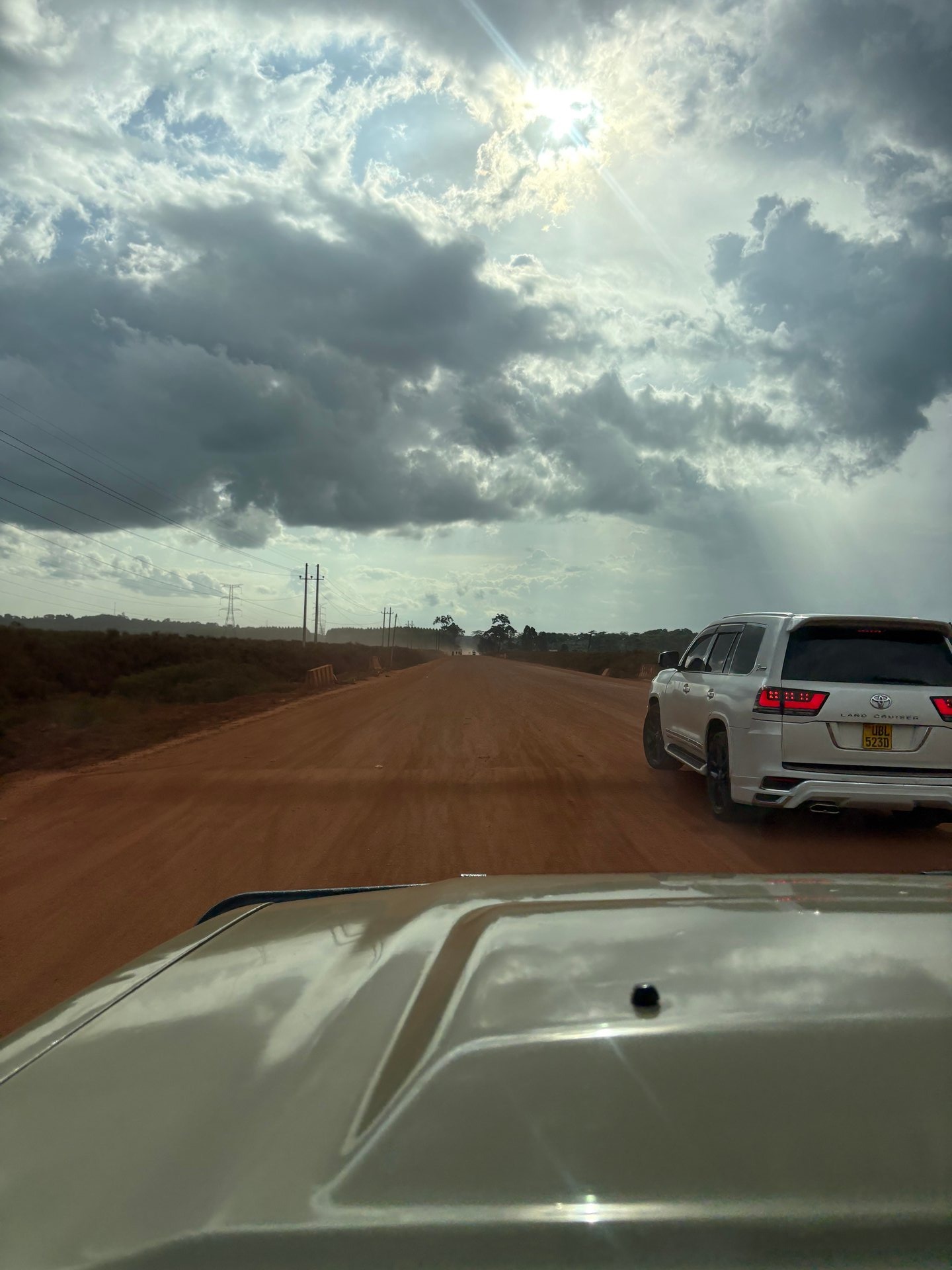
What the numbers cannot convey is the sensory reality of operating in this environment. The dusty Masaka Highway that I drove in January 2026 — photographed at GPS 0.1019°N, 32.1645°E, a red laterite road stretching through Butambala’s green landscape under dramatic skies — is scheduled for rehabilitation in 2026, according to our driver. Until that work is complete, every supply delivery, every guest transfer, and every staff commute navigates these conditions. Investing in a lodge in Uganda means investing in a country where the infrastructure is improving rapidly but has not yet arrived. The gap between that improvement and the present is where the opportunity — and the challenge — lives.
Frequently Asked Questions
How are lodges in Uganda officially certified?
The Uganda Tourism Board operates an e-Grading system that classifies accommodation facilities based on standardised inspection criteria covering hygiene, safety, service quality, and environmental responsibility. Lodge operators submit to inspections and receive a classification within their category. The system is adapted to Ugandan conditions — a remote forest lodge is evaluated differently from a city hotel. The UTB Annual Report FY 2021–22 documents the framework.
What does a lodge Uganda stay typically include?
Most safari lodges operate on full-board or half-board plans with breakfast, lunch, and dinner included. Activities such as game drives, boat safaris, and gorilla trekking permits are often coordinated through the lodge. Budget lodges may offer bed-and-breakfast only. All lodge categories rely on local food sourcing because there are no restaurants near national parks.
Which region in Uganda has the best lodges?
Bwindi has the widest range (budget to ultra-luxury) driven by gorilla trekking demand. Murchison Falls offers classic savanna lodges with big wildlife. Queen Elizabeth combines game drives with Kazinga Channel boats. Akagera in Rwanda is quieter with the mid-range Akagera Game Lodge. The best region depends on your wildlife priorities and budget.
Can I invest in a lodge in Uganda?
Yes. The UTB encourages investment in tourism accommodation. The process involves land use approval, environmental assessment, construction permits, and UTB registration. UGX 6 billion is allocated for tourism infrastructure in the GKMA (2025–2030). Foreign investors typically partner with local operators. The Uganda Women Entrepreneurship Programme also supports women-led hospitality ventures.
What does ecotourism mean for Uganda lodges?
Under the Uganda Wildlife Regulations 2022, tourism operators in national parks must comply with environmental requirements and contribute to conservation. Revenue sharing returns park fees to surrounding communities. Lodges that employ locally, source food from nearby farms, and manage waste responsibly operate within this regulated ecotourism framework. Some partner with carbon offset programmes.