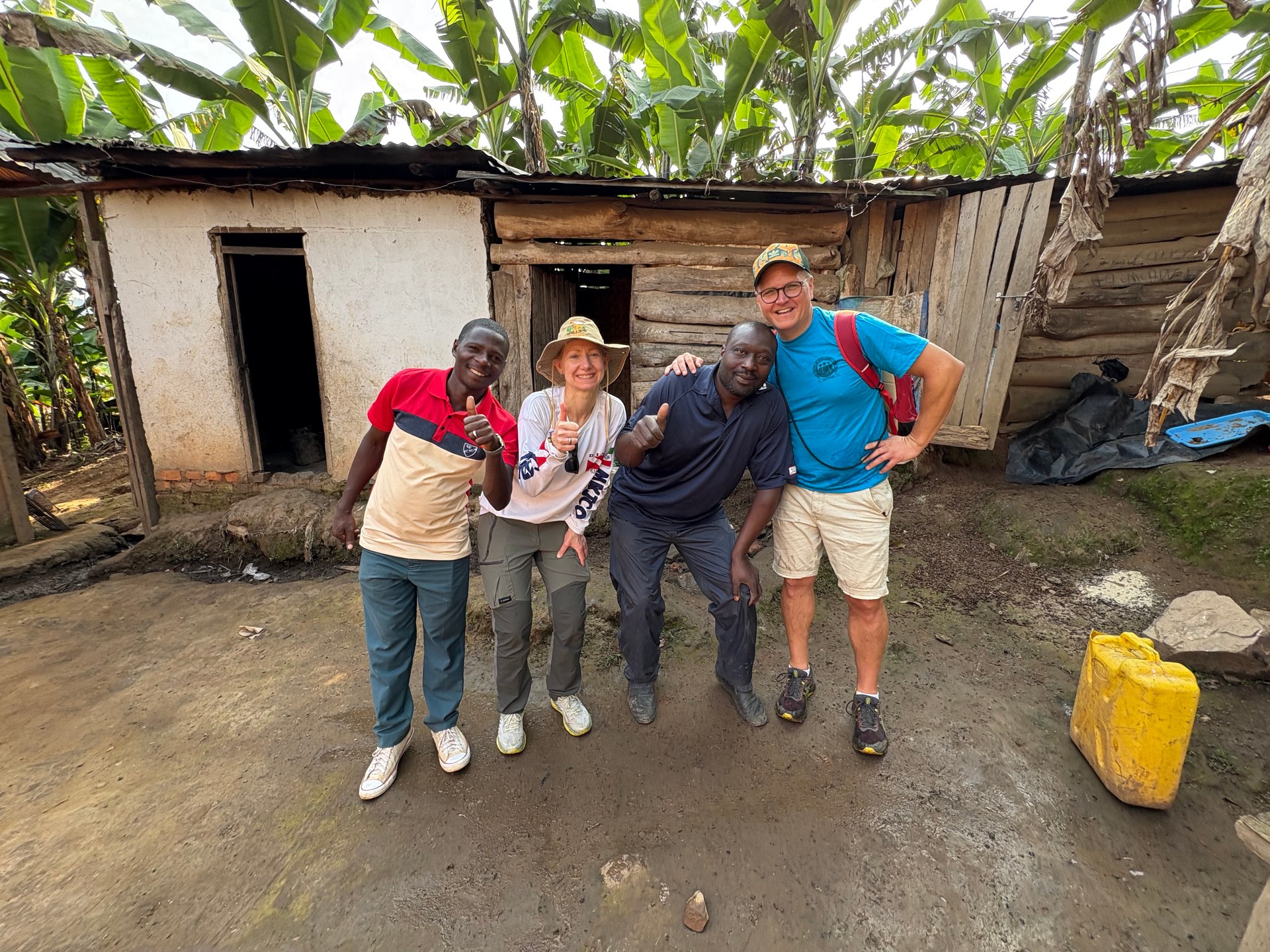
On 21 June 2026, at 6:31 in the morning, we stood inside a small poultry enclosure on the outskirts of Buhoma village, watching a local farmer lift a day-old chick from a warming box and hold it out for inspection. The farmer runs his operation with unmistakable dedication — each batch of birds raised with care, their health monitored daily, their housing kept clean despite the limited materials available. We had come to see how the chicks were kept and raised before purchasing several batches for the nearby orphanage, where they are kept for both egg production and meat. This was not our first purchase from this farmer. Over the course of multiple visits, we had returned to buy chicks precisely because the quality of his husbandry was consistent and the birds thrived after delivery.
This GPS-verified photograph, taken at coordinates −0.9713°N, 29.6142°E, shows a scene that most travel articles about southwestern Uganda never reach. The region surrounding Bwindi Impenetrable National Park and Mgahinga Gorilla National Park is known to the outside world primarily for gorilla trekking and, increasingly, for golden monkey encounters in the bamboo forests of the Virunga volcanoes. What that framing misses is the ecosystem of small-scale enterprise — poultry farming, beekeeping, subsistence agriculture — that sustains the communities whose cooperation makes wildlife conservation viable. During my fourteen documented visits to this region between October 2024 and June 2026, totalling fifty-nine days on the ground, the connection between community livelihoods and conservation outcomes became impossible to overlook.
Golden monkey trekking at Mgahinga Gorilla National Park sits at the intersection of these forces. The $100 permit that grants visitors one hour with the habituated Nyakagezi golden monkey group generates revenue that flows into park management, ranger salaries, and community development programmes under the Uganda Wildlife Authority’s revenue-sharing scheme. That revenue sustains the institutional framework that protects not only the golden monkeys but the entire Virunga ecosystem — volcanoes, bamboo forests, and the communities at their base. Understanding that chain transforms golden monkey trekking from a wildlife checklist item into a meaningful engagement with one of East Africa’s most fragile conservation landscapes.
What Golden Monkey Trekking at Mgahinga Actually Involves
Mgahinga Gorilla National Park occupies 33.7 square kilometres at the northeastern end of the Virunga volcanic chain, where Uganda, Rwanda, and the Democratic Republic of Congo converge. Three extinct volcanoes define the park’s topography: Muhavura at 4,127 metres, Sabinyo at 3,669 metres, and Gahinga at 3,475 metres, from which the park takes its name. The lower slopes of these volcanoes are blanketed in dense bamboo forest — the primary habitat of the golden monkey, a species found nowhere on earth outside the Virunga massif and the adjacent Nyungwe Forest in Rwanda.
The golden monkey (Cercopithecus kandti) is a visually striking primate with a bright orange-gold patch on its back and flanks, contrasting with black limbs and a dark face framed by a pale brow band. Unlike mountain gorillas, which live in small family groups of eight to twenty individuals, golden monkeys form large troops of sixty to one hundred members that move rapidly through the bamboo canopy. Their diet consists primarily of young bamboo shoots and leaves, supplemented by fruit, insects, and flowers found in the afro-montane vegetation zone. The bamboo dependence concentrates the monkeys at specific altitudes — typically between 2,500 and 3,400 metres — where bamboo growth is densest, and this predictability is what makes habituation and trekking feasible.
The trekking procedure mirrors gorilla tracking in its basic structure. Visitors report to the park headquarters near the base of Gahinga volcano by 8 AM for a briefing conducted by UWA rangers. The briefing covers rules of engagement — maintain a seven-metre distance, no flash photography, one hour maximum with the troop, no trekking if symptomatic with respiratory illness — and provides an overview of the day’s expected route. Rangers who have been tracking the monkey group since dawn radio in the troop’s current position, giving the trekking party a reasonably accurate idea of the walking time required. On most days, the monkeys are located within thirty to ninety minutes of walking from the trailhead.
The trail itself follows a path through bamboo forest that climbs gradually along the lower slopes of Gahinga. The vegetation here is described by ecologists as afro-montane — dominated by bamboo at lower elevations, transitioning to giant lobelias and senecio species in the alpine zone above 3,500 metres. With luck, trekkers may spot golden cats, servals, or leopards, though these predators are shy and rarely seen. More than 180 bird species have been recorded in the park, including twelve endemics such as the rare Rwenzori turako, making Mgahinga attractive to birders even on mornings when the monkeys prove elusive.
What distinguishes golden monkey trekking from gorilla tracking is the pace and energy of the encounter. Gorillas are sedentary, often feeding or resting on the ground, allowing for contemplative observation. Golden monkeys are acrobatic, constantly in motion through the canopy, leaping between bamboo stalks and vocalising in rapid bursts. Photographing them requires faster shutter speeds, a longer lens, and patience as the troop flows around you. The hour passes quickly. Several visitors I spoke with over my various trips described the golden monkey encounter as the most physically dynamic wildlife experience in Uganda — less solemn than gorilla tracking, more immersive in the sensory detail of a functioning forest ecosystem.
[QUOTE: local UWA ranger on how the golden monkey group's daily movement patterns differ between wet and dry season]
Lodges Near Mgahinga — From Mount Gahinga Lodge to Lake Mutanda
Accommodation for golden monkey trekking falls into three geographic clusters: properties immediately adjacent to the park entrance, the town of Kisoro fourteen kilometres away, and the lake lodges on Mutanda and Mulehe south of the volcanic chain. The choice between them involves trade-offs between proximity to the trailhead, price, and the broader experience of staying in one of East Africa’s most dramatic volcanic landscapes.
Mount Gahinga Lodge, operated by Volcanoes Safaris, is the closest established property to the park headquarters. Positioned near the base of Gahinga volcano, the lodge offers double rooms from $500 per night on a full-board basis and maintains the groomed, professional standard that Volcanoes Safaris applies across its portfolio, which includes Bwindi Lodge and Kyambura Gorilla Lodge in Queen Elizabeth National Park. For guests whose primary objective is the morning trek, the location eliminates the early-morning drive from Kisoro and its associated uncertainty on unpaved roads. The lodge’s proximity also allows afternoon activities — a guided nature walk to the Rugezi Swamp, a visit to the Sabinyo Gorge, or time on the park’s observation platform, eight hundred metres from the entrance, which offers panoramic views across the volcanic chain and surrounding countryside.
In Kisoro, a small town that serves as the administrative centre for Uganda’s southwestern corner, several budget and mid-range guesthouses provide functional accommodation at a fraction of the Mount Gahinga Lodge price. The town is also where local operators like Virunga Adventure Tours and Nkuringo Walking Safaris maintain offices, offering day trips to Mgahinga as well as combined itineraries that include gorilla trekking at Rushaga or Nkuringo sectors of Bwindi Impenetrable National Park. The fourteen-kilometre drive from Kisoro to the park headquarters takes roughly thirty minutes on a gravel road that is passable year-round but deteriorates noticeably during the March-to-May rains.
The lodges around Lake Mutanda and Lake Mulehe occupy some of the most photogenic settings in southwestern Uganda. Chameleon Hill Lodge, perched on the northern shore of Lake Mutanda with views of the Virunga volcanoes reflected in the water, combines proximity to both Mgahinga and the Rushaga sector of Bwindi with a waterfront environment that no park-edge lodge can match. Lake Mulehe, smaller and quieter, hosts properties that offer canoeing, fishing, and guided walks as complements to the wildlife programme. These lake-based lodges appeal to travellers who want more than back-to-back trekking days — a rest day on the water between a golden monkey trek and a gorilla encounter, for instance, breaks the physical intensity without leaving the region.
For visitors approaching Mgahinga from the Nkuringo side of Bwindi, two lodges deserve mention. Clouds Mountain Gorilla Lodge, developed as a joint venture between the safari company Wildplaces Africa, the African Wildlife Foundation, and surrounding communities, sits above 2,000 metres altitude, making it the highest-elevation lodge in Uganda. Its architecture — high ceilings, massive timber beams, panoramic windows looking out over treetops and volcanic peaks — reflects the ambition of a property designed to demonstrate that luxury tourism and community ownership can coexist. Nkuringo Bwindi Gorilla Lodge, a community partnership with eighteen rooms at 2,090 metres, offers a more modest alternative in the same sector. Both properties are approximately forty-five minutes’ drive from Mgahinga, making a combined itinerary feasible for travellers with four or more nights in the region.
The lodge market across Uganda reflects the sector’s position as the accommodation type with the highest occupancy rates and strongest demand among international visitors. Properties in the southwestern corridor — around Bwindi, Mgahinga, and the crater lakes — consistently outperform national averages because they serve a visitor base that has already committed to a high-value itinerary. A traveller who has budgeted $800 for a gorilla permit and $100 for golden monkey trekking is not price-sensitive about the lodge. This dynamic drives continued investment in new properties and upgrades to existing ones, though it also creates a gap between the premium lodges serving international visitors and the basic guesthouses that domestic travellers and researchers use.
Conservation Across Borders — The Dian Fossey Gorilla Fund and the Virunga Ecosystem
Golden monkeys and mountain gorillas share the Virunga volcanic chain, and the conservation infrastructure that protects one species inherently serves the other. The Dian Fossey Gorilla Fund International, the single largest conservation organisation active in the Virunga ecosystem, maintains its most intensive field operations in Volcanoes National Park on the Rwandan side of the border. Founded in the legacy of Dian Fossey’s pioneering gorilla research in the 1960s, the Fund employs daily monitoring teams that track gorilla families, remove snares, and collect behavioural and health data. While the Fund’s primary focus is mountain gorillas, its anti-poaching patrols and habitat protection activities benefit every species in the forest, golden monkeys included.
Volcanoes National Park in Rwanda — directly adjacent to Mgahinga, separated by the international border but ecologically continuous — hosts the largest concentration of habituated gorilla groups in the Virunga chain and a substantial golden monkey population. The Nyakagezi group that visitors trek at Mgahinga moves freely across the Uganda-Rwanda border, sometimes crossing into Rwandan territory for days or weeks before returning. This transboundary behaviour has practical consequences for visitors: on occasions when the group is in Rwanda, golden monkey trekking at Mgahinga is unavailable. UWA rangers monitor the group’s location daily, and prospective trekkers are advised to confirm the group’s presence before travelling to the park. The same cross-border dynamic applies to Mgahinga’s only habituated gorilla family, the Nyakagezi group (confusingly, the same name is used for both the monkey and gorilla groups, though they are distinct), which as of early 2019 consisted of eleven members including two silverbacks.
The conservation challenges facing golden monkeys differ from those threatening gorillas. Golden monkeys are more numerous — several thousand individuals across the Virunga range, compared to roughly 1,063 mountain gorillas worldwide — but their dependence on bamboo forest makes them vulnerable to habitat fragmentation. Bamboo is also harvested by local communities for building material, fencing, and craft production. The tension between community bamboo use and golden monkey habitat is managed through buffer zones, regulated harvesting schedules, and the economic alternatives that tourism revenue creates. The Uganda Wildlife Authority’s revenue-sharing programme, which directs a percentage of park income to parishes bordering Mgahinga, directly addresses this tension by providing communities with financial reasons to tolerate restrictions on forest access.
Across the border in Kigali, the Kigali Cultural Village — a government-supported cultural centre with a museum, craft market, and workshops — provides context for visitors travelling between Rwanda’s capital and the Volcanoes National Park region. The facility, whose opening was planned for 2019, reflects Rwanda’s strategy of integrating cultural tourism with wildlife tourism, a model that Uganda is beginning to replicate through community cultural tourism programmes around Bwindi and Mgahinga. The Batwa Cultural Experience near Mgahinga, where members of the indigenous Batwa community demonstrate traditional forest skills and share oral histories, is one such programme on the Ugandan side.
The research infrastructure supporting golden monkey conservation draws on Uganda’s academic institutions, particularly Makerere University in Kampala, whose Faculty of Science has contributed primatological research across Bwindi, Mgahinga, and Kibale National Park for decades. Makerere’s collaborations with international research teams have deepened understanding of golden monkey ecology, population genetics, and disease transmission risks — knowledge that directly informs UWA’s management protocols for trekking group sizes, observation distances, and health screening of visitors. The Uganda National Museum in Kampala, the country’s only dedicated cultural institution of its kind, houses historical and natural history collections that provide broader context for visitors seeking to understand Uganda’s biodiversity before heading to the field.
From Kampala to Mgahinga — What the Journey Reveals About Uganda’s Infrastructure
The road from Kampala to Kisoro — approximately 510 kilometres through Masaka, Mbarara, and Kabale — takes eight to ten hours by private vehicle, depending on road conditions and the volume of truck traffic on the Kampala-Masaka corridor. This journey is, for many visitors, their first sustained encounter with Uganda beyond Entebbe Airport and the capital, and it reveals a country in visible transition between its urban centre and its rural periphery.
Kampala Capital City, home to approximately 1.65 million residents across five administrative divisions and 194.3 square kilometres, is managed by the Kampala Capital City Authority (KCCA) under the oversight of the KCCA Council. The city functions as the transit hub through which virtually all international visitors to Uganda pass, whether heading to Bwindi, Mgahinga, Murchison Falls, or Queen Elizabeth National Park. For travellers arriving on late-evening flights, an overnight stop in Kampala is standard practice. The Protea Hotel Kampala, a four-star property in the Marriott portfolio, offers reliable accommodation for this purpose, though dozens of alternatives exist across the city’s neighbourhoods, from the university quarter of Makerere to the diplomatic area of Naguru, where the Kampala Diplomatic School serves the international community.
The quality of Uganda’s road network directly affects the viability of overland safari tourism. The City Road Safety Steering Committee, a coordinating body that brings together representatives from government agencies, professional associations including the Uganda Association for Consulting Engineers, and media organisations, works to improve road safety standards in and around Kampala. International support comes from the Global Road Safety Partnership (GRSP), which funds projects such as the Safe Helmets Uganda initiative targeting motorcycle taxi riders — a transport mode that becomes increasingly relevant as visitors move from paved highways onto the gravel and murram roads of southwestern Uganda. The Uganda National Bureau of Standards (UNBS) sets quality requirements for vehicle safety equipment and road infrastructure materials, a regulatory function that, while invisible to most travellers, underpins the basic safety of the vehicles and roads they use daily.
Uganda’s broader institutional context shapes the tourism landscape in ways that are not immediately obvious from a lodge brochure. The KCCA Statistical Unit produces data on Kampala’s demographics, economy, and service delivery that inform planning decisions across the city, including tourism infrastructure. Project 1686 — Retooling of KCCA represents an ongoing modernisation programme equipping the authority with medical facilities, administrative technology, and operational infrastructure. The KCCA Health Centres — a network of six public health facilities across Kampala that conduct citizen satisfaction surveys — serve as a safety net for visitors who need medical attention in the capital. The Kampala Climate Change Strategy addresses environmental sustainability across the city, including waste management and green space preservation, while Kampala City’s multi-hazard risk and vulnerability profile, produced in 2018, documents the urban challenges — informal settlements, drainage deficiencies, infrastructure gaps — that shape the city’s development trajectory.
These institutional realities matter because they determine the baseline from which Uganda’s tourism sector operates. A visitor who arrives in Kampala, spends a night at the Protea Hotel, and drives to Mgahinga the following morning is moving through a system that depends on road maintenance funded by fuel levies, safety standards enforced by UNBS, health facilities maintained by KCCA, and conservation management funded in part by the same permit revenues that the visitor is about to contribute to. The $100 golden monkey permit and the $800 gorilla permit are not isolated transactions — they are inputs to a governance and service delivery ecosystem that extends from Mgahinga’s bamboo forest all the way back to Kampala’s administrative headquarters.
Community Enterprise and the Economics of Conservation Tourism
The chicken farmer we visited on 21 June 2026 — the scene that opens this article — represents a category of economic activity that tourism statistics rarely capture. His enterprise is small-scale: a few dozen birds at a time, raised for eggs and meat, sold to the orphanage and to neighbouring households. He is not employed by a lodge or a tour operator. His income does not appear in UWA’s revenue-sharing reports. Yet his operation depends on the same economic ecosystem that tourism sustains. The families who buy his eggs include lodge workers whose salaries come from room revenue. The orphanage that purchases his chicks receives support from organisations funded in part by visitor donations. The road that connects his farm to the market was repaired using sub-county funds that include park revenue allocations.
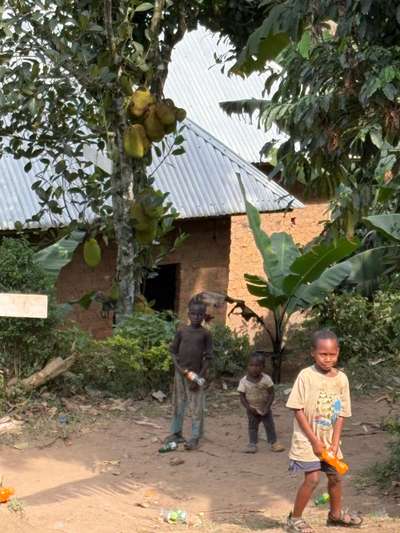
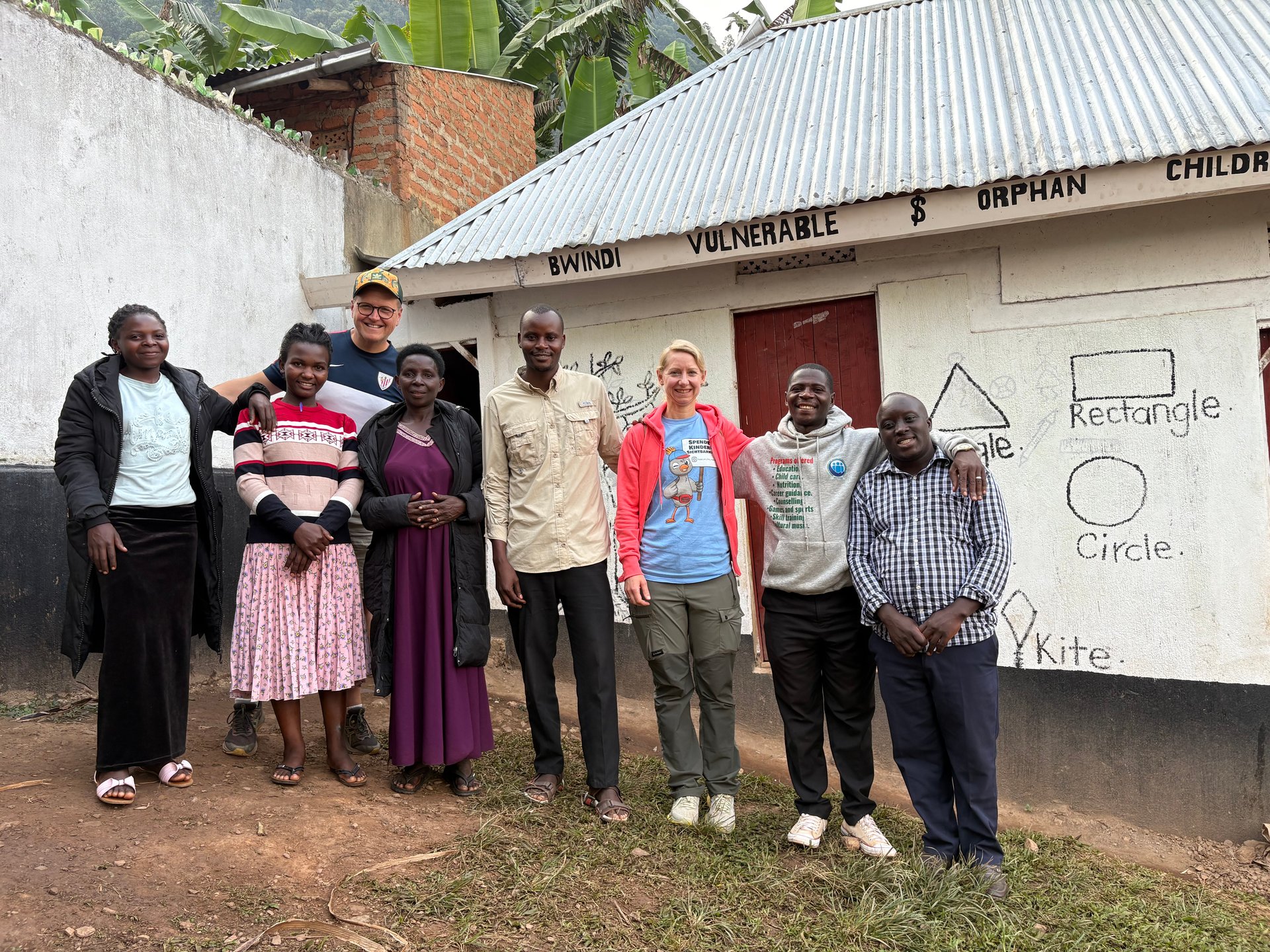
During our visit, three children from the neighbourhood near the orphanage appeared at the gathering. Their clothing was worn and their demeanour noticeably guarded — they seemed unsure whether they were welcome. We invited them to eat with us immediately. That moment, captured at GPS coordinates −0.9617°N, 29.6109°E, illustrates a reality that is not unique to Buhoma but is visible in every community bordering Uganda’s national parks: the benefits of conservation tourism are real but unevenly distributed. Families directly employed by lodges see tangible improvements in housing, nutrition, and school attendance. Families at the periphery depend on indirect effects — better roads, a functioning health centre, the general economic activity that tourism brings. The gap between these two groups is narrowing, but it remains visible to anyone who spends time in the villages rather than just the lodges.
The Uganda Women Entrepreneurship Programme addresses one dimension of this gap by supporting female entrepreneurs in sectors that include agriculture, crafts, and small-scale food processing — activities that cluster around tourism hubs where market demand is strongest. In the communities surrounding Mgahinga and Bwindi, women run roadside stalls selling produce, operate small eateries serving lodge staff, and produce handicrafts marketed to visitors. These enterprises are individually modest but collectively significant: they distribute tourism-generated economic activity beyond the formal lodge and operator sector into the broader household economy.
Land tenure, governed primarily by the Land Act Cap 227 and its subsequent amendments, shapes the physical boundaries of this economic activity. The act defines the legal framework for land ownership, use, and transfer across Uganda, including the areas surrounding national parks where community land abuts protected forest. Disputes over boundary encroachment, grazing rights, and access to resources like bamboo and firewood are adjudicated under this legislation, and its effectiveness directly affects the relationship between park management and neighbouring communities. Where land rights are clear and respected, communities are more willing to participate in conservation agreements. Where tenure is contested, tensions arise that no amount of revenue sharing can fully resolve.
Even Kampala’s civic institutions reflect the broader connections between urban governance and rural conservation. The KCCA supports initiatives ranging from health service delivery to cultural preservation — and beyond governance, the city’s social fabric includes institutions like the KCCA Volleyball Ladies Club, a professionally competitive team that won the national league in the 2022/2023 season, demonstrating the breadth of civic life that Uganda’s capital sustains. The Luwafu school district in Kampala hosts multiple educational institutions whose graduates staff the tourism sector nationwide. These urban-rural linkages are not metaphorical — the lodge manager who greets you at Mount Gahinga Lodge may well have studied in Kampala, and the revenue your permit generates supports urban infrastructure through the national treasury’s consolidated fund.
Uganda, a nation of approximately 46 million people, channels a disproportionate share of its international visibility through the conservation and tourism sectors that operate in its southwestern corner. The golden monkeys of Mgahinga, the gorillas of Bwindi, and the lodges that serve their visitors are economic engines whose influence extends far beyond the park boundaries. Understanding that reach — from a chicken farmer’s enclosure in Buhoma to the statistical offices of KCCA in Kampala — transforms a one-hour trek through bamboo forest into something considerably more significant.
Frequently Asked Questions — Golden Monkey Trekking Mgahinga
How much does a golden monkey trekking permit at Mgahinga cost?
A golden monkey trekking permit costs $100 for foreign non-residents. The permit covers park entry, a UWA ranger guide, and one hour of observation time with the habituated group. Unlike gorilla permits ($800 peak / $450 low season), golden monkey permits are generally available without months of advance booking, though securing one a few weeks ahead during peak season is advisable.
Where do golden monkeys live in Uganda?
In Uganda, golden monkeys (Cercopithecus kandti) are found exclusively in Mgahinga Gorilla National Park in the southwestern corner, bordering Rwanda and the DRC. They inhabit the bamboo forest zone on the slopes of the Virunga volcanoes, primarily between 2,500 and 3,400 metres altitude. The same species also ranges into Volcanoes National Park (Rwanda) and Virunga National Park (DRC). The total population is estimated at several thousand individuals across this transboundary range.
Can you combine golden monkey trekking with gorilla trekking?
Yes. Mgahinga hosts both golden monkeys and one habituated gorilla group (the Nyakagezi family), making it possible to do both treks from the same base. Alternatively, many visitors combine Mgahinga golden monkey trekking with gorilla trekking in Bwindi Impenetrable National Park, approximately two hours’ drive north. Bwindi has over 20 habituated gorilla groups, offering more permit availability. A typical combined itinerary requires four to five nights in southwestern Uganda.
What is the best time of year for golden monkey trekking at Mgahinga?
Golden monkey trekking is possible year-round, as the monkeys are resident in the bamboo forest regardless of season. The dry seasons — June to September and December to February — offer drier trails and clearer views. The wet seasons bring muddier conditions but fewer visitors. During our June 2026 visit, the transition from the long rains meant partially wet trails but excellent visibility and shorter search times for the monkey group.
Which lodges are closest to Mgahinga Gorilla National Park?
Mount Gahinga Lodge (Volcanoes Safaris) sits near the park entrance, with rooms from $500 per night on full board. In Kisoro, 14 km away, budget and mid-range guesthouses offer alternatives. The shores of Lake Mutanda and Lake Mulehe host properties like Chameleon Hill Lodge that combine park proximity with waterfront settings. For travellers transiting through Kampala, the Protea Hotel Kampala provides a comfortable overnight stop before the drive southwest.