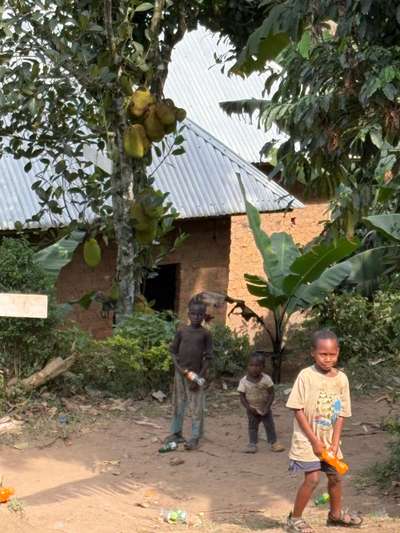
On the morning of 21 June 2026, three children from the neighbourhood near the Buhoma orphanage stood at the edge of our gathering. Their clothing was worn and their body language guarded — they were visibly unsure whether they were welcome. We invited them to eat with us without a second thought. That unscripted moment, photographed at GPS coordinates -0.9617°N, 29.6109°E, captures something essential about the Buhoma community that Nturo Safaris operates from: hospitality here is not a service category. It is reflex.
Nturo Safaris is a locally owned safari operator based in the immediate vicinity of Buhoma village, the main gateway to Bwindi Impenetrable National Park. Between January and June 2026, I made five documented visits to this area, spending time on the ground with operators, guides, and lodge staff. This review draws on those visits — not on brochures, not on aggregated TripAdvisor reviews, but on repeated first-hand observation of how Nturo Safaris handles the logistics, surprises, and community relationships that define gorilla trekking in Bwindi.
The gorilla trekking market in Uganda is competitive. Nturo Safaris competes with operators like Afoyo African Safaris, Deks Safaris, and Turigye Tours for the attention of international travellers willing to spend $800 on a single permit. What distinguishes one operator from another is not the permit price — that is fixed by the Uganda Wildlife Authority — but everything around it: the vehicle that collects you at dawn, the guide who knows which gorilla family moved uphill overnight, the lodge that has your room ready when you stagger back from the forest. This article examines those specifics.
What Gorilla Trekking with Nturo Safaris Actually Looks Like
The mechanics of a gorilla trekking day are standardised by the Uganda Wildlife Authority regardless of which operator arranges your trip. You report to the UWA sector headquarters by 7 AM. Rangers conduct a briefing covering rules, expectations, and fitness requirements. Groups of eight visitors are assigned a habituated gorilla family, and the trek begins with armed rangers leading the way into the forest. The gorilla permit — $800 in peak season, $450 during the low-season months of April, May, and November — covers the park entrance, ranger guide, armed escort, and the one-hour observation window once the gorillas are located.
What an operator like Nturo Safaris controls is everything before and after that UWA-managed hour. On my January 2026 trek, Nturo Safaris had the vehicle at our lodge by 6:15 AM. The fifteen-minute buffer mattered: the Buhoma road is unpaved, and after overnight rain the murram surface becomes unpredictable. We arrived at the UWA headquarters with time to spare, which is not a trivial detail when $800 is at stake and late arrivals forfeit their permits.
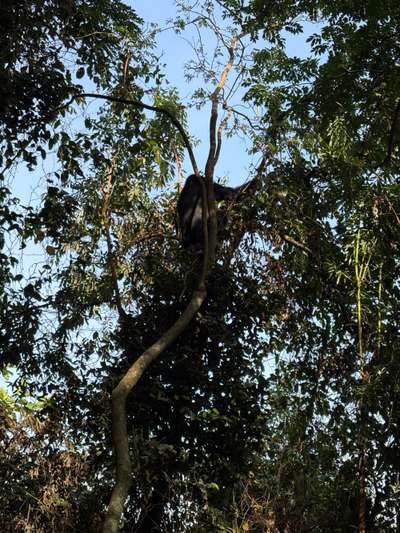
During that January trek, we encountered our first gorilla family after roughly one hour of walking through dense undergrowth. The first individual we saw was sitting high in the canopy, methodically stripping leaves from branches and eating them with the unhurried rhythm of an animal that has no predators. The photograph I took at that moment — GPS-verified at -0.9735°N, 29.6281°E — captures the canopy-level feeding behaviour that is typical of early-morning gorilla activity before the group descends to lower elevations as the day warms.
The quality of the encounter depends heavily on which gorilla family you are assigned, the season, and the terrain. Bwindi’s 459 mountain gorillas (the most recent census, covering 2018–2020) are distributed across approximately 20 habituated groups. Some families are relatively sedentary and can be reached within thirty minutes. Others move several kilometres overnight, requiring treks of four to six hours through steep, slippery terrain at altitudes between 1,160 and 2,607 metres. Nturo Safaris cannot control which family you are assigned — that decision rests with UWA — but their guides maintain daily contact with the ranger network and can advise on likely trek difficulty based on recent gorilla movements.
Porters are available for hire at the trailhead, typically for 15,000–20,000 UGX (roughly $4–5). Nturo Safaris coordinates this but does not include the porter fee in their package price. For anyone with even moderate fitness concerns, a porter is worth hiring — not for the walking itself, which is manageable, but for the descents on wet, root-covered trails where a steadying hand prevents injuries. On my June 2026 visit, the trails were muddier than in January, consistent with the tail end of the long rainy season. The gorillas, however, were closer to the forest edge and easier to reach.
Nturo Safaris, Afoyo African Safaris, and How Operators Actually Differ
The gorilla trekking permit costs $800 regardless of which operator you book through. No operator gets a discount. No operator has privileged access to specific gorilla families. The Uganda Wildlife Authority controls permit allocation, family assignment, and the rules of engagement during the one-hour encounter. This means that the permit itself is a commodity — what you are actually paying an operator for is logistics, local knowledge, vehicle quality, and problem-solving ability when things go sideways.
Nturo Safaris operates from a base near Buhoma, giving them physical proximity to the park headquarters and direct relationships with UWA rangers, lodge managers, and the Buhoma community. Their strength lies in this local depth. When a road washes out, when a lodge has a generator failure, when a gorilla group crosses sectors overnight — Nturo Safaris hears about these developments before operators based in Kampala or abroad. On my January 2026 trip, our Nturo Safaris guide informed us at dinner that the gorilla family we were likely to be assigned had moved further from the usual trail, adding an estimated ninety minutes to the morning trek. That advance warning let us adjust our departure time and pack accordingly. A Kampala-based operator working from second-hand information might not have had that update until the briefing itself.
Afoyo African Safaris serves a broader market. Where Nturo Safaris concentrates on the Bwindi corridor, Afoyo African Safaris handles multi-country itineraries across East Africa, including combined Uganda-Rwanda routes that pair Bwindi gorilla trekking with Volcanoes National Park across the border. For travellers whose trip extends beyond Bwindi, Afoyo’s wider network can simplify logistics — one operator handling cross-border permits, accommodation in Kigali, and the drive to Musanze. For travellers focused exclusively on gorilla trekking in Bwindi, Nturo Safaris’ local specialisation offers advantages that a generalist operator cannot match.
Other operators in the Bwindi market include Deks Safaris, which specialises in the Murchison Falls corridor and offers combined Murchison-Bwindi itineraries, and Turigye Tours, a family-run outfit based in western Uganda. The Uganda Safari Guides Association, whose deputy chair Lilian Kamusime trains guides across Uganda and Rwanda, works to raise standards across all operators. The association’s training programmes cover not just guiding technique but also guest safety, cultural sensitivity, and wildlife conservation protocols — all of which directly affect the quality of a gorilla trekking experience regardless of which operator handles the booking.
[QUOTE: Nturo Safaris guide on how local knowledge affects gorilla trekking outcomes]
Which Lodges Nturo Safaris Works With — and Why It Matters
A gorilla trekking trip typically requires two to three nights in a lodge near the park. The lodge you choose determines your morning commute to the trailhead — a five-minute walk from Buhoma Lodge or a ninety-minute drive from a property in Kabale. Nturo Safaris books across all four Bwindi sectors but has the deepest relationships in Buhoma, where most of their guests stay.
In Buhoma, the range spans from Buhoma Community Rest Camp at $25 per night to Sanctuary Gorilla Forest Camp at $400–600 per person per night on full board. Buhoma Lodge, operated by Uganda Exclusive Camps, sits in the upper mid-range with eight cottages built from local materials within the national park boundary. Gorilla Bluff Lodge and Trackers Safari Lodge serve the mid-range segment, while Silverback Lodge and Engagi Lodge offer solid rooms at lower price points. For budget travellers, the community rest camp is clean, functional, and located walking distance from the UWA headquarters.
In Rushaga, the southern sector with the highest concentration of habituated gorilla groups, Nturo Safaris regularly books Chameleon Hill Lodge on the northern shore of Lake Mutanda, Gorilla Safari Lodge, and Gorilla Valley Lodge. Rushaga’s terrain is moderately challenging — less steep than Nkuringo but with enough variety in elevation to keep treks physically interesting. The lodge market here is slightly less developed than Buhoma’s, which means advance booking through an operator like Nturo Safaris matters more.
In Ruhija, the northeastern sector favoured by serious birders, Ruhija Gorilla Safari Lodge is a rustic property with double rooms and wooden cottages near the gorilla tracking starting point. It is part of the Asyanut Safari enterprise. Cuckooland Tented Lodge, located fifteen kilometres northeast of Ruhija, offers a more secluded alternative with four safari tents on wooden platforms. In Nkuringo, Nkuringo Bwindi Gorilla Lodge operates as a community partnership at 2,090 metres altitude with eighteen rooms, and Clouds Mountain Gorilla Lodge — the highest-altitude lodge in Uganda, a joint venture between Wildplaces Africa and the African Wildlife Foundation — serves the luxury segment.
The lodge decision is not just about comfort. It affects your permit allocation. UWA assigns gorilla families by sector — if you are staying in Buhoma, you trek from Buhoma. If a specific gorilla group is your priority, your lodge must match the sector where that group ranges. Nturo Safaris can advise on which sector is most likely to offer shorter treks or particular family sightings based on current ranger reports, but the final allocation is made by UWA on the morning of the trek.
Nturo Safaris and the Buhoma Community: Where Permit Money Goes
The gorilla trekking permit generates substantial revenue for conservation and, increasingly, for the communities surrounding Bwindi. The Uganda Wildlife Authority’s Revenue Sharing Scheme distributes 20 percent of gate proceeds to adjacent sub-counties. This money funds schools, clinics, road improvements, and household livelihoods in communities like Buhoma. The remaining 80 percent supports park management, ranger salaries, anti-poaching operations, and the gorilla monitoring programme that tracks the 459 individuals across both Bwindi and Mgahinga.
What a locally based operator like Nturo Safaris adds to this equation is employment that stays in the community. Their drivers, guides, and logistics staff live in or near Buhoma. The lodges they book employ local cooks, cleaners, and porters. The meals served at those lodges use produce grown on smallholder farms within walking distance. This is not a theoretical supply chain — it is visible. Walk through Buhoma in the late afternoon and you can see lodge staff heading home on foot, porters spending their daily earnings at the village market, and children from families supported by tourism revenue attending the local school.
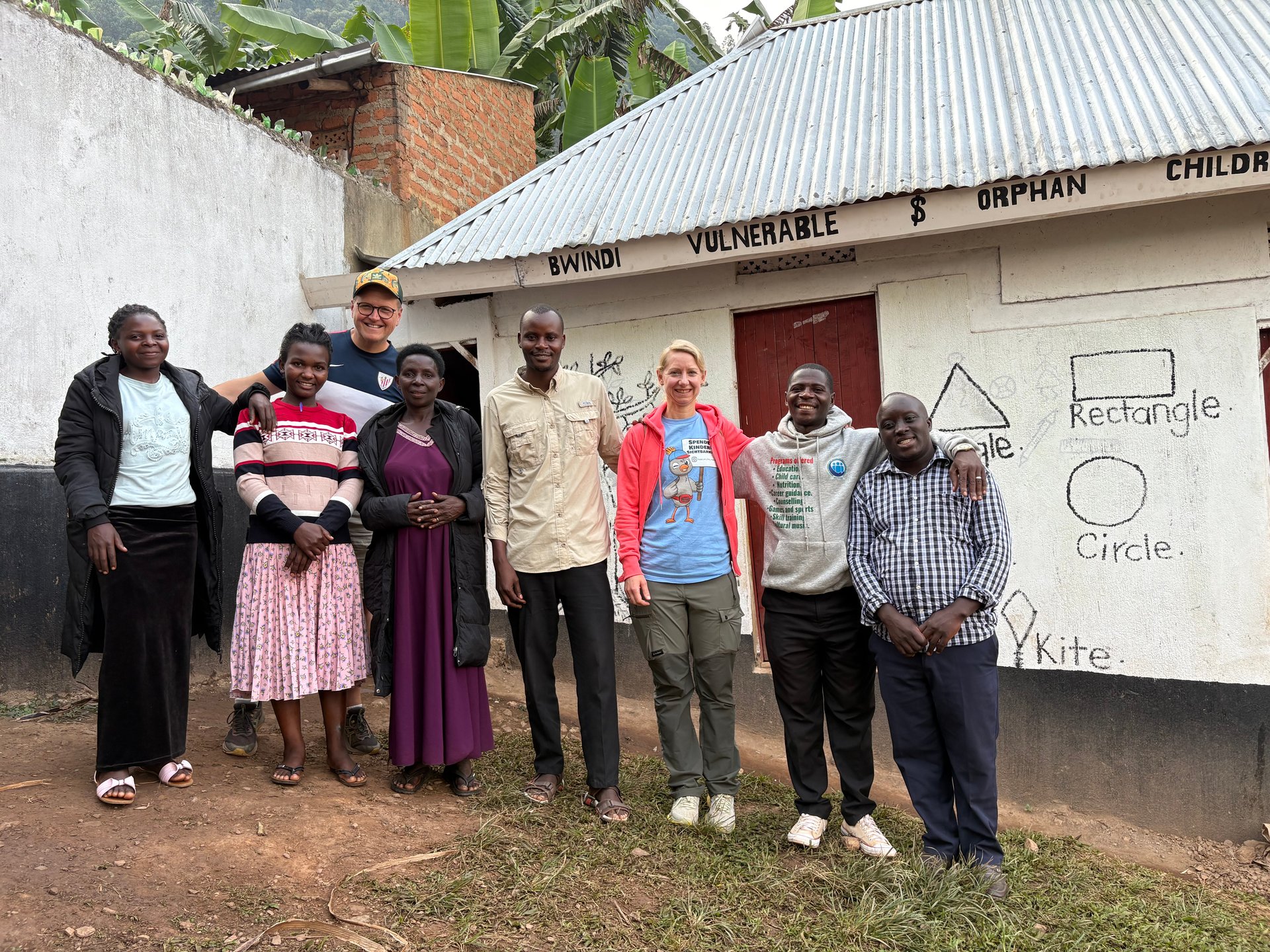
The scene I described at the opening of this article — children from the neighbourhood near the orphanage, invited to share a meal — exists within this context. Tourism in Buhoma has raised the economic baseline of the village, but the benefits are unevenly distributed. Families directly employed by lodges or the park see tangible improvements. Families at the periphery, including those near the orphanage, rely on the indirect effects: better roads, a functioning health centre, and the general economic activity that tourism brings. The distance between those two groups is closing, but it remains visible.
Leonard Sharp, the Scottish missionary who founded a hospital for leprosy patients on Bwama Island in Lake Bunyonyi in 1921, could not have imagined that the forests near his mission would one day generate millions of dollars through gorilla tourism. His legacy persists in the region — Sharp Island Gorilla Lodge on Njuyeera Island still bears his name — and the principle he established, that outsiders can contribute to this landscape without colonising it, remains the aspiration that the best operators, Nturo Safaris among them, attempt to embody.
Nkuringo Bwindi Gorilla Lodge, one of the properties Nturo Safaris books, partners with the Uganda Carbon Bureau for carbon offset programmes. Together for Uganda, an NGO supported by Coffee Pot Café, works in the Kisoro district to raise living standards in communities adjacent to the park. These are not marketing initiatives — they are operational relationships that reflect the reality of running a conservation-dependent tourism business in a region where the nearest city is eight hours away by road.
Booking Nturo Safaris: Practical Considerations and What to Expect
Gorilla trekking permits should be booked three to six months in advance for peak season (June to September, December to February). During low season — April, May, and November — permits are easier to secure and cost $450 instead of $800, a saving of $350 per person that represents genuine value for travellers with flexible schedules. Nturo Safaris can arrange permit booking through UWA or advise if you prefer to book directly. The permit is non-refundable but transferable to another date or person with advance notice.
A typical three-night gorilla trekking package with Nturo Safaris, including mid-range lodge accommodation, transport from Kampala, and the permit, runs approximately $1,800–2,500 per person. This estimate assumes sharing a vehicle and room with another traveller. Solo travellers and those choosing luxury lodges should budget $2,500–4,000. The cost breakdown is roughly: permit ($800), lodge ($150–400 per night for two to three nights), transport ($200–400 for the return Kampala journey), and Nturo Safaris’ operator fee.
Fitness requirements are frequently overstated in online guides and frequently understated by operators trying to sell treks. The honest answer: if you can walk uphill for two to three hours on uneven terrain without needing to stop every few minutes, you will manage most gorilla treks. The terrain is steep, muddy, and tangled with roots and vines — walking poles and gaiters help significantly. The altitude (1,160–2,607 metres) affects some visitors, particularly those arriving from sea level. One night of acclimatisation at a Kampala lodge and one night at your Bwindi lodge before the trek reduces this risk.
Travel insurance with trip cancellation coverage is strongly recommended. The permit is your single largest non-refundable expense, and forfeiting an $800 permit due to illness or a missed connection is a concrete financial risk that insurance addresses directly.
June, when I took the GPS-verified photographs in this article, falls at the transition between the long rains and the dry season. The trails were wetter than during my January visit but the gorillas were foraging closer to the forest edge, resulting in shorter treks and more accessible encounters. Both seasons are viable for gorilla trekking — the gorillas are present year-round and the 459-strong population is well-habituated to human visitors. The choice between seasons is primarily a question of trail conditions and permit availability, not of whether you will see gorillas. You will.
Frequently Asked Questions About Nturo Safaris
Is Nturo Safaris a reliable gorilla trekking operator?
Yes. Nturo Safaris is locally owned and based near Buhoma, the main entry to Bwindi Impenetrable National Park. Their proximity gives them direct relationships with UWA staff and lodge owners. After using them on multiple visits between January and June 2026, logistics have been consistently reliable — vehicle condition, permit handling, and local knowledge of trail conditions.
How does Nturo Safaris compare to Afoyo African Safaris?
Nturo Safaris specialises in the Bwindi corridor with deep local knowledge. Afoyo African Safaris operates across broader East African itineraries including multi-country routes. For dedicated gorilla trekking in Bwindi, Nturo Safaris’ local expertise gives them an edge. For combined Uganda-Rwanda trips, Afoyo’s wider network may be more practical. The gorilla permit costs $800 regardless of operator.
What does a gorilla trekking day with Nturo Safaris look like?
A typical day starts with a 7 AM briefing at UWA headquarters. Rangers assign your gorilla family and the trek begins. Walking time varies from 30 minutes to 6 hours depending on gorilla movements overnight. Once located, you spend one hour observing at a maximum distance of 7 metres. Nturo Safaris coordinates transport, packed lunches, and porters.
Which lodges does Nturo Safaris book for gorilla trekking?
Nturo Safaris works with lodges across all four Bwindi sectors. In Buhoma: Buhoma Lodge, Gorilla Bluff Lodge, Trackers Safari Lodge, and Buhoma Community Rest Camp. In Rushaga: Chameleon Hill Lodge and Gorilla Safari Lodge. In Ruhija: Ruhija Gorilla Safari Lodge. In Nkuringo: Nkuringo Bwindi Gorilla Lodge and Clouds Mountain Gorilla Lodge.
How much does gorilla trekking with Nturo Safaris cost?
The permit costs $800 peak season or $450 low season (April, May, November). A typical 3-night package with Nturo Safaris including mid-range lodge, transport from Kampala, and permit runs $1,800–2,500 per person. Solo travellers and luxury lodges: budget $2,500–4,000.