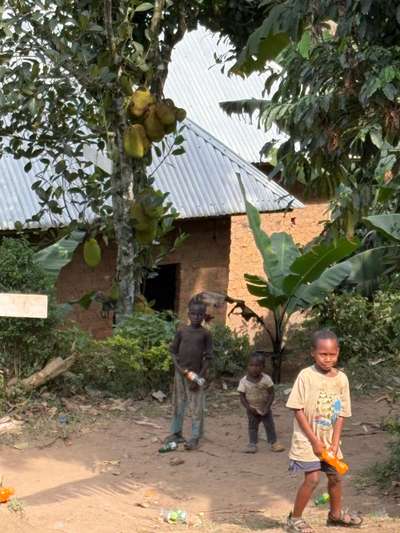
The children from the orphanage neighborhood were slightly shy, their clothing and behavior were noticeable — we immediately invited them to eat with us. They sat down without hesitation, and within minutes the shyness was gone. A shared plate of food dissolved whatever distance had existed between strangers from different continents. This was not in a lodge dining room or a tourist restaurant. It was in a small village near Buhoma, at the edge of Bwindi Impenetrable National Park, during a visit in January 2026 that had nothing to do with gorillas and everything to do with the people who live alongside them.
That moment — unrehearsed, unscheduled, and entirely human — is the kind of encounter that families travelling with children find most naturally in Bwindi. The gorillas are extraordinary, but they are only part of the story. And for families with children under fifteen, the gorillas are, in practical terms, off limits. The Uganda Wildlife Authority enforces a strict minimum age of fifteen for all gorilla trekking participants. There are no exceptions. No waivers. No special arrangements for particularly mature or physically capable thirteen-year-olds. The rule exists to protect both the gorillas and the children, and it is applied uniformly across all four trekking sectors of Bwindi Impenetrable National Park.
This is the single most important piece of information for any family planning a trip to Bwindi with younger children. It shapes everything that follows: which lodges to choose, how to structure your days, how to divide activities between adults and children, and how to ensure that the trip is rewarding for everyone — not just the adults who get to spend an hour in the forest with a silverback.
The Age Rule — What It Means for Your Family Trip
The gorilla trekking permit costs $800 per person (Uganda Wildlife Authority, 2026) and allows one hour with a habituated gorilla family. The permit is available only to visitors aged fifteen and older. This restriction applies to all four Bwindi sectors — Buhoma, Ruhija, Rushaga, and Nkuringo — and also to the gorilla habituation experience, which involves a longer four-hour visit with a semi-habituated group. Children under fifteen cannot participate in either activity. They cannot accompany a trekking group even if a parent is present. They cannot wait at the trailhead while the rest of the group enters the forest.
For families, this means planning in shifts. One parent treks while the other stays with the children. Or both parents trek on the same day if the children are old enough to be supervised by lodge staff or a hired guide — some family-oriented lodges in the Buhoma sector can arrange this. The practical solution is to stay at least two nights: arrive the afternoon before, have one parent trek the first morning while the other explores with the children, then switch the next day if both parents want to trek. This requires two permits at $800 each, bringing the family’s gorilla trekking cost alone to $1,600 before accommodation, transport, or any other activity.
Bwindi Impenetrable National Park covers 331 square kilometres of montane and lowland forest in south-western Uganda. It is home to approximately 459 mountain gorillas — roughly half the world’s total population, according to the 2018–2020 census conducted by UWA, the Greater Virunga Transboundary Collaboration, and the Max Planck Institute for Evolutionary Anthropology. The park is divided into four trekking sectors, each with its own UWA headquarters and habituated gorilla families. Of these four, Buhoma is by far the most practical choice for families.
Buhoma — The Most Family-Friendly Sector
Buhoma is the oldest gorilla trekking sector in Uganda, operating since 1993. It sits at approximately 1,490 metres above sea level in the northern part of Bwindi, which makes it the lowest-altitude sector and, consequently, the one with the mildest climate and the least physically demanding access. For families, these are meaningful advantages. The road to Buhoma, while unpaved for its final stretch, is the best-maintained approach route of any Bwindi sector. The village has a primary school, a health post, craft cooperatives, woodworking workshops, small shops, and a functioning community economy that exists partly because of and partly alongside the gorilla tourism industry.
Buhoma has three habituated gorilla families available for trekking: Mubare, Habinyanja, and Rushegura. The Mubare group was the first gorilla family habituated for tourism in Uganda, and it remains one of the most frequently visited. Permits for Buhoma are consistently in demand, and booking several months in advance is advisable, particularly for the peak months of June through September and December through February. The sector headquarters is within walking distance of most lodges — a critical advantage for families, because it means no early-morning vehicle transfer is required. One parent walks to the 07:30 briefing while the other stays at the lodge with the children. No driver needed. No coordination anxiety. Just a five-to-fifteen-minute walk to the trailhead.
The infrastructure around Buhoma makes it uniquely suitable for the kind of split-day arrangement that families with younger children need. While one parent is in the forest — a trek that can last anywhere from one to seven hours depending on where the gorillas are that morning — the other parent and children have a genuine village to explore. This is not a resort compound where children are confined to a swimming pool. The Buhoma area offers real encounters with real people doing real work, and children respond to that authenticity in ways they rarely do to staged attractions.
What Families Can Do While the Gorillas Wait
The range of activities available to families in Bwindi — particularly in the Buhoma sector — is broader than most visitors expect. The gorilla trek dominates the marketing and the imagination, but the surrounding area offers experiences that children often find more engaging than adults anticipate. Community walks through Buhoma village are the most accessible option. Guided by local residents, these walks visit craft cooperatives where women weave baskets and produce batik fabrics, woodworking workshops where men carve gorilla figurines and furniture from local timber, and the village primary school, where visiting children are often welcomed into classrooms with a warmth that transcends any language barrier.
Birdwatching in and around Bwindi is exceptional. The park supports over 350 bird species, including 23 Albertine Rift endemics — species found nowhere else on earth. Children who show even a passing interest in nature will find the birdlife extraordinary: turacos with crimson wings, sunbirds in metallic blues and greens, and the great blue turaco, whose size and colour are startling enough to hold any child’s attention. Several lodges arrange guided birdwatching walks along trails outside the national park boundary that are open to visitors of all ages. These walks are gentler than gorilla treks, typically two to three hours on relatively flat terrain, and can be adjusted to the pace and stamina of younger participants.
The Batwa cultural trail is another option that works well for families. The Batwa are the indigenous forest-dwelling people of the Bwindi region who were displaced from the forest when the national park was gazetted in 1991. Community members lead guided walks through sections of forest, demonstrating traditional skills — fire-making, honey gathering, medicinal plant identification — and sharing stories of their historical relationship with the forest and its gorillas. The experience is educational, physical enough to keep children engaged, and provides a perspective on conservation that goes beyond wildlife protection to include the human cost of preserving wild spaces.
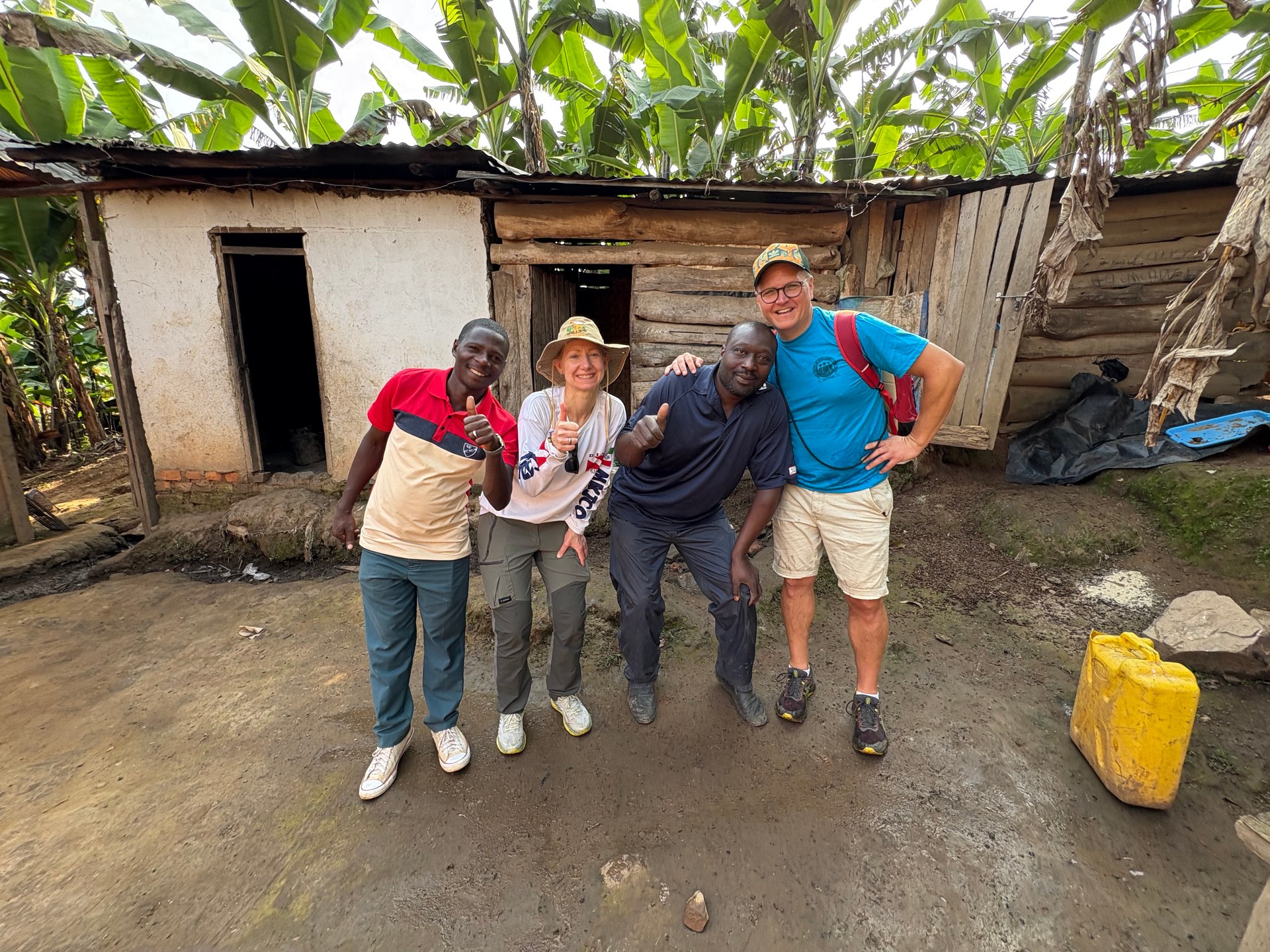
Village visits to nearby farming communities offer yet another dimension. During our January 2026 visit, we stopped at a small chicken farm near Buhoma where a farmer showed us his poultry operation — a modest enterprise of perhaps thirty birds, housed in a timber-and-wire structure he had built himself. We bought chicks from him for a nearby orphanage. The transaction was small in monetary terms but significant in its directness: money from a visiting family going straight to a local farmer, with the produce going to children who needed it. These are not pre-packaged tourist experiences. They happen because the village is there, the people are there, and if you walk the roads with your eyes open, opportunities for genuine connection present themselves without fanfare.
Family Lodges in Bwindi — Where to Stay
Uganda has approximately 350,550 rooms across the country, with 23 graded safari lodges and 117 graded lodges in total. The Bwindi region accounts for a small but significant share of the country’s safari lodge capacity. For families, the choice of lodge is shaped by considerations that solo travellers and couples can afford to ignore: room configuration, meal flexibility, grounds safety, proximity to the trekking headquarters, and the availability of activities that do not require entering the national park.
Buhoma Lodge sits in a prime position near the Buhoma sector headquarters and is one of the better-established properties in the area. Rooms start at approximately $500 per night on a value plan that includes meals. The lodge has spacious grounds with maintained gardens, a dining room that serves both local and international food, and staff who are accustomed to hosting families. The proximity to headquarters means that the trekking parent can walk to the 07:30 briefing in minutes, while the family enjoys breakfast at the lodge. Buhoma Lodge is not a budget option, but for families who want comfort, reliability, and a location that minimizes logistics, it represents a practical choice.
Little Elephant Camp is a different proposition entirely and one that deserves particular attention from families. Located near Buhoma at approximately $150 per night for self-catering accommodation, it is popular with families for reasons that go beyond price. Self-catering means independence — the ability to prepare meals when children are hungry rather than when the restaurant opens, to accommodate dietary requirements or preferences without negotiation, and to maintain the kind of flexible daily rhythm that family travel demands. The camp has safe, enclosed grounds where children can play without constant supervision, and the self-catering kitchen is equipped for families who prefer to buy local produce from the village and cook their own meals. For a family of four staying three nights, the cost difference between Little Elephant Camp and a full-board lodge can easily amount to $1,000 or more — money that covers an additional gorilla permit or several days of guided activities.
Community rest camps in Buhoma offer the most affordable accommodation near Bwindi, with rooms starting at approximately $30–60 per night. The Buhoma Community Rest Camp is run by the local community and provides basic but clean rooms within walking distance of the trekking headquarters. Facilities are simple — do not expect hot water on demand or restaurant-quality dining — but for budget-conscious families who are comfortable with basic conditions, rest camps represent a viable option. The money spent here goes more directly into the local economy than at most private lodges, which adds a dimension of social value to the accommodation choice.
The Other Sectors — Are They Suitable for Families?
While Buhoma is the clear first choice for families, the other three Bwindi sectors have their own characteristics that some families may find appealing, depending on circumstances and preferences.
Rushaga, in the southern part of Bwindi, has the largest number of habituated gorilla families of any sector, which means permit availability is often slightly better than at Buhoma. For families booking at shorter notice, this can be a decisive advantage. Rushaga also has strong Batwa cultural tourism programmes, and the community experiences here are arguably the most developed of any sector. However, the lodge selection is narrower than Buhoma, family-specific facilities are less established, and the terrain is steeper — factors that matter when travelling with children.
Nkuringo, at approximately 2,090 metres in the park’s southwestern corner, offers the most dramatic scenery of any Bwindi sector — views across the Virunga volcanoes and the Albertine Rift that leave a lasting impression. The Nkuringo Bwindi Gorilla Lodge is a community-owned property with 18 rooms. However, Nkuringo involves the steepest trekking of any sector, and the approach roads are the most challenging. For families with young children, the physical demands and limited infrastructure make Nkuringo less practical than Buhoma.
Ruhija, at approximately 2,300 metres, is the highest-altitude sector and offers a quieter, more remote forest experience. The cooler temperatures and thinner air at this altitude are noticeable, and the lodge selection is limited. Ruhija appeals to visitors who want solitude and a more demanding trekking experience — priorities that do not typically align with family travel involving younger children.
| Sector | Altitude | Family Suitability | Key Advantage | Key Limitation |
|---|---|---|---|---|
| Buhoma | ~1,490 m | Excellent | Widest lodge range, best village infrastructure, walkable to HQ | Permits in high demand; book early |
| Rushaga | ~1,800 m | Moderate | Most gorilla families, better permit availability | Fewer family-oriented lodges, steeper terrain |
| Nkuringo | ~2,090 m | Limited | Dramatic views, community-owned lodge | Steepest trekking, challenging roads |
| Ruhija | ~2,300 m | Limited | Quiet, remote, fewer tourists | High altitude, cold nights, limited lodges |
Choosing Your Lodge by Gorilla Group
A detail that many first-time visitors overlook is the relationship between lodge location and gorilla group allocation. When you book a gorilla trekking permit, you are assigned to a specific habituated gorilla family. Each family ranges within a particular sector, and the trek begins from that sector’s UWA headquarters. If your permit is for a Buhoma group — Mubare, Habinyanja, or Rushegura — you need to be at the Buhoma headquarters by 07:30. If your permit is for a Rushaga group, you need to be at the Rushaga headquarters.
The practical implication is straightforward: choose your lodge based on which gorilla group your permit is for. Staying in Buhoma when your permit is for Rushaga means an early-morning drive of two to three hours on unpaved roads before the trek even begins — a logistical burden that is stressful for adults and significantly worse for families with children. Book your permit first, confirm which sector it covers, and then select a lodge in that sector. For families specifically requesting Buhoma — which is advisable for the reasons outlined above — ensure your permit is for one of the three Buhoma groups when booking.
Equipment and Preparation for Family Trips
Even though children under fifteen cannot join the gorilla trek, the trekking parent needs proper preparation. Bwindi’s montane forest is steep, wet, and physically demanding. Sturdy hiking boots with ankle support are essential — the trails are muddy, root-tangled, and often on a gradient steep enough that you are climbing rather than walking. A fleece jacket or warm mid-layer is necessary at all altitudes, as temperatures in the forest canopy can drop to 10–15 degrees Celsius even when the lowland is warm. Rain gear is non-negotiable: Bwindi receives rainfall throughout the year, and the forest creates its own microclimate of dripping moisture even on nominally dry days. A rain cover for your camera is worth the small investment — the humidity in the forest is relentless, and condensation on a lens during a once-in-a-lifetime gorilla encounter is the kind of avoidable frustration that preparation eliminates.
For the children and the non-trekking parent, the equipment requirements are less demanding but still worth attention. Comfortable walking shoes are sufficient for village walks and community trails. Sun protection matters at altitude, even on overcast days. Insect repellent is advisable, though the Buhoma sector at 1,490 metres has fewer mosquitoes than Uganda’s lowland areas. A small daypack with water, snacks, and sun cream covers most needs for a half-day of village exploration.
A Personal Reflection — What Children Actually Remember
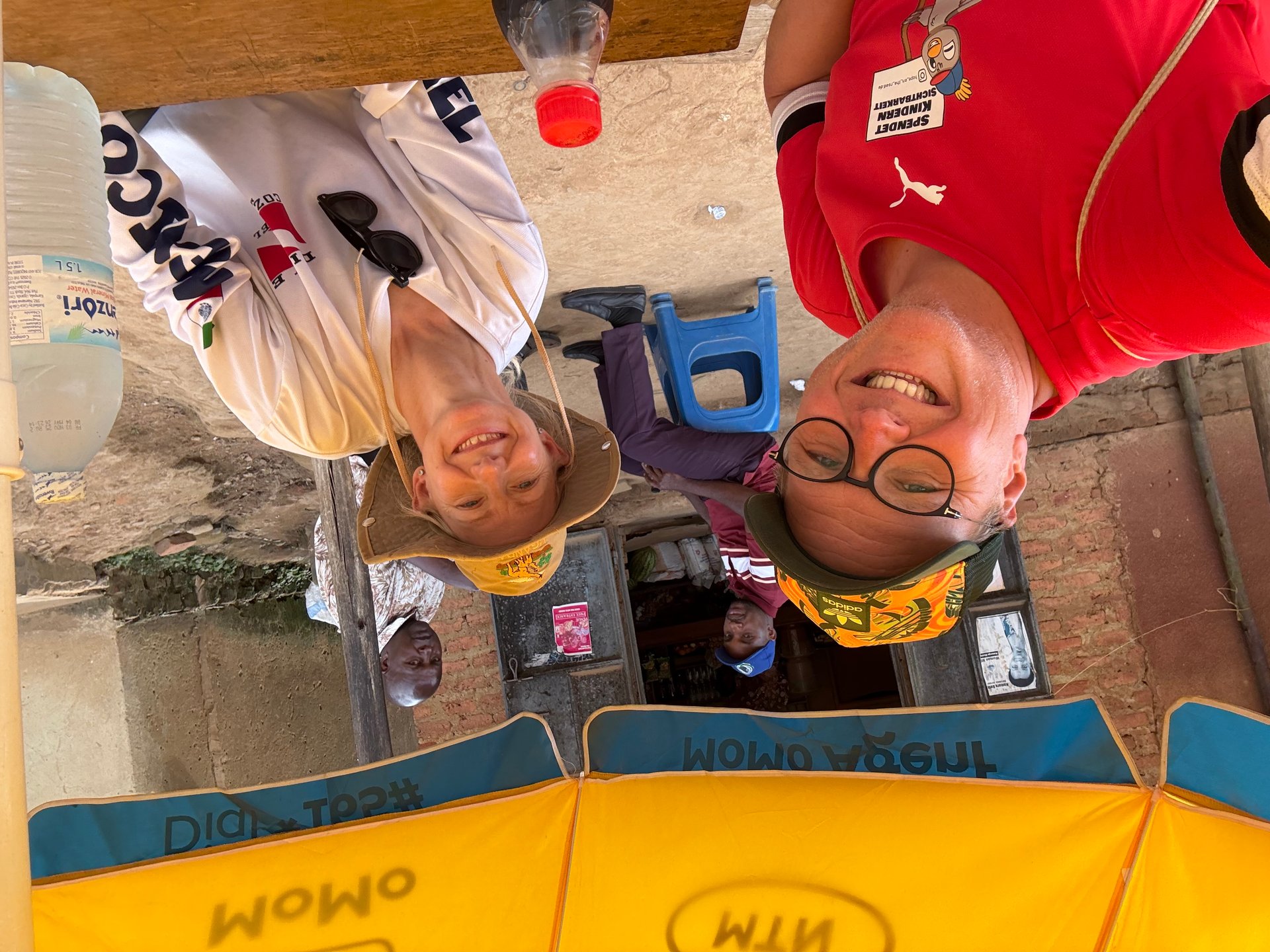
During our January 2026 visit to Buhoma, one of the quieter moments happened on the main road through the village. We sat in front of a small store on a bench, under an umbrella, drinking water and watching the village go about its day. Motorcycles passed. Children walked to school. A woman carried a basin of bananas on her head with a balance that seemed to defy physics. Nothing about this moment was arranged or marketed. It was simply life in a Ugandan village, observed from a bench, at the pace of the village itself.
Later that same day, we visited the chicken farmer and bought chicks for the orphanage. The farmer was proud of his birds and happy to show them. The children from the orphanage neighborhood were delighted. The chicks were small and loud and entirely captivating to everyone present, regardless of age or nationality. I have been on safari drives where a leopard appeared at twenty metres. I have sat with gorillas in the Bwindi forest. But the image of those children holding chicks, laughing in a language I do not speak, in a village I had never heard of until I arrived — that image has its own kind of permanence.
Families who travel to Bwindi expecting only gorillas may feel that the age restriction diminishes the trip. Families who travel to Bwindi expecting to encounter a place — its people, its rhythms, its informal economy of roadside enterprise and community cooperation — will find that the trip exceeds what any brochure promises. The gorillas are remarkable. The hour in the forest with them is extraordinary. But the hours outside the forest, in the village, on the road, sitting on a bench with your children while the world passes by — those hours have their own depth, and they are available to visitors of any age.