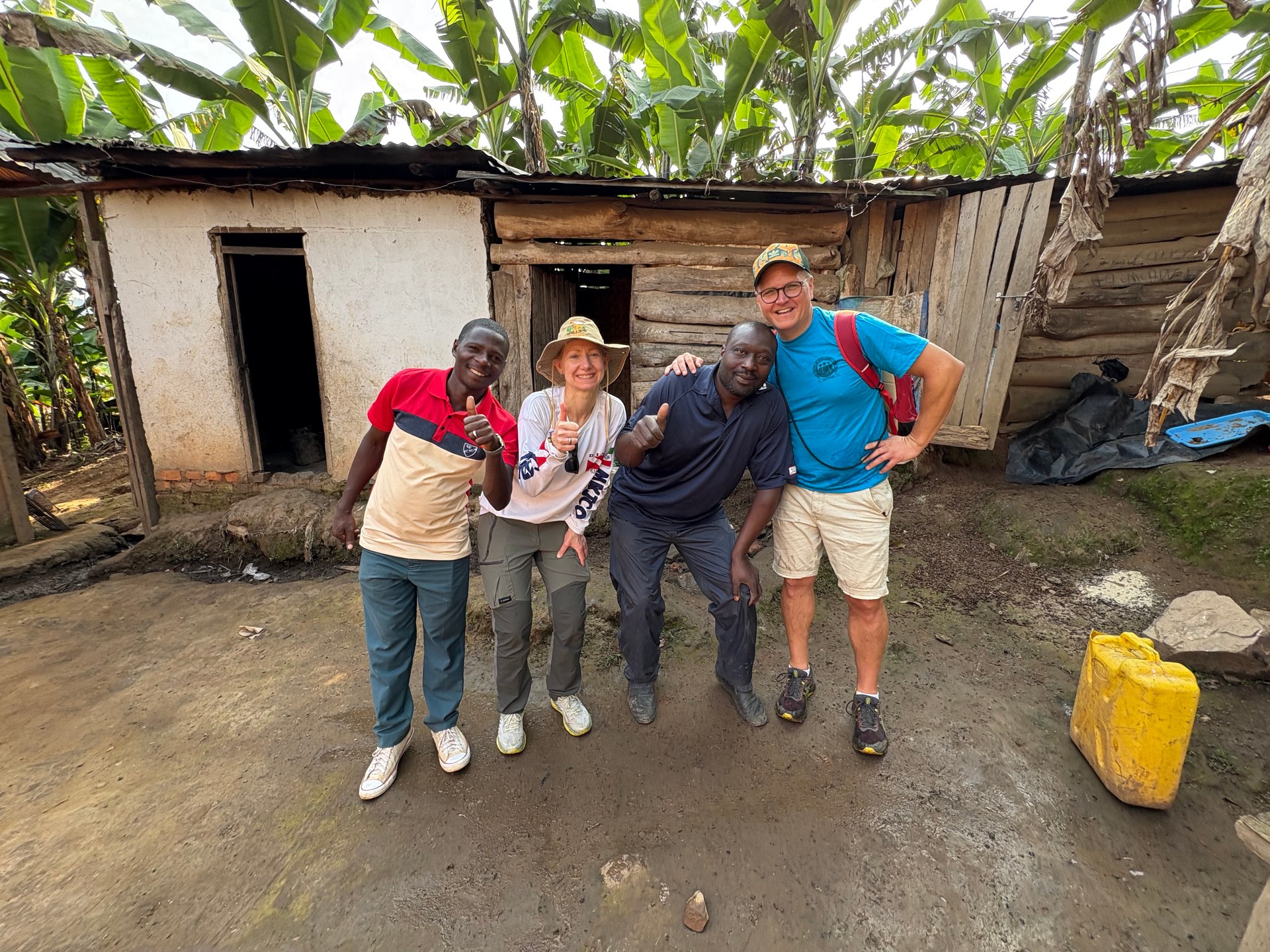
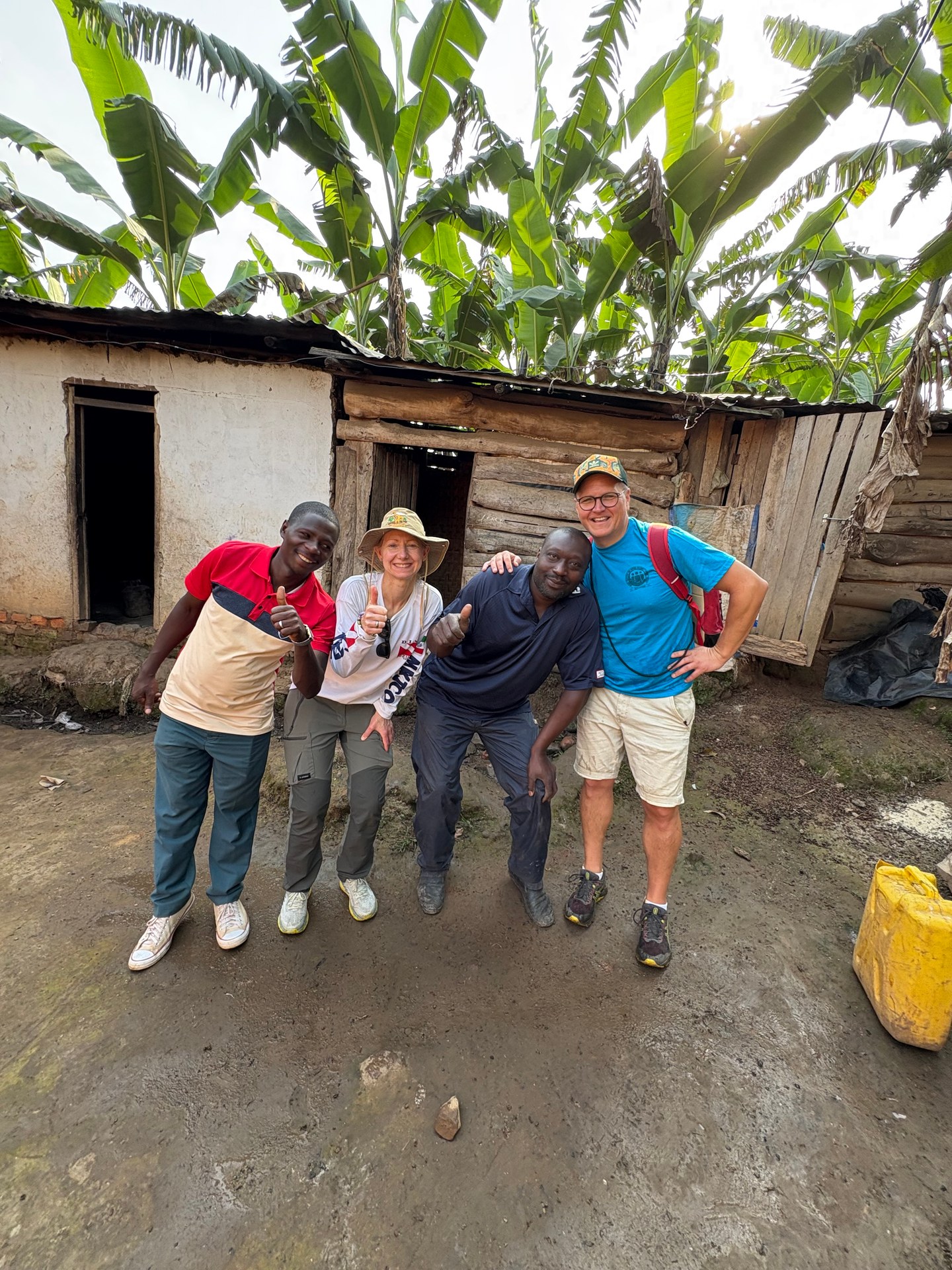
We visited the local chicken farmer to see how the chicks are kept and raised. The farmer lives this very intensely and treats the chicks very well. We have bought chicks there multiple times for the orphanage — they are kept either for eggs or meat. The scene was a simple one: a man in a small compound on the outskirts of Buhoma village, his warming boxes humming, his birds pecked and fed on a schedule he maintains with quiet precision. A group of four people from our team stood around him as he presented the first batch of chickens we had purchased for the orphanage on a previous visit — those birds had since been raised, their eggs used for self-sufficiency, some sold at the local market to generate income. The cycle from chick to egg to revenue had closed exactly as intended.
That stop, at GPS coordinates −0.9665°N, 29.6126°E on a June morning in 2026, is the kind of encounter that happens between lodge and forest — in the hours before or after the gorilla trek, in the communities that exist because of and alongside the tourism economy of Bwindi Impenetrable National Park. Choosing where to stay around Bwindi is not a trivial decision. The park spans four distinct trekking sectors, each with its own habituated gorilla groups, its own briefing point, its own collection of lodges ranging from bare-bones camping to internationally marketed luxury. Your permit assigns you to a specific sector, and staying close to that sector determines whether your morning begins with a short walk to the briefing point or a pre-dawn scramble along mountain roads. This comparison covers every sector and every price tier, drawn from six separate visits totalling fifteen days on the ground between January and June 2026.
Sector-by-Sector Comparison Table
| Sector | Lodge Examples | Price Range | Gorilla Groups | Access |
|---|---|---|---|---|
| Buhoma | Buhoma Lodge, Buhoma Community Rest Camp, Silverback Lodge, Engagi Lodge | $15 camping – $500+ VP | Mubare (11), Habinyanja (15), Rushegura (15) | Most established; 4–5 hrs from Kabale |
| Nkuringo | Nkuringo Bwindi Gorilla Lodge, Clouds Mountain Gorilla Lodge, Bwindi Backpackers Lodge | $10 camping – $400+ | Nkuringo (14) | Steep approach road; quieter sector |
| Rushaga | Nshongi Gorilla Resort, Nshongi Camp, Gorilla Valley Lodge, Chameleon Hill Lodge | $4 camping – $250+ | Multiple groups (most groups in park) | Closest to Lake Bunyonyi; southern access |
| Ruhija | Ruhija Community Rest Camp, Gorilla Friends Resort, Trekkers Tavern, Gorilla Safari Lodge | $5 camping – $200+ | Several habituated groups | Northeastern; higher altitude (~2,300 m) |
Buhoma Sector — The Most Popular Gateway to Bwindi
Buhoma is where gorilla tourism in Bwindi began. It is the park’s northwestern sector, the first to develop habituated gorilla groups for visitor trekking, and it remains the most popular entry point for international travellers. Three habituated groups operate here: Mubare with 11 members, Habinyanja with 15, and Rushegura with 15. That gives Buhoma a combined trackable gorilla population of 41 individuals across three family groups, meaning up to 24 trekking permits can be issued daily for this sector alone (eight trekkers per group per day, as regulated by the Uganda Wildlife Authority).
The accommodation range in Buhoma reflects its maturity as a trekking base. At the top end, Buhoma Lodge charges upwards of $500 per person on a full-board or value-plus basis — a rate that includes guided activities, meals prepared by a dedicated kitchen team, and the kind of attentive service that international visitors paying $800 for a gorilla permit expect from their overnight base. The lodge sits within the community zone adjacent to the park boundary, close enough that the morning walk to the briefing point takes minutes rather than requiring a vehicle transfer.
At the opposite end of Buhoma’s price spectrum, Buhoma Community Rest Camp offers camping from $15 per person per night. This is a community-operated facility — revenue flows directly to the local community rather than to an external operator. The camping is basic: a pitch, a shared bathroom block, and access to a simple kitchen or cooking area. For budget travellers and backpackers, the rest camp is the entry-level option that makes Bwindi accessible without requiring the budget normally associated with gorilla tourism. Between these extremes, properties like Silverback Lodge and Engagi Lodge serve the mid-range segment at $100–250 per person, providing solid rooms, restaurant meals, and guided community walks.
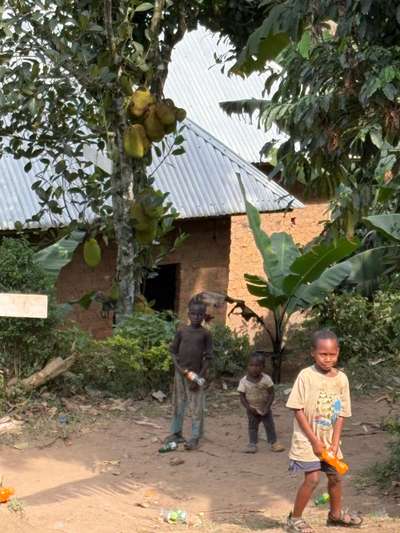
The village surrounding the Buhoma park gate has developed its own micro-economy. Small shops sell water, snacks, and basic supplies. Community guides offer walks to waterfalls, Batwa cultural experiences, and birdwatching excursions along the forest edge. The children we encountered near the orphanage during our June visit — shy, their clothes worn, accepting our invitation to eat with a quiet seriousness — live within this economy. Their daily experience is shaped by whether the lodges are full or empty, whether the guides are booked or idle, whether the trading centre is active or quiet. Buhoma’s popularity as a trekking sector translates directly into economic activity for these families, and the lodge where you choose to stay determines how that economic activity distributes.
Nkuringo Sector — Steep Terrain, Quiet Trekking, Community Ownership
Nkuringo sits on Bwindi’s southern flank, accessed via a steep and winding road that climbs through terraced hillsides before reaching the trekking zone at approximately 2,000 metres altitude. The sector is home to the Nkuringo group, a habituated family of 14 members. With only one trackable group, the sector issues a maximum of eight permits per day, making it one of the quieter trekking experiences available — fewer trekkers on the trails, fewer vehicles at the briefing point, and a more intimate encounter with the forest and its gorillas.
The most prominent accommodation in this sector is Nkuringo Bwindi Gorilla Lodge, a community-owned property at 2,090 metres with eighteen rooms. This lodge operates on a partnership model developed with the African Wildlife Foundation, where community members hold ownership stakes and benefit directly from guest revenue. The lodge collaborates with the Uganda Carbon Bureau on carbon offset initiatives, adding an environmental dimension beyond the immediate conservation value of gorilla tourism. Rates position it in the mid-to-upper range, competitive with the better-established Buhoma properties but supported by a community ownership structure that distinguishes it from commercially operated alternatives.
Clouds Mountain Gorilla Lodge, developed by Wildplaces Africa in partnership with AWF and local communities, represents the luxury tier in Nkuringo. With rates exceeding $400 per person per night, it targets the high-end market — travellers who want the gorilla encounter framed by premium hospitality. The property occupies a ridge position with views across the Virunga volcanoes on clear days, and its community-ownership model has become a reference case for how luxury tourism can integrate with conservation economics.
At the budget end, Bwindi Backpackers Lodge in Nkuringo offers camping from $10 per person per night. This makes it one of the most affordable bases for gorilla trekking anywhere in Bwindi. The facilities are basic — tent pitches, shared ablution blocks, and a communal cooking area — but the location places budget travellers within reach of the Nkuringo briefing point without requiring the $500-per-night expenditure that the luxury properties demand. The price gulf between $10 camping and $400+ luxury within the same sector illustrates the extraordinary range of visitor profiles that Bwindi accommodates.
Rushaga Sector — Most Gorilla Groups, Lowest Prices, Southern Access
Rushaga is Bwindi’s southernmost trekking sector and hosts the highest number of habituated gorilla groups in the park. This concentration of groups means more daily permits are available here than in any other single sector, making Rushaga a practical choice for travellers with limited booking flexibility who need a higher probability of securing a permit. The sector’s southern position also makes it the closest Bwindi sector to Lake Bunyonyi — approximately sixty to ninety minutes by road — which opens the possibility of combining a gorilla trek with a lakeside rest day without requiring a long cross-park transfer.
The budget accommodation in Rushaga is the cheapest available anywhere around Bwindi. Nshongi Camp offers camping from $4 per person per night — a figure that barely covers the cost of the ground you pitch on, but which makes gorilla trekking accessible to travellers operating on backpacker budgets where the $800 permit already consumes the majority of the allocation. Nshongi Gorilla Resort, a separate property in the same area, offers camping from $10 per person and rooms at higher rates, providing a step up from the $4 camp without entering mid-range pricing.
Mid-range properties in Rushaga include Gorilla Valley Lodge and Chameleon Hill Lodge, both offering comfortable rooms in the $100–250 range on full-board terms. Chameleon Hill Lodge occupies a hillside position near Lake Mutanda, a smaller and less-visited lake than Bunyonyi, and its colourful architectural style gives it a distinctive visual identity among Bwindi’s more conventionally rustic lodges. These mid-range options represent the practical sweet spot for many visitors — comfortable enough for a good night’s sleep before an arduous trek, affordable enough that the combined permit-plus-lodge cost does not become prohibitive.
The southern access route into Rushaga passes through Kisoro, a border town approximately forty-five minutes from the Cyanika crossing into Rwanda. This geographical advantage makes Rushaga the natural choice for travellers combining Uganda gorilla trekking with a continuation into Rwanda — whether for Volcanoes National Park gorilla trekking, Lake Kivu, or the city of Kigali. The drive from Kisoro to Rushaga follows a gradually deteriorating road surface that becomes challenging in wet weather, but in dry conditions the route is manageable for standard vehicles.
Ruhija Sector — High Altitude, Forest Edge, Strong Birding
Ruhija occupies Bwindi’s northeastern quadrant at approximately 2,300 metres — the highest altitude of any trekking sector in the park. The elevation produces a distinctly cooler climate: nights can drop below 10°C, mornings are frequently wrapped in cloud, and the forest here carries the damp, mossy character of a true montane environment. Several habituated gorilla groups operate in the Ruhija sector, and the trekking experience tends to involve steeper terrain than in Buhoma or Rushaga, with trails that climb and descend through dense undergrowth.
Ruhija Community Rest Camp serves the budget tier, offering basic rooms and camping in a community-operated facility similar in concept to the Buhoma Community Rest Camp. The camp’s revenue model directs income to the local community, and its location near the Ruhija park gate puts trekkers within a short walk of the morning briefing point. Facilities are functional rather than comfortable — beds, blankets, shared bathrooms, and a basic meal service — but the camp fulfils its purpose of providing an affordable overnight base for the trekking day.
Gorilla Friends Resort offers the sector’s cheapest accommodation, with camping pitches from $5 per person per night. At that price point, the resort provides little more than a flat surface and access to basic facilities, but it represents one of the lowest-cost gorilla trekking bases in Uganda. For the budget-conscious traveller who has already committed $800 to the permit, $5 for a night’s camping versus $200 for a lodge room is a meaningful calculation.
Trekkers Tavern occupies the mid-budget niche in Ruhija — more comfortable than the camping options, less expensive than the dedicated lodges. Its restaurant serves meals to both residents and passing travellers, making it a social hub of sorts in a sector where the settlement is small and options are limited. Gorilla Safari Lodge, positioned at the higher end of Ruhija’s accommodation range, offers double rooms and timber cottages at $120–200 per person on a full-board basis. The property sits at the forest edge with views across the mountain ridges, and its birdwatching is among the best accessible from any Bwindi lodge — the Albertine Rift endemics that inhabit the Ruhija zone include species found nowhere else in Uganda.
Ruhija’s comparative disadvantage is accessibility. The road from Kabale or Buhoma involves long stretches of unpaved surface that deteriorate significantly in the wet season. During our January 2026 visit, sections of the Ruhija access road required four-wheel drive and low gear for extended periods. Travellers assigned to Ruhija should plan for a longer transfer day and, if arriving from Kampala, consider an overnight stop in Kabale or along the route rather than attempting the full drive in a single day. The sector’s altitude also demands warmer clothing than the other three sectors — a factor that catches some visitors off guard, given that Bwindi sits barely one degree south of the equator.
Understanding the Price Spectrum — What You Get at Each Tier
The price range across Bwindi’s lodges is extraordinary by any standard. At $4 per night for camping at Nshongi Camp in Rushaga, the cost of accommodation is negligible next to the $800 gorilla permit. At $500 or more per person at Buhoma Lodge, the accommodation cost approaches two-thirds of the permit fee. Both categories of guest will meet at the same briefing point the following morning, receive the same briefing from the same ranger, walk the same trail into the same forest, and spend the same one hour with the same gorilla family. The trekking experience does not scale with lodge price. What scales is the comfort of the night before and the quality of the meal after.
Uganda’s national accommodation stock comprises 350,550 rooms according to the most recent industry data, of which 117 facilities have been formally graded and only 23 carry safari lodge classifications. Bwindi’s lodges exist within this national framework, but many of the park’s smaller properties — the community rest camps, the backpacker lodges, the $4 camping grounds — operate below the grading threshold. This does not necessarily indicate poor quality; it indicates that these properties serve a market segment where formal grading adds cost without proportional benefit. The northern region occupancy average of 54.5% provides context for the pricing pressure across all tiers — occupancy rates in southwestern Uganda fluctuate significantly with gorilla permit availability and seasonal demand.
For the mid-range traveller — the largest segment of Bwindi’s visitor market — the $50–150 per person bracket offers the most practical balance. At this level, you get a private room with an en-suite bathroom, hot water (though reliability varies), three meals per day, and a location close enough to the briefing point that the morning walk is measured in minutes. Properties in this range include lodges across all four sectors, making it the tier with the most choice regardless of sector assignment. The critical differentiator within this bracket is not the room itself but the quality of the food, the reliability of the hot water, and the knowledge of the staff — factors that are difficult to assess from booking photographs alone.
Practical Logistics — Permits, Transfers, and Sector Assignment
The single most important factor in choosing a Bwindi lodge is your gorilla trekking permit assignment. The Uganda Wildlife Authority issues permits for a specific sector, and once assigned, you cannot transfer between sectors on the trekking day. This means a traveller with a Buhoma permit who has booked a lodge in Rushaga faces a cross-park transfer of several hours on unpaved roads before the trek even begins — an uncomfortable and unnecessary complication that is entirely avoidable by matching your lodge to your permit sector.
Book your permit first, then your lodge. This sequence ensures you are staying in the correct sector. If you are booking through a tour operator, confirm that the lodge they propose is in the same sector as the permit they have secured. Mismatches occur more often than they should, sometimes because operators hold block bookings at specific lodges and attempt to fill rooms regardless of the client’s permit assignment. Asking “which sector is my permit for, and which sector is the lodge in?” before confirming any booking protects against this.
Gorilla permits cost $800 per person during peak season — June through September and December through February — and $450 during the low season. Children under 15 years of age are not permitted to participate in gorilla trekking under any circumstances. This age restriction is non-negotiable and is enforced at the briefing point. Families travelling with younger children should plan alternative activities for non-trekking family members on the trekking day; most mid-range and luxury lodges can arrange community walks, birdwatching excursions, or supervised activities at the property.
Transfer logistics from Kampala to any Bwindi sector involve a minimum of eight to ten hours by road, assuming dry conditions and no mechanical delays. The most common approach is to fly from Entebbe to Kihihi airstrip (for Buhoma) or Kisoro airstrip (for Rushaga and Nkuringo), reducing the journey to approximately one hour in the air followed by one to two hours by road. For Ruhija, there is no nearby airstrip, and the approach is by road from either direction. Travellers on tighter budgets who drive the full route from Kampala should plan an overnight stop — Mbarara or Kabale are the conventional choices — rather than attempting to reach Bwindi in a single driving day.
Community Impact — How Your Lodge Choice Shapes Local Economics
The communities surrounding Bwindi Impenetrable National Park exist in a direct economic relationship with the lodges that serve gorilla tourism. Revenue from gorilla permits, a portion of which the Uganda Wildlife Authority mandates for community benefit, provides the base layer of this economy. Lodge employment adds a second layer — kitchen staff, housekeeping, guides, porters, drivers, and maintenance workers drawn from the surrounding villages. Food sourcing from local farms adds a third. The farmer we visited near Buhoma, with his chicks destined for the orphanage, operates within this system: his livelihood is connected to the broader health of the tourism economy even though he does not work in a lodge.
Community-owned properties — the Buhoma Community Rest Camp, the Ruhija Community Rest Camp, and the Nkuringo Bwindi Gorilla Lodge — route revenue most directly to local benefit. When you stay at a community rest camp, your $15 camping fee or $30 room rate enters the community treasury rather than an external shareholder’s revenue statement. This does not make privately operated lodges exploitative; many private operators employ significant local staff and source locally. But the ownership structure determines the ultimate destination of the profit margin, and for travellers who factor this into their decisions, the community-owned options offer maximum local economic return per dollar spent.
The children we met near the Buhoma orphanage — quiet, their clothing worn thin, accepting our invitation to eat without fanfare — represent the human stakes of these economic flows. When lodge occupancy drops, the cascade is tangible: fewer porter bookings, less food purchased from local markets, reduced revenue at the community rest camps, and less money available for the kinds of support that keep the orphanage functioning. The chickens we bought from the farmer, raised to produce eggs for the orphanage’s kitchen and surplus sold for income, are a small intervention in a system that depends on the continuous circulation of tourism revenue. Choosing a lodge is not merely a consumer decision; in this context, it is an economic allocation that reaches further than the guest ever sees.
Which Sector Suits Which Traveller — A Decision Framework
First-time gorilla trekkers with flexible permits: Buhoma. The sector’s established infrastructure, wide range of accommodation, and three gorilla groups provide the highest-probability experience with the most support. The village around the park gate offers post-trek activities, the guides are the most experienced in the park, and the community tourism options add depth to a visit that might otherwise be solely about the one hour with gorillas.
Budget travellers: Rushaga or Ruhija. With camping from $4 at Nshongi Camp (Rushaga) and $5 at Gorilla Friends Resort (Ruhija), these sectors offer the lowest accommodation costs. Rushaga adds the advantage of proximity to Lake Bunyonyi for a low-cost rest day after trekking. Ruhija offers excellent birdwatching as a free bonus activity for visitors with an interest in Albertine Rift endemics.
Luxury travellers: Buhoma or Nkuringo. Buhoma Lodge at the top of the Buhoma market and Clouds Mountain Gorilla Lodge in Nkuringo represent Bwindi’s premium offerings. Both command $400+ per person per night and provide the kind of service, cuisine, and guided experience that justifies the rate for travellers who are already spending $800 on a permit and potentially thousands on flights and internal transfers.
Travellers continuing to Rwanda: Rushaga. Its proximity to Kisoro and the Cyanika border crossing makes it the natural final stop on a Uganda leg before crossing into Rwanda for Volcanoes National Park, Lake Kivu, or Kigali. Combining Rushaga with a night on Lake Bunyonyi creates a two-stop exit route that covers gorilla trekking, lakeside rest, and border proximity in a logical sequence.
Birdwatchers and naturalists: Ruhija. The sector’s 2,300-metre altitude supports Albertine Rift endemic species that are absent or rare in the lower-altitude sectors. The Mubwindi Swamp trail, accessible from Ruhija, is one of Bwindi’s premier birdwatching routes. Gorilla Safari Lodge and Trekkers Tavern both cater to guests whose interests extend beyond the gorilla trek into the broader biodiversity of the montane forest.
Those seeking quiet: Nkuringo. With one gorilla group and a maximum of eight daily permits, Nkuringo sees fewer visitors than any other sector. The steep access road deters casual visitors, and the community-owned lodge model attracts travellers with specific interest in conservation economics. If your priority is solitude in the forest rather than social activity at the lodge, Nkuringo delivers that experience more consistently than the busier sectors.
Frequently Asked Questions
What is the cheapest accommodation near Bwindi Impenetrable National Park?
The cheapest accommodation is Nshongi Camp in the Rushaga sector, offering camping from $4 per person per night. Other budget options include Gorilla Friends Resort in Ruhija ($5 camping), Bwindi Backpackers Lodge in Nkuringo ($10 camping), and Buhoma Community Rest Camp in Buhoma ($15 camping). All of these place you within walking distance of the gorilla trekking briefing points.
Which Bwindi sector is best for gorilla trekking?
Buhoma is the most popular sector with three habituated gorilla groups — Mubare (11 members), Habinyanja (15), and Rushegura (15). It has the widest accommodation range and the most established infrastructure. However, your sector is assigned with your permit, and each sector offers a genuine gorilla encounter. Rushaga has the most groups overall, while Nkuringo and Ruhija tend to be quieter.
How much does a gorilla trekking permit cost in Uganda?
A gorilla trekking permit costs $800 per person during peak season (June to September and December to February) and $450 during low season. Permits must be booked in advance through the Uganda Wildlife Authority — often months ahead during peak periods. Children under 15 are not permitted to participate in gorilla trekking.
Can I choose which Bwindi sector to trek in?
You can request a specific sector when booking, but allocation depends on availability. During peak season, flexibility increases your chances of securing a permit. Your sector assignment determines which lodge is most practical — always match your accommodation to your permit sector to avoid long early-morning transfers.
Is it worth staying at a luxury lodge or will a budget option work?
Both work. The gorilla trekking experience is identical regardless of where you sleep — all trekkers meet at the same briefing point. Budget options ($4–$15) provide basic shelter near the park. Mid-range ($50–$150) adds comfort, hot water, and meals. Luxury ($300–$500+) offers premium service and often community partnerships. The $800 permit is the major cost; your lodge choice scales independently of the trek quality.