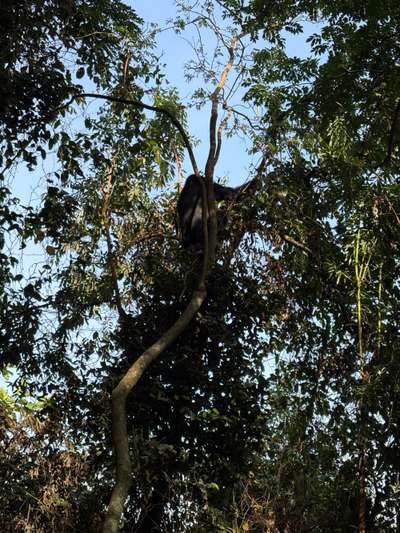
After three hours of walking through Bwindi Impenetrable National Park in January 2026, we reached the gorilla family. They were entirely peaceful. We were close enough to hear them breathing — the soft rhythmic sound of an animal weighing over 150 kilograms pulling leaves from a branch at arm’s length. No fence, no barrier, no glass. Just the forest floor between us and a family of mountain gorillas going about their afternoon. The encounter lasted one hour. The walk to get there had taken three. The memory has not dimmed in six months.
That trek began at the Uganda Wildlife Authority sector headquarters in Buhoma at 07:30 in the morning — which means it began, practically, the evening before, at a lodge less than a kilometre from the trailhead. Where you stay the night before your gorilla trek is not a minor logistical detail. It determines how rested you are for a hike that can last anywhere from one to seven hours through steep, dense montane forest. It determines whether you arrive at the briefing point calm and prepared or exhausted from an early-morning drive. And across five documented visits to the Bwindi region between January and June 2026, with seven GPS-tagged photographs from locations verified at -0.9705°N, 29.6195°E and surrounding coordinates, I have stayed in enough lodges to have a grounded view of what the accommodation landscape around Bwindi actually looks like — not from a booking platform, but from the terrace, the dining room, and the steep timber-step pathways that connect the rooms to the forest.
Bwindi Impenetrable National Park covers 331 square kilometres of montane and lowland forest in south-western Uganda, bordering the Democratic Republic of Congo. It is home to approximately 459 mountain gorillas — roughly half the world’s total population, according to the 2018–2020 census conducted by UWA, the Greater Virunga Transboundary Collaboration, and the Max Planck Institute for Evolutionary Anthropology. The park is divided into four trekking sectors, each with its own UWA headquarters, habituated gorilla families, and surrounding lodge infrastructure: Buhoma in the north, Ruhija in the northeast, Rushaga in the south, and Nkuringo in the southwest. Choosing a lodge means choosing a sector — and choosing a sector shapes the entire experience.
Buhoma — The Original Sector and the Widest Choice of Lodges
Buhoma is where gorilla trekking in Uganda began. The sector has operated since 1993 — the longest-running gorilla tourism operation in the country — and the surrounding village has developed the most extensive accommodation infrastructure of any sector at Bwindi. Lodges in Buhoma range from the community-run Buhoma Community Rest Camp, which offers basic but functional rooms from approximately $30–60 per night, to mid-range options like the Gorilla Bluff Lodge, where rooms with private terraces sit between $100 and $200 per night, to higher-end lodges that approach $400–600 per night. The village itself has a primary school, a health post, a craft cooperative, several woodworking workshops, and a functioning road that connects to the park headquarters. It is, by the standards of south-western Uganda, well-served.
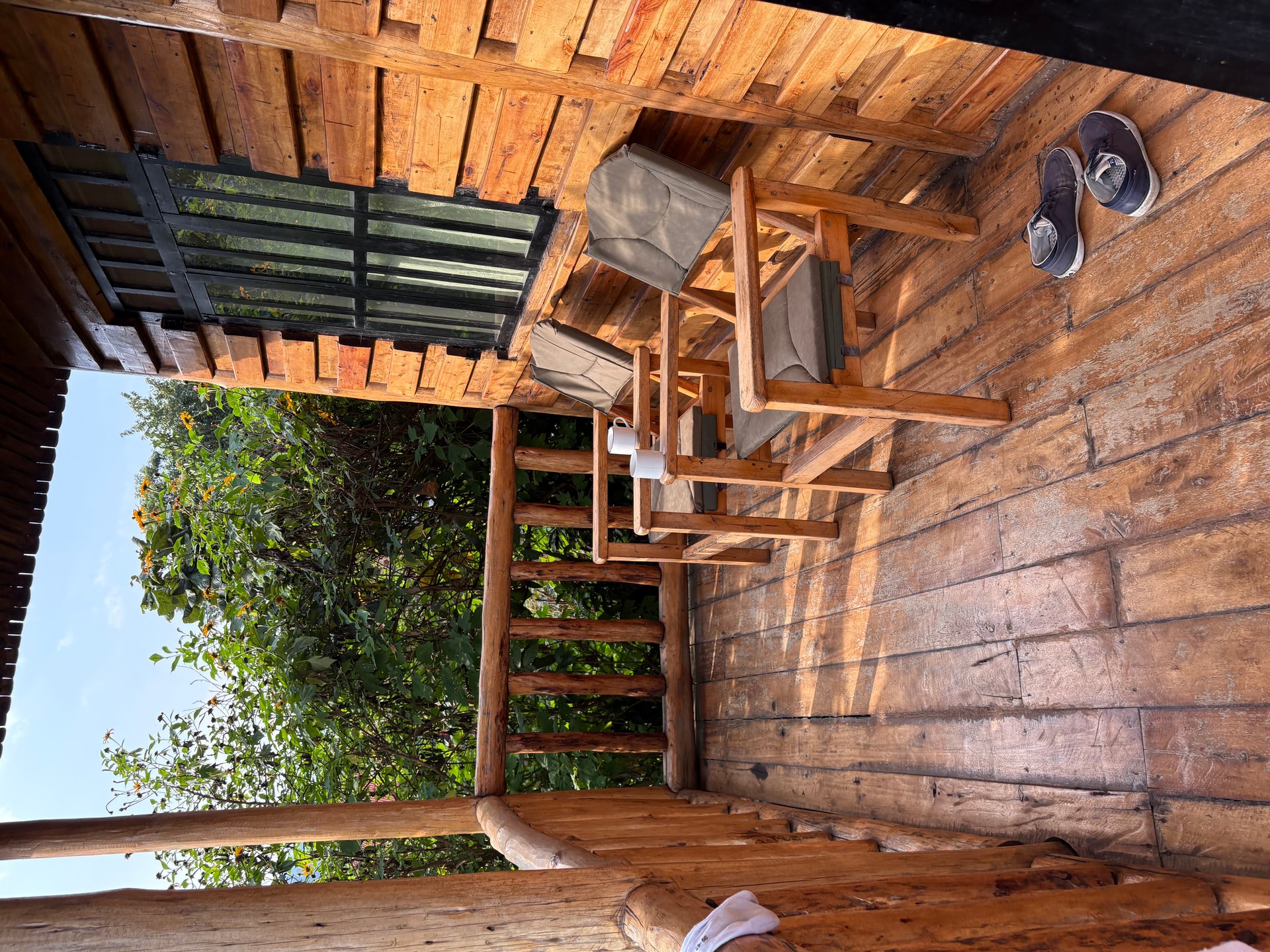
We stayed at the Gorilla Bluff Lodge in January 2026. The lodge is built into a steep hillside above Buhoma village — the rooms are connected to the main building by pathways of massive log steps cut from local timber, which are charming in daylight and require a degree of concentration after dark. The steps lead from room level down to the restaurant and common areas, and the descent is steep enough that you feel it in your legs — a useful warm-up for the next morning’s trek. Each room has a private terrace with a view into the surrounding forest. Every morning, staff brought coffee and African tea to the terrace — a quiet ritual that set the rhythm of the day. The architecture is timber and stone, rustic but well-maintained, with the kind of patina that comes from building in a climate where rainfall is substantial and everything organic eventually claims its share of any surface.
On the road opposite the Gorilla Bluff Lodge, we met Clinton — a seventeen-year-old artist who paints and sells pictures to tourists and passing visitors. Clinton supports his family with his earnings: his father died, and he provides for his mother, two brothers, and a younger sister who has a disability. His paintings are colourful depictions of gorillas and forest scenes, produced with a skill and consistency that suggests both talent and sustained practice. His ambition is to become a tour guide. Clinton is one of many young people in Buhoma whose livelihoods are directly shaped by the proximity of gorilla tourism — the economic influence of the trekking sector extends far beyond the lodges and the UWA payroll, reaching into the informal economy of roadside art, craft sales, and the small enterprises that line the village road.
Buhoma has three habituated gorilla families available for trekking, including the Mubare group — the first gorilla family habituated for tourism in Uganda. Permits for Buhoma are consistently in demand, and booking several months in advance is advisable, particularly for the peak months of June to September and December to February. The sector headquarters is within walking distance of most lodges — a practical advantage that means no early-morning vehicle transfer is required. You leave your lodge on foot, walk to the briefing, and enter the forest from there.
Ruhija — High Altitude, Fewer Crowds, and a Quieter Forest
Ruhija sits in the northeastern part of Bwindi at a higher altitude than Buhoma — approximately 2,300 metres above sea level, compared to Buhoma’s roughly 1,490 metres. The difference is noticeable in the temperature (cooler, particularly at night), the vegetation (denser bamboo zones at higher altitude), and the character of the trekking experience (steeper terrain, thinner air, and a forest that feels more enclosed). Ruhija has fewer lodges than Buhoma, and the village infrastructure is less developed — this is not a disadvantage for visitors who prefer a quieter, more remote setting, but it does mean fewer options in terms of dining, supplies, and evening entertainment.
The Ruhija Gorilla Safari Lodge, part of the Asyanut Safari operation, offers rustic double rooms and timber cottages close to the sector’s trekking departure point. It is a solid mid-range option that benefits from proximity to the trail — a feature that matters when briefings start at 07:30 and the forest is a short walk from the lodge entrance. Rest camps in the Ruhija area provide budget alternatives, though the range of accommodation is narrower than at Buhoma. Ruhija’s habituated gorilla groups include families that range through higher-altitude forest, and the trekking here can be more physically demanding than in other sectors — a consideration for visitors with limited fitness or mobility.
The drive from Buhoma to Ruhija takes approximately two to three hours on a road that is unpaved for much of its length and can be challenging in wet conditions. Visitors booking permits for Ruhija should plan to arrive the afternoon before their trek and stay at least one night in the sector. Attempting to drive from Buhoma or another distant base on the morning of the trek is not practical given the road conditions and the early briefing time.
Rushaga and Nkuringo — The Southern Sectors
Rushaga, in the southern part of Bwindi, has the largest number of habituated gorilla families of any sector — a practical advantage for visitors booking permits at shorter notice, as availability tends to be slightly better here than at Buhoma. The area is home to Batwa communities who were displaced from the forest when the national park was gazetted, and several community-based tourism initiatives in the Rushaga sector offer cultural experiences alongside gorilla trekking. Lodges in Rushaga tend to be mid-range, with a smaller selection than Buhoma but sufficient to accommodate the sector’s trekking capacity. The terrain is steep and the forest dense — trekking difficulty is comparable to Ruhija.
Nkuringo sits at approximately 2,090 metres in the park’s southwestern corner and offers the most dramatic physical setting of any Bwindi sector. The Nkuringo Bwindi Gorilla Lodge, a community-owned lodge with 18 rooms, is located at this altitude and provides views across the Virunga volcanoes and the Albertine Rift that are difficult to match anywhere else at Bwindi. The lodge operates in partnership with the Uganda Carbon Bureau for carbon offset initiatives — one of the few accommodation providers in the region with a formal environmental programme. The African Wildlife Foundation has been involved in conservation projects in the Nkuringo area, reflecting the sector’s ecological significance as a buffer zone between the park and the surrounding agricultural landscape.
Nkuringo is the most physically challenging sector for trekking. The approach involves descending steep hillsides into the Nkuringo valley before entering the forest — a descent that must be climbed again on the way out. Visitors with limited fitness should consider this carefully. The reward, beyond the gorilla encounter itself, is a forest environment that feels genuinely wild and a landscape setting that the northern sectors do not offer. The medicinal plant demonstration garden in the Nkuringo buffer zone, maintained as an educational and conservation resource, adds a dimension to the visit that extends beyond the gorilla trek.
Access to both southern sectors is typically via Kisoro District — the nearest town with fuel, banking, and supplies. The drive from Kampala to Kisoro takes approximately nine to eleven hours, or visitors can fly to Kisoro airstrip (served by domestic charter flights from Entebbe and Kajjansi) and transfer by road to their lodge. This air option reduces the journey to under two hours from Entebbe and is worth considering for visitors on tight schedules.
The Gorilla Trek — What Happens After You Leave the Lodge
The gorilla trekking permit costs $800 per person (Uganda Wildlife Authority, 2026) and allows one hour with a habituated gorilla family. Permits are limited to eight trekkers per group per day — a restriction that protects the gorillas from excessive human contact and ensures the encounter retains the intimacy that makes it extraordinary. Briefings begin at 07:30 at the sector headquarters, where UWA staff assign trekking groups, explain the rules (maintain seven metres distance, no flash photography, no eating or drinking near the gorillas), and pair each group with a guide and two armed rangers.
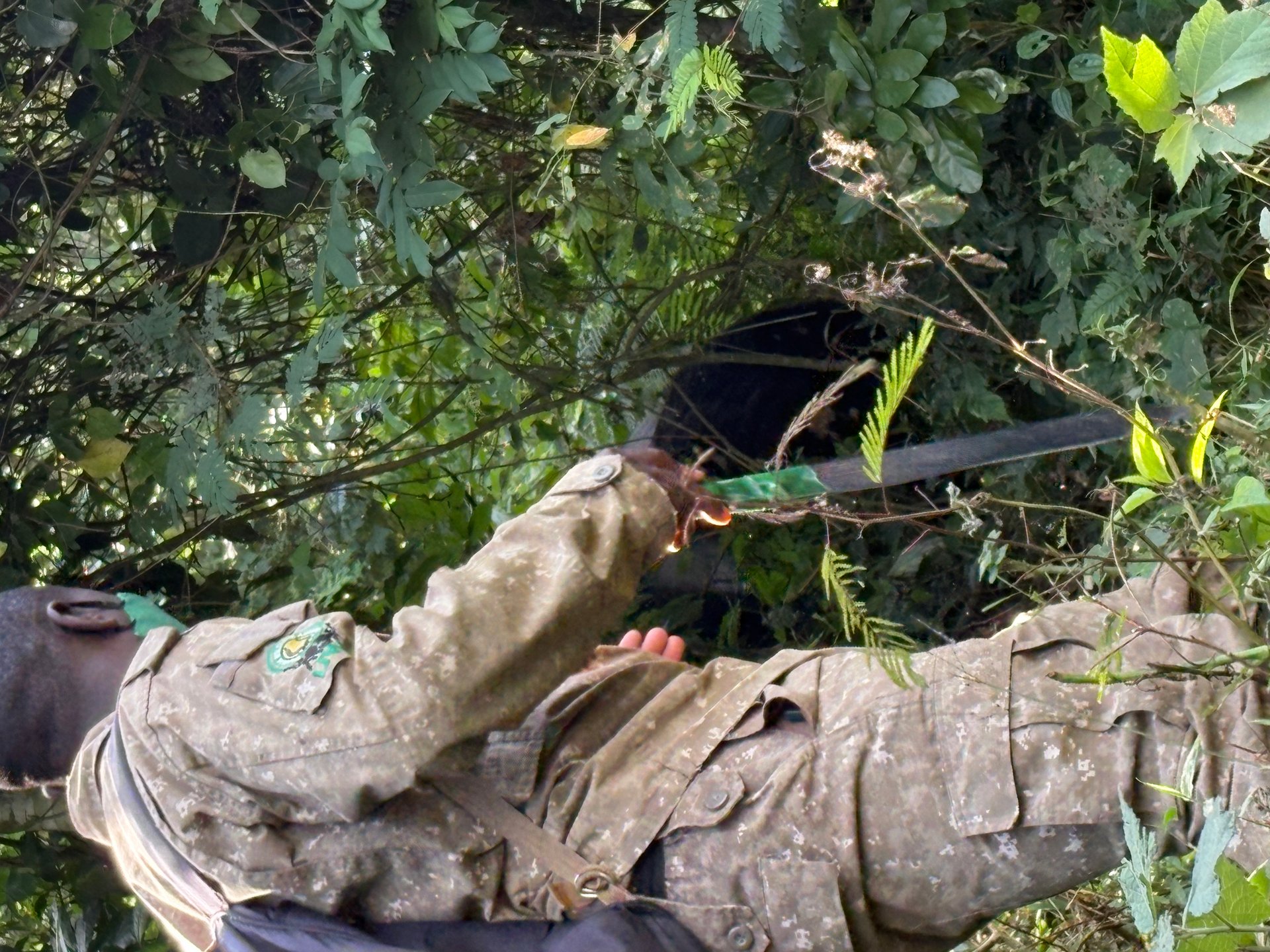
During our January 2026 trek from Buhoma, we were accompanied by a guide and two rangers. The rangers carried rifles — a precaution that felt unusual at first but is standard protocol for forest patrols where encounters with buffalo or elephants are possible. The rangers were excellent company: experienced in the terrain, quick to offer a hand on the steeper sections, and visibly proud of the gorillas they protect. They are not guards in any threatening sense. They are professionals whose presence ensures that the experience is safe for both trekkers and gorillas.
After the first hour of walking, we encountered a gorilla feeding in the canopy of a large tree — a male sitting calmly among the branches, pulling leaves towards his mouth with one hand while bracing himself with the other. The image of a 150-kilogram primate balanced in a tree, eating with the unhurried composure of someone having lunch, is one that no photograph fully conveys. The scale of the animal, the sound of leaves tearing, the slight movement of the branch under its weight — these are sensory details that require proximity. We had it. The gorilla looked at us briefly, assessed that we were not interesting, and returned to his meal.
Three hours further into the forest, we reached the main family group. A mountain gorilla peered through the dense foliage at eye level — close enough that the texture of its face was visible, the dark eyes sharp and attentive. The family was peaceful. A silverback sat on the ground nearby, a juvenile played in the undergrowth, and two females groomed each other in the filtered light. We sat in the forest with them for one hour. Nobody spoke above a whisper. The guides gestured rather than talked. The gorillas, habituated over years to the presence of small human groups, largely ignored us. It was, without qualification, the most remarkable wildlife encounter of my life.
[QUOTE: local guide or ranger on what makes Bwindi trekking unique]
Choosing Your Sector — A Practical Comparison
| Sector | Altitude | Lodges | Difficulty | Best For |
|---|---|---|---|---|
| Buhoma | ~1,490 m | Widest range ($30–$600) | Moderate | First-time trekkers, community engagement, longest-running sector |
| Ruhija | ~2,300 m | Limited mid-range | Demanding | Quieter experience, higher-altitude forest, fewer tourists |
| Rushaga | ~1,800 m | Mid-range selection | Demanding | Most gorilla families, Batwa cultural experiences, permit availability |
| Nkuringo | ~2,090 m | Community lodge + few others | Very demanding | Dramatic views, carbon-offset lodge, medicinal plant garden |
The historical background of the Bwindi region adds context that most lodge listings omit. Leonard Sharp, a Scottish missionary and physician, established a hospital for leprosy patients on Bwama Island in Lake Bunyonyi in 1921 — one of the earliest Western medical interventions in south-western Uganda. Lake Bunyonyi, approximately 30 kilometres from Buhoma, is now a popular stopover for visitors travelling to or from Bwindi, and several lodges on its shores offer a lower-altitude rest day between trekking days. Sharp’s hospital is part of the historical fabric of the region — a reminder that the infrastructure of care and accommodation in south-western Uganda has deep roots, even if the gorilla tourism economy is comparatively recent.
For visitors planning a gorilla trekking trip, the practical recommendation is straightforward: book your permit first, then choose your lodge based on the sector your permit is allocated to. Most lodges can be booked through tour operators such as Nturo Safaris or Deks Safaris, who handle permits, transport, and accommodation as a package. Independent travellers can book directly with lodges and arrange permits separately through UWA, though this requires more advance planning and coordination. Whichever route you take, arrive the evening before your trek, sleep well, and bring the stamina for a walk that will earn every metre of the encounter that follows.