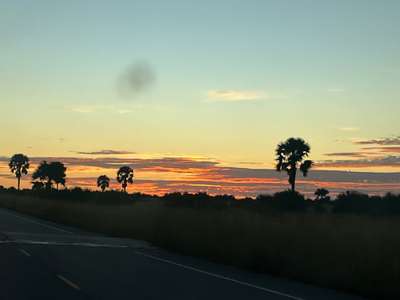
Game Drives at Murchison Falls — What Deks Safaris Clients Experience
Murchison Falls National Park is divided by the Victoria Nile into two distinct zones. The northern bank is where the game drives happen — an expanse of savanna grassland, woodland, and riverine forest that supports the park’s densest wildlife concentrations. The southern bank is forested, home to chimpanzees and primates, and accessed separately. Most operators, including Deks Safaris and Nturo Safaris, base their clients at lodges near the Paraa ferry crossing, which provides access to both banks.

The game drive on the northern bank follows a network of dirt tracks through open grassland. On our October 2024 drive, we encountered elephants within the first hour — a large individual crossing the track ahead of us with the calm authority that only a multi-tonne animal can project. Its tusks caught the early light, white against dark skin. The rest of the herd stood some distance back, watching. There was no urgency, no alarm. The elephant walked, we watched, and the guide kept the vehicle at a respectful distance. That kind of encounter — close, unhurried, on the animal’s terms — is what Murchison Falls delivers better than almost any other park in Uganda.
Common sightings on the northern savanna include Rothschild’s giraffe (one of the rarest giraffe subspecies, with Murchison Falls being a key conservation site), Uganda kob, Jackson’s hartebeest, oribi, waterbuck, and buffalo. Lions are present but harder to spot — the tall grass during the wet season (March to May, October to November) makes sightings less predictable. When I visited in October, the short rains had started, the grass was high, and game visibility depended on sticking to the areas where the vegetation was shorter near waterholes and river crossings.
[QUOTE: Murchison Falls game drive guide on the best time for sightings — collect on next visit]
A good operator schedules two game drives at Murchison Falls: an early morning drive (departing before 06:30 to catch sunrise and peak animal activity) and an afternoon drive (departing around 15:00 for the softer light and cooler temperatures when predators become active). Deks Safaris and similar operators typically arrange both. The cost of a game drive is included in most safari packages; the main variable is the park entry fee, which is 40 USD per person per day for foreign non-residents (Stand 2026, UWA rate).
The Victoria Nile Boat Safari — Crocodiles, Elephants, and the Falls
The boat safari from Paraa upstream to the base of Murchison Falls is, without qualification, one of the best wildlife experiences in East Africa. The three-hour journey follows the Victoria Nile as it narrows from a broad, slow-flowing river into the turbulent channel that feeds the falls. Both banks are lined with dense vegetation, and the concentration of wildlife along the water’s edge is extraordinary.
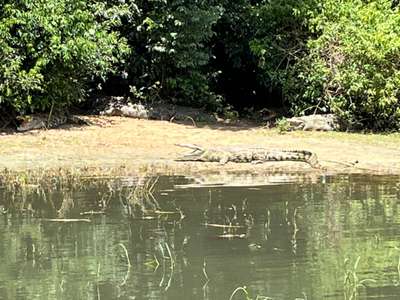
Our boat carried about 14 passengers, fitted with life jackets and a sun canopy. It was a wobbly ride — the smaller boats sit low in the water, and every time the guide pointed at something on the bank, the boat tilted as everyone leaned to one side. But the instability was worth it for the proximity to the wildlife. Within the first 30 minutes, we spotted Nile crocodiles resting on the muddy banks. They were some distance from the boat, but even at that range, the sheer size and power of these animals was striking. Their speed in the water, the guide explained, is what makes them dangerous — on land they look sluggish, but in the river they are fast and decisive.
The elephants were the highlight. We watched one large individual standing at the water’s edge, bending down to drink from the river while the boat drifted past. Another fed in the dense vegetation near the bank, pulling branches with a deliberateness that suggested our presence was beneath its notice. From the boat, the perspective is different from a game drive — you are at water level, looking up at the bank, and the animals loom larger because you are below them.
The journey culminates at the base of Murchison Falls themselves. The entire flow of the Victoria Nile is compressed through a rock gap just seven metres wide before plunging 43 metres into the gorge below. The noise is immense — a constant, deep roar that you feel in your chest before you hear it clearly. The spray catches the light, and the turbulence in the water below the falls is violent enough that the boat holds position well back from the impact zone. During our visit, the water level was high from the short rains, and the force of the cascade was genuinely dramatic — a natural spectacle that photographs struggle to convey.
Boat safaris depart from the Paraa jetty, typically at 09:00 and 14:00. The afternoon departure is generally considered better for light and wildlife activity. Most operators, including Deks Safaris, include the boat safari as a standard element of any Murchison Falls itinerary. The boat fee is approximately 30–40 USD per person (Stand 2026), separate from the park entry fee.
Lodges at Murchison Falls — Where Safari Operators Base Their Clients
Lodges in Uganda have the highest occupancy rates among all accommodation types, and the properties around Murchison Falls are among the most consistently booked in the country. The lodge landscape here is well developed, with options ranging from budget camps to luxury tented properties. Operators like Deks Safaris, Nturo Safaris, and Afoyo African Safaris each have their preferred properties, and the choice of lodge determines how much driving is needed on game-drive mornings.
Paraa Safari Lodge, at the ferry crossing on the Victoria Nile, is the most established property in the park. It has been welcoming visitors since the 1950s, and its position directly at the ferry gives it the shortest access time to both the northern game-drive circuit and the southern primate forest. The lodge has been renovated multiple times but retains its historical character. Rooms overlook the Nile, and the afternoon light from the terrace is particularly good for watching hippos in the river below.
Bakers Lodge, named after the explorer Samuel Baker who reached the falls in 1864, is the luxury option. Ten tented suites on the south bank, each with a private deck overlooking the river. Full-board pricing reflects the premium positioning: expect 300–600 USD per night depending on season (Stand 2026). For travellers whose priority is comfort after a long day in the bush, this is the standard that Murchison Falls’s high-end operators aim for.
Pakuba Safari Lodge sits on the north bank in a more isolated position, surrounded by game-viewing country. Its location means less driving to reach the main wildlife areas, but more distance from the boat safari departure point at Paraa. Bwana Tembo Safari Camp, near Pakwach at the park’s western edge, is an unexpected find — an Italian-influenced camp with good food in a remote location. Chobe Safari Lodge, on the south bank near the Nile, has a swimming pool and conference facilities — a more conventional hotel experience than the tented camps.
Budget travellers typically use Red Chilli Rest Camp at the park headquarters near Paraa, which offers dormitory beds, bandas (simple wooden cabins), and a campsite. Pricing starts around 15 USD for camping, 40–80 USD for a banda. This is where backpackers, overlanders, and travellers on tight budgets converge, and the atmosphere is social — shared dinners, travel stories swapped over beer, and early-morning departures in a communal vehicle for the game drive.
Under the National Environment (Audit) Regulations, Statutory Instrument No. 47 of 2020, luxury tented camps, lodges, hotels and resorts operating in or near wildlife reserves must undergo environmental compliance audits. Reports must be submitted every three years, and the lead agency must file an Environmental Enforcement Audit Report with the Uganda Wildlife Authority within 30 days of completing each audit. This regulatory framework gives established, compliant lodges a documented environmental record — a fact worth asking about when evaluating any operator’s lodge choices.
The Road to Murchison Falls — What the Journey Tells You About Uganda
The drive from Kampala to Murchison Falls National Park takes five to six hours via the main highway through Luwero and Masindi. The road is tarmacked and in reasonable condition for most of the route. What catches your attention is not the road surface but what travels on it.
On our drive from Butiru towards the park, we passed a minibus loaded with mattresses and household goods stacked to roughly double the height of the vehicle itself. The cargo towered above the roof, lashed down with ropes, swaying gently as the bus navigated the highway. It was a sight that was simultaneously alarming and entirely unremarkable to everyone else on the road. This is the informal logistics network that moves goods across rural Uganda — creative, resourceful, and built on a tolerance for overloading that no European safety inspector would sign off on. It is also, in its own way, a window into the economic reality of a country of approximately 46 million people (UBOS estimate, 2024) spread across 111 districts, where formal freight infrastructure serves the cities but the countryside relies on improvisation.
For travellers arriving with Deks Safaris or similar operators, the drive itself is part of the experience. A good guide uses the transit time to explain what you are seeing: the sugar cane plantations near Luwero, the Budongo Forest Reserve (home to chimpanzees and accessible as a half-day detour), the Karuma Bridge crossing where the Nile first appears, and the shift from fertile agricultural land to the drier savanna of the Bunyoro region as you approach the park. The operators that treat the drive as dead time — headphones in, air conditioning up, no stops — miss an opportunity. The ones that treat it as a safari in its own right tend to have clients who arrive at Murchison Falls with a richer sense of where they are.
Uganda’s Safari Landscape — Beyond Murchison Falls
Murchison Falls is Uganda’s largest national park, but it is one of ten managed by the Uganda Wildlife Authority (UWA, established 1996). A typical Deks Safaris itinerary combines Murchison Falls with one or more of Uganda’s other flagship parks: Queen Elizabeth National Park (tree-climbing lions at Ishasha, the Kazinga Channel boat safari), Bwindi Impenetrable National Park (gorilla trekking at 800 USD per permit, Stand 2026), Kibale Forest (chimpanzee tracking), and Kidepo Valley National Park (Uganda’s most remote and wildest park, 77 mammal species, 475 bird species).
The challenge for any operator working across these parks is distance. Uganda is not a country where you can comfortably visit three parks in four days. Kampala to Murchison Falls is five hours. Murchison Falls to Queen Elizabeth is eight hours via Fort Portal. Queen Elizabeth to Bwindi is another four to five hours. Operators who try to compress too many parks into too few days create itineraries where the client spends more time in the vehicle than in the bush. The best operators — whether Deks Safaris, Nturo Safaris, or Afoyo African Safaris — understand that realistic pacing is a feature, not a limitation.
For travellers starting with Murchison Falls, a sensible itinerary adds Budongo Forest Reserve (chimpanzee tracking, half-day detour on the way to or from the park), then continues south to Kibale or Queen Elizabeth before finishing at Bwindi for gorilla trekking. This western circuit is the backbone of most Uganda safari packages and takes a minimum of seven to ten days to cover properly.
The Lodges of Uganda operator directory lists 495+ verified operators with contact details, specialisation profiles, and regional coverage. The lodge directory covers 215+ properties with pricing, GPS locations, and activity information. For Murchison Falls specifically, see the best lodges at Murchison Falls guide.