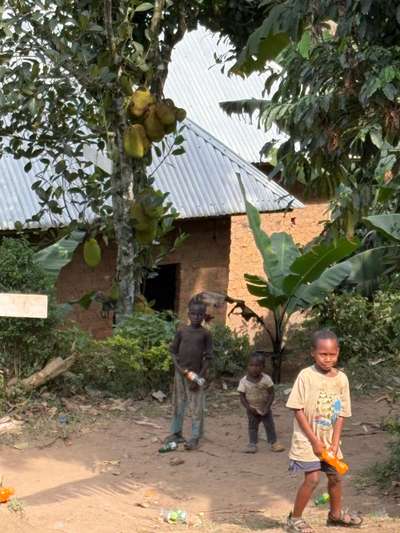
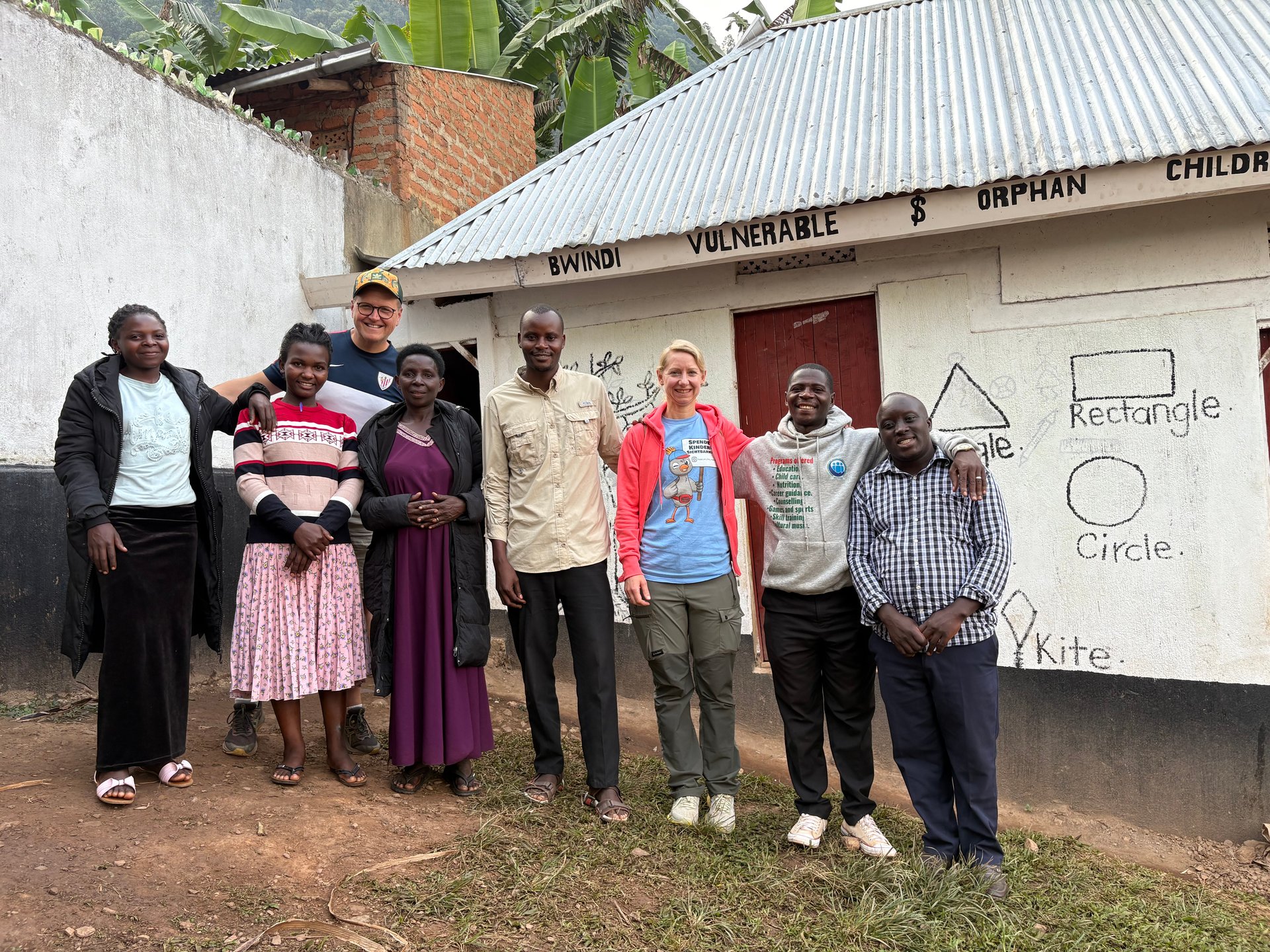
The children from the orphanage neighbourhood were slightly shy, they unfortunately didn’t look well. Their clothing and behaviour were noticeable — we immediately invited them to eat with us. It was June 2026, our fourteenth visit to Uganda, and we were sitting in Buhoma at the western edge of Bwindi Impenetrable National Park. The scene was unremarkable by local standards: a shared meal under a corrugated-iron roof, prepared with ingredients sourced from the hillside gardens that climb the slopes above the village. What made it instructive for anyone planning a trip to Uganda was the economic context surrounding that table. The orphanage exists within a community whose livelihood depends substantially on the lodges, rest camps, and guesthouses that serve gorilla trekking visitors. The cheapest of those properties charges $10 per night. The most expensive, deeper in the forest, charges over $1,500. Both send their guests into the same forest to see the same gorillas on the same trails, managed by the same Uganda Wildlife Authority rangers.
That price spread — a factor of 150 between the cheapest and most expensive night in the same national park corridor — is what makes the budget versus luxury question in Uganda fundamentally different from the same question in, say, Kenya or Tanzania. Uganda’s accommodation market spans from genuinely basic community-run rest camps where you sleep on a foam mattress under a mosquito net for less than the cost of a London coffee, to ultra-premium tented camps where a single night exceeds the monthly salary of everyone who works there combined. This article maps that spectrum based on documented prices, observed conditions, and the practical differences that matter to travellers making real booking decisions.
| Tier | Price Range (pp/night) | Meals | Power | WiFi | Example Properties |
|---|---|---|---|---|---|
| Budget | $4–50 | Self-catering or B&B; dinner $5–8 extra | Generator (18:00–22:00) or solar | Rare outside Kampala | Buhoma Community Rest Camp, Bwindi Backpackers, Nyumba 591, Kampala Backpackers |
| Mid-range | $90–300 | Half board or full board | Generator + solar backup | Available, slow | Queen Elizabeth Bush Lodge, Protea Hotel Entebbe, Bakiga Lodge, Lake Mulehe Safari Lodge |
| Luxury | $500–2,600 | Full board or all-inclusive (VP) | Generator + solar; some 24-hour | Available, moderate speeds | Buhoma Lodge, Wildwaters Lodge, Bisate Lodge, Sabyinyo Silverback Lodge |
Budget Tier — $4 to $50 per Night
Uganda’s budget accommodation tier is genuinely affordable by any global standard. Camping in or near national parks starts at $4–15 per person per night, with your own tent pitched on designated grounds that provide basic toilet and washing facilities. At this price level, you are responsible for your own food, equipment, and often your own water treatment. The trade-off is access: campgrounds at Bwindi, Queen Elizabeth, and Murchison Falls national parks place you inside or immediately adjacent to the wildlife corridors, and the morning birdsong at a $4 campsite is identical to what guests at the $1,500 lodge next door hear through their imported Egyptian cotton pillows.
Community rest camps represent the next step up. Buhoma Community Rest Camp, operated by the local community association at the western gate of Bwindi Impenetrable National Park, charges $10–15 per night for a basic room with a bed, mosquito net, and shared or private bathroom. The camp has operated for over two decades and its revenue supports community projects in the surrounding parishes — the same parishes where the children we shared lunch with live. Nshongi Camp near the Rushaga sector offers a similar proposition at comparable rates, providing a functional base for gorilla trekking without the price premium of commercial lodges.
Backpacker hostels serve the urban corridors. Kampala Backpackers, located in the Ntinda neighbourhood, charges $15–25 per night for dormitory or basic private rooms. The hostel functions as a transit hub for budget travellers assembling safari groups or arranging onward transport to the national parks. Masaka Backpackers, positioned on the Kampala–Kabale highway roughly halfway to the southwestern parks, serves a similar staging function for overland travellers heading toward Lake Bunyonyi or Bwindi. Bwindi Backpackers, closer to the park, offers budget beds specifically targeting the gorilla trekking market.
In smaller towns along the tourism corridors, basic guesthouses offer rooms for $8–20. Nyumba 591, a guesthouse charging approximately $12 per night, represents this tier: clean enough, functional, and located within reach of the attractions that bring visitors to the region. Marina Bar & Lodging provides similar budget accommodation with the addition of a social gathering space that serves both local residents and passing travellers. These properties do not appear in glossy safari brochures, but they serve a real and growing market segment: independent travellers, volunteers, researchers, and the increasing number of East African domestic tourists exploring their own country.
The practical realities of budget accommodation in Uganda require honest framing. Generator power, where it exists, typically runs from 18:00 to 22:00. After that, you are in the dark unless you have a headlamp or charged power bank. Hot water may be solar-heated (warm by afternoon, cool by morning) or heated by wood fire on request. WiFi is unreliable or absent outside Kampala and Entebbe. Mattresses range from adequate to thin foam over plywood. None of this is dangerous or unsanitary — Ugandan guesthouses at the $10–20 level are generally cleaner than equivalent pricing in many Southeast Asian backpacker markets — but it requires a calibrated expectation set, particularly for travellers whose frame of reference is European budget hotels.
Mid-Range Tier — $90 to $300 per Night
The mid-range tier is where most organised safari visitors to Uganda land, and it is the tier that has seen the most growth since the post-COVID tourism recovery. Properties in this bracket typically include half board (Halbpension, HP) or full board (Vollpension, VP) — a critical distinction in remote national park locations where no independent restaurants exist within walking distance. When your lodge is the only building for kilometres in any direction, the meal plan is not an upsell; it is a necessity.
Queen Elizabeth Bush Lodge, situated within the Queen Elizabeth National Park ecosystem in the Ishasha sector, charges $90–170 per person per night on a full-board basis. The lodge provides comfortable rooms, generator power supplemented by solar, and guided game drives in the Ishasha sector — famous for its tree-climbing lions. The price point positions it well below the luxury safari lodges that dominate the northern (Mweya) sector of the park while delivering a substantially better experience than the budget guesthouses in nearby Kihihi or Ishasha village. For travellers driving the southwestern circuit from Bwindi to Queen Elizabeth National Park, this kind of mid-range property offers the right balance between comfort and cost.
Protea Hotel Entebbe, part of the Marriott-affiliated Protea chain, represents the urban mid-range at $160–200 per night. Positioned near Entebbe International Airport, it serves primarily as an arrival and departure point for safari visitors. The hotel offers reliable mains electricity, international-standard WiFi, air conditioning, and the kind of predictable service quality that travellers transitioning between a long-haul flight and a bush safari appreciate. Entebbe’s accommodation market has expanded significantly since 2020, with several new mid-range properties competing for the pre-safari and post-safari overnight market.
In the Bwindi corridor, mid-range options include Bakiga Lodge near Buhoma ($80–120 pp, full board), Lake Mulehe Safari Lodge between Rushaga and Nkuringo (from $280 pp, full board), and several community-owned or community-partnered properties that have upgraded their facilities in recent years. The mid-range tier is where the distinction between half board and full board matters most financially: a property quoting $120 on a VP basis may represent better value than one quoting $90 on a B&B basis once three meals at $15–25 each are added. Always compare on a full-board equivalent basis when evaluating lodges outside Kampala.
A week of mid-range accommodation for an individual traveller in Uganda costs approximately 500 EUR, excluding gorilla trekking permits ($800 pp in peak season, $450 in low season through the Uganda Wildlife Authority) and vehicle hire or organised safari costs. This figure assumes a mix of Entebbe hotel nights, a Kampala transit night, and three to four nights at national park lodges on a full-board basis. Couples sharing rooms can reduce the per-person figure to roughly 350–400 EUR per week.
Luxury Tier — $500 to $2,600 per Night
Uganda’s luxury accommodation tier is small but growing, concentrated around the country’s marquee wildlife experiences: gorilla trekking in Bwindi and Mgahinga, game viewing in Queen Elizabeth and Murchison Falls, and the Nile-based adventure market near Jinja. The properties at this level compete directly with luxury safari lodges in Kenya, Tanzania, Rwanda, and Botswana — and in several cases, they are operated by the same international hospitality groups.
Buhoma Lodge, located near the Buhoma gorilla trekking briefing point in Bwindi, charges approximately $500 per person per night on a full-board (VP) basis. The lodge occupies a forest-edge position with views into the canopy and operates at a quality level that would satisfy travellers accustomed to four-star properties in East Africa. The $500 price point places it at the entry level of Uganda luxury — a category that escalates rapidly from there.
Wildwaters Lodge, built on a private island in the White Nile near Jinja, charges approximately $600 per person on a VP basis. The setting is unique: individual wooden cabins perched above the rapids, accessible only by boat, with the sound of the Nile as a permanent soundtrack. Wildwaters represents a different luxury proposition from the gorilla trekking lodges — it sells the river experience rather than wildlife proximity, and it serves travellers who include Jinja’s white-water rafting and Nile source visit in their Uganda itinerary.
Sabyinyo Silverback Lodge, operated by Governors’ Camp Collection near Mgahinga Gorilla National Park in the Virunga foothills, charges approximately $1,000 per person per night on a VP basis. The lodge’s community trust model — where a significant proportion of revenue is channelled to local development projects — has been cited as a benchmark for conservation-linked luxury tourism in the East African highlands. The property’s position near Kisoro provides access to both Mgahinga gorilla trekking and golden monkey tracking, as well as cross-border excursions to Volcanoes National Park in Rwanda.
At the apex of the market sits Bisate Lodge in Rwanda, operated by Wilderness Safaris near Volcanoes National Park, at approximately $2,598 per person per night on a VP basis. While technically across the border in Rwanda, Bisate is relevant to this comparison because many Uganda itineraries include a Rwanda extension via the Katuna (Gatuna) or Cyanika border crossings. The price differential between Uganda’s luxury tier ($500–1,000 pp) and Rwanda’s ultra-luxury tier ($1,500–2,600 pp) is one reason why travellers seeking the gorilla trekking experience at lower overall cost choose Uganda over Rwanda — where the trekking permit alone costs $1,500 compared to Uganda’s $800.
Luxury tented camps represent a distinct sub-category within this tier. Properties like Sanctuary Gorilla Forest Camp in Bwindi and Apoka Safari Lodge in Kidepo Valley National Park use semi-permanent canvas structures that blend the bush camp aesthetic with hotel-grade interiors: proper beds, en-suite bathrooms with flushing toilets and hot showers, and generator or solar power sufficient to maintain lighting and device charging throughout the night. The tented camp format allows operators to position properties in locations where permanent construction would face environmental restrictions or planning challenges, particularly within or immediately adjacent to national park boundaries.
What the Price Does Not Change
The most important thing to understand about Uganda’s accommodation spectrum is what remains constant regardless of what you pay per night. A gorilla trekking permit costs $800 per person during peak season (June–September and December–February) and $450 during low season, administered exclusively by the Uganda Wildlife Authority. This fee is identical whether you sleep in a $10 community rest camp or a $1,500 luxury tented camp. The UWA ranger who leads your trek, the habituated gorilla family you are assigned to, the one hour you spend with the gorillas, and the forest trails you walk are all determined by permit sector and group availability, not by your lodge booking.
This means that the core wildlife experience — the reason most international visitors come to Uganda — is democratically priced. A German backpacker staying at Buhoma Community Rest Camp and a Swiss couple at Sanctuary Gorilla Forest Camp will stand in the same morning briefing circle, follow the same trackers into the forest, and photograph the same silverback from the same seven-metre minimum distance. The luxury premium buys what happens before and after the trek: the quality of your sleep, the breakfast that fuels your hike, the hot shower that greets your return, and the gin and tonic served on a terrace overlooking the canopy at sunset.
Road conditions are also tier-independent. The drive from Kampala to Bwindi takes 8–10 hours regardless of your destination lodge. The unpaved highland roads between Kabale and the park entrance do not improve because your accommodation costs more. A 4x4 vehicle is essential for all visitors during the wet seasons (March–May and October–November), and advisable year-round for the final approach to most Bwindi-area lodges. Some luxury operators arrange domestic flights from Entebbe to Kihihi or Kisoro airstrips, reducing the road transfer to 60–90 minutes, but this is a separate cost ($250–400 one way) that sits outside the accommodation pricing.
Weekly Cost Comparison — Real Numbers for Real Itineraries
The following estimates reflect 2024–2026 pricing observed across multiple trips and are presented as weekly accommodation costs for a single traveller. They exclude gorilla trekking permits, vehicle hire, fuel, park entrance fees, and internal flights.
Budget traveller — approximately 200 EUR per week
Mix of camping ($4–15/night), community rest camps ($10–15/night), and backpacker hostels ($15–25/night). Self-catering or basic meal purchases at local restaurants ($3–8 per meal). Typical itinerary: two nights in Kampala or Entebbe at a hostel, one night transit in Masaka or Mbarara, three to four nights near national parks at community camps or budget guesthouses.
Mid-range individual traveller — approximately 500 EUR per week
Mix of mid-range hotels in Entebbe or Kampala ($80–160/night) and national park lodges on full board ($90–200/night). Meals largely included in room rate outside cities. Typical itinerary: one night Entebbe, one night Kampala, four to five nights at lodges in the Bwindi or Queen Elizabeth corridors. This is the most common spending pattern for European individual travellers arranging their own transport.
Luxury traveller — approximately 3,500–7,000 EUR per week
Premium lodges at $500–1,000 per night on full board or all-inclusive plans. Domestic flights to reduce road time. Private safari vehicle with driver-guide. Typical itinerary: one night at a premium Entebbe property, two nights at a luxury Bwindi lodge for gorilla trekking, two nights at a luxury Queen Elizabeth lodge for game viewing, one night at Wildwaters Lodge on the Nile.
Ultra-luxury with Rwanda extension — 10,000–18,000 EUR per week
Top-tier properties including Bisate Lodge ($2,598/night) or One&Only Gorilla’s Nest in Rwanda, combined with Uganda’s premium lodges. Charter flights between destinations. This tier represents the smallest market segment by volume but the highest per-visitor revenue contribution to the regional tourism economy.
Infrastructure Realities Across All Tiers
Generator power is the norm at lodges outside Kampala and Entebbe, regardless of price tier. Most properties run their generators from approximately 18:00 to 22:00, providing electricity for lighting, phone charging, and sometimes hot water heating. After 22:00, the generator switches off and the property goes dark. This applies to mid-range lodges and, until recently, to many luxury properties as well. The shift toward solar power is accelerating — newer luxury lodges and some mid-range properties now maintain 24-hour electricity through solar panel arrays with battery storage — but travellers should not assume continuous power at any property without confirming in advance.
Water supply varies by location and altitude. Properties near Bwindi, situated in the highland rainfall zone at 1,500–2,000 metres, generally have adequate water year-round, sourced from springs, rainwater collection, or community gravity-flow systems. Properties in the drier savannah zones around Queen Elizabeth National Park and the Rift Valley corridor may experience seasonal water pressure issues. Hot water at budget and mid-range properties is typically solar-heated or wood-fired on request; luxury properties maintain pressurised hot water systems powered by generators or dedicated boilers.
WiFi availability has improved dramatically since 2022, driven by the expansion of mobile data networks (MTN Uganda and Airtel Uganda being the dominant providers). Most mid-range and above lodges now offer WiFi, though speeds are slow by Western European or North American standards — typically 2–8 Mbps download, sufficient for email and messaging but inadequate for video streaming or large file transfers. Budget properties rarely offer WiFi, but a Ugandan SIM card with a data bundle ($5–15 for 5–20 GB) provides mobile data coverage across most of the southwestern tourism corridor, with notable dead zones in deep valleys and inside the forest canopy at Bwindi.
Uganda’s Accommodation Landscape — The Numbers Behind the Choices
Uganda’s accommodation sector is simultaneously large and under-documented. The Uganda Statistical Abstract 2025 records approximately 350,550 accommodation rooms across the country, but only 117 properties are formally graded by the Uganda Tourism Board (UTB). This gap between total inventory and graded inventory reveals the structure of the market: the vast majority of rooms are informal guesthouses, lodging houses, and rest camps that operate without star classification. For budget travellers, this means that quality at the $10–30 price level is highly variable and discovery depends on word of mouth, online reviews, or simply walking in and inspecting the room before committing.
The tourism accommodation sector contributed approximately 3,110 billion UGX to Uganda’s GDP according to the same statistical abstract — a figure that reflects both the direct revenue from room sales and the multiplier effects of associated spending on food, transport, guides, and crafts. The western region, encompassing the Bwindi and Queen Elizabeth National Park corridors where most safari tourism concentrates, accounts for approximately 27% of graded accommodation capacity. The central region dominated by Kampala holds roughly 65%, reflecting the capital’s role as the primary business and conference destination.
The mountain gorilla population — 459 individuals recorded in Bwindi during the 2018–2020 census, with the global population now exceeding 1,000 across Bwindi and the Virunga volcanic range shared between Uganda, Rwanda, and the Democratic Republic of Congo — drives the highest per-visitor revenue of any single wildlife attraction in East Africa. Each gorilla trekking permit generates $800 in peak season, of which a percentage flows to community revenue-sharing programmes in the parishes surrounding the park. This revenue-sharing mechanism means that even budget travellers who spend minimally on accommodation contribute significantly to community welfare through their permit purchase.
Recommendations by Traveller Type
The right accommodation tier depends on your travel style, total budget, and what you want the non-wildlife hours of your trip to feel like. The following recommendations are based on what I observed across 59 days and 14 visits to Uganda, staying at or inspecting properties across all three tiers.
Independent backpackers and gap-year travellers
The budget tier is not just adequate; it is part of the experience. Buhoma Community Rest Camp, Nshongi Camp, and the backpacker hostels along the Kampala–Kabale corridor deliver proximity to the attractions without the financial burden that makes a $800 gorilla permit feel even heavier. At $200 EUR per week for accommodation, the permit becomes the single largest expense — which is appropriate, given that it is the single most valuable experience.
European couples on a two-week safari
The mid-range tier offers the best value-to-comfort ratio. Full-board lodges at $90–200 per person eliminate meal logistics in remote areas, provide private rooms with en-suite bathrooms, and maintain a standard of comfort that makes the long drive days bearable. At approximately 500 EUR per person per week, a two-week trip across Bwindi, Queen Elizabeth, and Lake Bunyonyi stays within a realistic European holiday budget once permits and transport are added.
High-end safari travellers comparing Uganda with Kenya, Tanzania, or Rwanda
Uganda’s luxury tier at $500–1,000 per night delivers a comparable product to the $800–2,000 per night properties in the Serengeti, Masai Mara, or Volcanoes National Park — often at a lower price with smaller visitor volumes. The gorilla permit saving ($800 in Uganda versus $1,500 in Rwanda) further tilts the cost comparison. For travellers who would pay luxury prices regardless, Uganda offers exclusivity that more established safari destinations have lost to volume.
Families with children
Mid-range to luxury properties with full board are the practical choice. Children under 15 are not permitted on gorilla treks, so family itineraries typically centre on Queen Elizabeth (game drives, boat safaris on the Kazinga Channel) and Kibale (chimpanzee tracking, where the minimum age is 12). Properties like Queen Elizabeth Bush Lodge offer family-friendly pricing and enough space for children to move safely. Budget camping with children is possible but demanding, particularly given the long drive distances and limited medical facilities in remote areas.
Bottom Line
Budget ($4–50/night) is not a compromise in Uganda — it is a legitimate way to travel the country, used by researchers, volunteers, and experienced Africa travellers who know that the wildlife experience is not diminished by a simple room. Weekly cost: approximately 200 EUR.
Mid-range ($90–300/night) is the sweet spot for most international visitors, offering full-board meal plans, private en-suite rooms, and enough comfort to recover from long drive days and demanding treks. Weekly cost: approximately 500 EUR.
Luxury ($500–2,600/night) buys setting, service, and seamlessness — but not a better gorilla encounter. The $800 permit equalises the in-forest experience across all tiers. Choose luxury if you value what surrounds the trek, not the trek itself.
Frequently Asked Questions
How much does a week of accommodation cost in Uganda?
A week of mid-range accommodation in Uganda costs approximately 500 EUR for an individual traveller, excluding gorilla permits and vehicle hire. Budget travellers using hostels, guesthouses, and camping can reduce that to roughly 200 EUR per week. These figures are based on 2024–2026 pricing across properties visited in Kampala, Entebbe, the southwestern highlands, and Queen Elizabeth National Park. Luxury lodges with full board or all-inclusive plans can push weekly costs to 3,500–18,000 EUR depending on the property tier.
Is it worth staying at a luxury lodge for gorilla trekking in Uganda?
The gorilla trekking experience itself is identical regardless of lodge tier — the Uganda Wildlife Authority assigns gorilla groups based on permit sector, not accommodation. A guest at Buhoma Community Rest Camp ($10–15 per night) treks the same forest trails and spends the same one hour with the gorillas as a guest at Sanctuary Gorilla Forest Camp ($1,500+ per night). The luxury premium buys comfort before and after the trek: better beds, hot water on demand, curated meals, and professional guiding between the lodge and briefing point. Whether that premium is worth $800–1,500 per night above budget alternatives depends on your priorities and total trip budget.
Do budget lodges in Uganda have electricity and WiFi?
Most budget and mid-range lodges outside Kampala rely on generator power, typically running from 18:00 to 22:00. Charging phones and cameras is possible during generator hours, and some properties offer solar-powered charging stations during the day. WiFi is increasingly available at mid-range and above properties, though speeds are slow by Western standards — sufficient for messaging and email but rarely adequate for video calls or large uploads. Budget hostels in Kampala and Entebbe generally have mains electricity and basic WiFi. Solar power is expanding rapidly across all tiers, particularly at newer properties built after 2020.
What is included in full board and all-inclusive rates at Uganda lodges?
Full board (Vollpension, VP) includes breakfast, lunch, and dinner. This is the standard meal plan at most mid-range and luxury lodges in Uganda’s national park corridors, where no independent restaurants exist nearby. Half board (Halbpension, HP) includes breakfast and either lunch or dinner. All-inclusive plans at luxury properties additionally cover drinks (alcoholic and non-alcoholic), laundry, selected activities such as nature walks or boat trips, and sometimes airport transfers. Budget properties typically offer bed-and-breakfast or room-only rates, with meals available separately at modest cost. At community rest camps, a basic dinner might cost $5–8 on top of the room rate.
How many graded accommodation rooms does Uganda have?
According to the Uganda Statistical Abstract 2025, Uganda has approximately 350,550 accommodation rooms across the country, of which 117 properties are formally graded by the Uganda Tourism Board. The western region, which includes the Bwindi and Queen Elizabeth National Park corridors, accounts for approximately 27% of graded capacity. The central region dominated by Kampala holds roughly 65%. The tourism accommodation sector contributed approximately 3,110 billion UGX to Uganda’s GDP. The gap between total rooms and graded properties reflects the dominance of informal guesthouses, particularly outside the capital and major tourism circuits.
About the author: Mark Suer has visited Uganda 14 times between October 2024 and June 2026, totalling 59 days across the country. Observations in this article are based on documented visits to properties across all accommodation tiers in the Bwindi, Queen Elizabeth, Murchison Falls, and Kampala/Entebbe corridors. All photography is GPS-verified. Sources: Uganda Statistical Abstract 2025, Uganda Tourism Board, Uganda Wildlife Authority.