Ngamba Island Chimpanzee Sanctuary is a 40-hectare forested island on Lake Victoria, roughly 23 kilometres southeast of Entebbe, where rescued chimpanzees that cannot be returned to the wild live under the protection of a consortium of international conservation organisations. Established in 1998, the sanctuary serves both as a permanent refuge for confiscated and orphaned chimpanzees and as a visitor destination that funds their ongoing care. During my visit in October 2024, I spent an afternoon on the island observing the chimpanzees from the feeding platform and walking the grounds with the resident caregivers. The experience was unlike any other primate encounter in Uganda — quieter, more personal, and shaped by the individual histories of the animals you see.
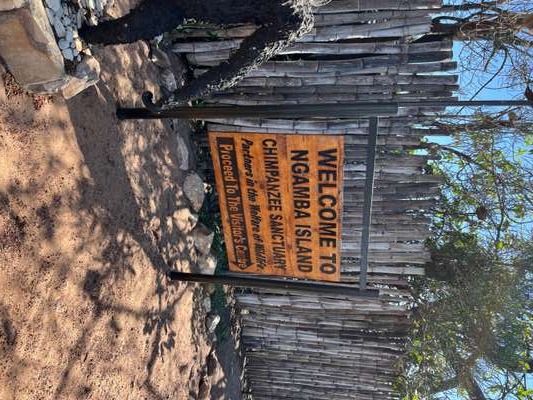
When we arrived at the island, the welcome was warm and genuinely inviting. A hand-painted wooden sign reading "Ngamba Island Chimpanzee Sanctuary" greeted us at the entrance, its weathered letters on an orange background setting an honest, unpretentious tone for what lay ahead. That sign, which I photographed at 14:52 on 19 October 2024, marks the beginning of a visit that combines wildlife observation with a lesson in primate rehabilitation. During a return visit in January 2026, I was able to see how the sanctuary operates across different seasons and how the chimpanzees' routines shift between the wet and dry months. Across 14 visits to Uganda between October 2024 and July 2026, Ngamba Island stands out as a place where conservation work is visible, tangible, and deeply personal.
How Ngamba Island Became a Chimpanzee Sanctuary
The story of Ngamba Island as a sanctuary begins in 1998, when the island was established as a permanent home for chimpanzees that could not safely be released into Uganda's remaining wild populations. The founding group included more than 20 chimpanzees transferred from two sources: a pilot project on Isinga Island in Lake Edward within Queen Elizabeth National Park, and the Uganda Wildlife Education Centre (UWEC) in Entebbe. Over the following years, the population steadily grew as confiscated animals were added — many of them smuggled from the Democratic Republic of Congo by illegal wildlife traders and intercepted by Ugandan authorities. By 2018, 49 chimpanzees were living in the sanctuary, making it one of the larger rescue populations in East Africa.
The sanctuary is operated by the Chimpanzee Sanctuary & Wildlife Conservation Trust (CSWCT), a collaborative body that brings together some of the most recognised names in primate conservation. The Jane Goodall Institute provides scientific guidance and global advocacy. The International Fund for Animal Welfare (IFAW) contributes funding and logistical support. UWEC, as the Ugandan government's wildlife education body, serves as the institutional link to national conservation policy. The Born Free Foundation and the Zoological Parks Board of New South Wales in Australia round out the partnership, each contributing specific expertise in animal welfare, veterinary care, and public education.
The reason these chimpanzees cannot return to the wild is both practical and biological. Chimpanzees that have spent years in captivity — whether as pets, performers, or victims of the bushmeat trade — often lack the social skills needed to integrate into wild communities. Reintroduction attempts have historically resulted in rejection by wild groups, serious injury, or death. The chimpanzees on Ngamba Island range from those confiscated as infants, who never learned to forage independently, to adults who were kept in isolation for years. For each of them, the island's 40 hectares of tropical moist forest represent the closest approximation of natural life that their circumstances allow.
One consequence of maintaining a closed population on a limited landmass is the need for veterinary birth control. The sanctuary places hormonal depot implants under the skin of sexually mature females to prevent pregnancies, because the island cannot support an indefinitely growing population. This is a deliberate and medically supervised programme, carried out by the sanctuary's resident veterinary team. It is one of the less discussed aspects of running a chimpanzee rescue facility, but it reflects the genuine constraints of island-based conservation — a theme that becomes very real when you stand on Ngamba and look at the forest boundary where the land simply ends at the lake shore.
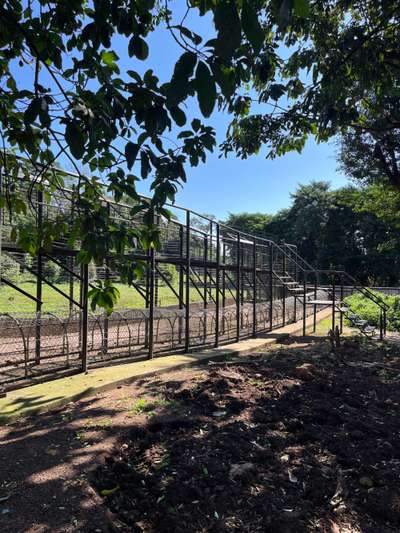
When I first saw the metal enclosure fence, it was an unsettling sight. The robust steel barrier looks stark against the lush tropical vegetation, and the initial impression is one of confinement rather than freedom. But the caregivers explained that behind this fence stretches a substantial area of natural forest — the chimpanzees' actual living space. The fence exists to separate the visitor area and staff quarters from the chimps' domain, not to cage them in a small space. Once you understand this distinction, the layout makes sense: the infrastructure is minimal and functional, designed to keep humans out of the chimps' forest rather than the other way around. The fence I photographed at 15:40 on 19 October 2024 represents that boundary between the necessary human infrastructure and the reclaimed wildness of the sanctuary interior.
What to Expect When Visiting Ngamba Island
A day visit to Ngamba Island follows a straightforward pattern. Boats depart from a pier in Entebbe, typically in the mid-morning, for the approximately 45-minute to one-hour crossing of Lake Victoria. The journey itself is part of the experience — Lake Victoria is the largest lake in Africa by surface area, and the open-water crossing offers wide views of the Entebbe peninsula receding behind you and, depending on conditions, the occasional sighting of fish eagles or other waterbirds along the way.
On arrival, visitors are briefed by sanctuary staff about the chimpanzees' backgrounds, the rules of the visit, and the layout of the island. The main viewing opportunity comes at the feeding platform, a raised observation deck where you can watch the chimpanzees emerge from the forest for their scheduled meals. Feeding times are at 11:00 and 14:30 daily. These are the moments when you see the full community assembled, and the individual personalities become apparent. Some chimps approach eagerly; others hang back at the forest edge, watching. The caregivers know each animal by name and can describe its origin story, temperament, and social relationships within the group. [QUOTE: local caregiver on individual chimpanzee personalities and rescue backgrounds]
The viewing distance is close enough for detailed observation and photography but maintains a respectful separation. Unlike chimpanzee trekking in forests such as Kibale National Park, where you follow habituated groups through dense undergrowth, Ngamba Island offers a more stationary experience. You watch from the platform as the chimps move freely in the open area between the forest and the fence. For visitors who cannot manage the physical demands of forest trekking or who are travelling with children (the minimum age for chimpanzee trekking in national parks is 15 years), Ngamba Island provides an alternative that is both accessible and educational.
Day visits typically include the boat transfer, an introductory talk, viewing time at the feeding platform, and a guided walk around the visitor area of the island. The total time on the island is roughly three to four hours. Plan for a full day when you factor in the boat crossings and any time spent at the Entebbe pier before departure. Visitors should bring sun protection, a rain jacket (Lake Victoria generates unpredictable afternoon showers in any season), binoculars for birdwatching, and a camera with a reasonable zoom lens.
For those who want a deeper experience, Ngamba Island offers overnight stays in spacious safari-style tents set on raised wooden platforms with views over Lake Victoria. The overnight package includes the boat transfer, full board, and extended viewing sessions. At approximately 443 USD per person, it is not a budget option, but it offers something that day visitors miss entirely: the chance to watch chimpanzees building their nests at dusk, the experience of the island at night with the sounds of the lake and the forest overlapping, and the early morning hours when the chimps wake and begin their day. Overnight guests also have the island largely to themselves once the day-trip boats have departed, which creates a qualitatively different atmosphere. The tented camp accommodates only a small number of guests at any given time, maintaining the sense of seclusion that defines the place.
Beyond chimpanzees, the island supports a notable diversity of wildlife. Hippos are present in the surrounding waters. Fish otters, Nile monitors, and African fish eagles are regularly seen. Birdwatchers have recorded 154 species on and around the island, making it a significant birding site in its own right. For visitors combining Ngamba with time in the Entebbe area, the island adds a genuine wildlife dimension to what is otherwise primarily an airport-transit zone.
Ngamba Island and Uganda's Wider Primate Tourism Landscape
Uganda markets itself as the primate capital of Africa, and the claim is well supported. The country is home to roughly half the world's remaining mountain gorillas — 459 individuals were counted in the 2018-2020 census — and its forests harbour an estimated 5,000 chimpanzees across multiple national parks and forest reserves. Gorilla trekking in Bwindi Impenetrable National Park dominates the international tourism narrative, and for good reason: it is a singular experience. But chimpanzee encounters offer a complementary perspective on primate behaviour that is quite different in character.
Chimpanzees in the wild are smaller, more agile, and significantly less predictable than mountain gorillas. In Kibale National Park, where habituated groups are tracked through primary rainforest, the standard chimpanzee tracking experience allows one hour of observation once a group is located. A full-day habituation experience, priced at 220 USD per person, lets participants spend an entire day alongside researchers as they follow a chimpanzee community through its daily routines. The Kyambura Gorge in Queen Elizabeth National Park offers another option, with a smaller community of approximately 28 habituated chimpanzees visible in the dramatic setting of a steep river gorge. Kalinzu Forest Reserve, near Ishaka and Bushenyi, maintains 25 chimpanzees habituated for tourism. The northern section of Budongo Forest, specifically the Kanyio Pabidi area, provides additional chimpanzee tracking in a landscape very different from the wet forests further south.
Ngamba Island occupies a distinct position within this network. It is not a wild chimpanzee tracking experience. The chimps here are not habituated wild animals going about their natural routines in a national park — they are rescued individuals living in managed conditions on an island. This distinction matters, and it is worth understanding before you visit. What Ngamba offers instead is proximity to individual chimpanzees whose histories are known, whose recovery you can observe, and whose care is funded in part by your visit. For travellers building a primate-focused itinerary across Uganda, Ngamba Island adds a conservation and welfare dimension that complements the wild tracking experiences available elsewhere.
The Uganda Wildlife Education Centre (UWEC) in Entebbe, sometimes still referred to locally as the Entebbe Zoo, also holds chimpanzees — 14 individuals were recorded there in 2011. UWEC serves an educational role, particularly for Ugandan schoolchildren and domestic visitors, but it does not offer the semi-wild, forest-based setting that Ngamba provides. For international visitors, Ngamba is the stronger option if the goal is to see rescued chimpanzees in conditions that approximate a natural habitat.
The question of where Ngamba Island fits within a broader Uganda itinerary depends on your starting point and time constraints. The island's proximity to Entebbe makes it an obvious addition to either the first or last day of a safari trip. Most international visitors fly into Entebbe International Airport, and a day trip to Ngamba can be arranged for the arrival or departure day without requiring additional overland travel. For visitors on longer itineraries, combining Ngamba with a stay on the Ssese Islands — also on Lake Victoria — creates a lake-based extension that contrasts well with the interior safari circuit.
Conservation Realities: What Ngamba Island Reveals About Primate Protection
Visiting Ngamba Island is, unavoidably, an encounter with the consequences of the illegal wildlife trade. Every chimpanzee on the island arrived because something went wrong: a mother killed by poachers, an infant smuggled across the border from the DRC, a pet kept in a cramped urban enclosure until authorities intervened. The sanctuary staff do not shy away from these stories. Each animal's background is part of the interpretive programme, and it gives the visit a weight that purely recreational wildlife tourism does not always carry.
The cross-border dimension is particularly significant. The Democratic Republic of Congo, which shares Uganda's western border, has been a persistent source of illegally traded chimpanzees. Infant chimps are captured after their mothers and other group members are killed, then smuggled through porous border regions where enforcement is difficult. Those intercepted by Ugandan wildlife authorities typically end up at either UWEC or Ngamba Island, depending on their condition and the available space. The steady growth of Ngamba's population — from the original 20-plus founders to 49 by 2018 — reflects both the success of interdiction efforts and the ongoing scale of the trafficking problem.
The financial model of the sanctuary depends heavily on tourism revenue. Visitor fees fund the daily operations: food for the chimpanzees, veterinary care, staff salaries, boat maintenance, and the upkeep of the island's infrastructure. This creates a direct link between your visit and the animals' welfare that is unusually transparent. When you pay for a day trip or an overnight stay, you know where the money goes. The involvement of international partners such as the Jane Goodall Institute and IFAW provides additional funding and institutional stability, but the sanctuary's long-term viability is tied to a consistent flow of visitors.
[QUOTE: sanctuary manager on the relationship between tourism revenue and chimpanzee care]
For travellers interested in the broader context of sustainability in Uganda's tourism sector, Ngamba Island is a useful case study. It demonstrates both the potential and the limitations of conservation tourism: the potential to fund genuine wildlife protection through visitor fees, and the limitation that this funding depends on external factors such as global travel trends, regional security perceptions, and the logistical realities of lake transport.
Planning Your Trip: Logistics, Costs, and What to Bring
Getting there: All visits to Ngamba Island begin from Entebbe. The departure pier is accessible by road from Entebbe town, and most tour operators include transfer from Entebbe-area hotels. If you are staying in Kampala, allow 45 minutes to one hour for the drive to Entebbe before the boat departure. The lake crossing itself takes approximately 45 minutes to one hour. [RECHERCHE NOETIG: current boat departure times and booking procedure for 2026]
Costs: Day-trip prices vary by operator, but expect to pay in the range of [RECHERCHE NOETIG: current day-trip price for 2026] per person including the boat transfer and viewing time. Overnight stays in the tented camp start from approximately 443 USD per person, including full board and the boat transfer. Booking through a licensed Uganda tour operator is the most straightforward approach, as they handle the logistics of boat scheduling and can combine the visit with other Entebbe-area activities.
What to bring: Sunscreen and a hat (the lake crossing and the island's open areas offer little shade), a waterproof layer (Lake Victoria produces sudden rain at any time of year), binoculars for birdwatching, a camera with at least moderate zoom capability, and drinking water. The island has basic amenities for day visitors, but there is no shop. Overnight guests should bring a headlamp or small torch for navigating between the tents and communal areas after dark.
When to go: The sanctuary operates year-round. The dry seasons from June to September and December to February generally provide calmer lake crossings. When I visited in October 2024, during the short rains, the crossing was smooth in the morning but the lake grew choppy by mid-afternoon. This is a pattern worth noting: if you are prone to seasickness, a morning departure and early-afternoon return reduces your exposure to rougher water. The chimpanzees themselves are active and viewable regardless of season. The feeding times at 11:00 and 14:30 are consistent.
Combining with other destinations: A half-day or full-day Ngamba visit fits naturally at the start or end of a safari itinerary. Visitors arriving at Entebbe Airport with a free afternoon can visit the same day. Those departing on an evening flight can schedule a morning visit. For longer stays, consider combining Ngamba with the best lodges near Entebbe Airport for an overnight, then heading into the interior the following morning for gorilla trekking, chimpanzee tracking in Kibale, or the savannah parks of the western circuit.
Accommodation near the departure point: Entebbe has a well-developed range of lodges and guesthouses suited to travellers using the town as a base before or after safari. For a detailed overview of the region's accommodation, the Lodges of Uganda directory covers properties by region, price category, and proximity to key sites including the Ngamba Island departure pier.
Frequently Asked Questions
How do you get to Ngamba Island from Entebbe?
Ngamba Island lies approximately 23 kilometres southeast of Entebbe in Lake Victoria. Visitors reach the island by motorboat from a designated pier in Entebbe. The crossing takes roughly 45 minutes to one hour depending on lake conditions. Tour operators and the Chimpanzee Sanctuary & Wildlife Conservation Trust coordinate daily departures, typically leaving Entebbe mid-morning and returning in the afternoon. Private boat charters and speedboat transfers are also available for those on tighter schedules.
How many chimpanzees live on Ngamba Island?
As of 2018, 49 chimpanzees were living in the sanctuary. The population has continued to grow through new rescues. These are individuals that were confiscated from illegal wildlife traders, rescued from captivity, or could not be released into the wild because they would face rejection or aggression from wild chimpanzee communities. Birth control is practised on the island through hormonal implants in sexually mature females, because the 40-hectare forested area has limited carrying capacity.
Can you stay overnight on Ngamba Island?
Yes. The sanctuary operates a small tented camp with spacious safari-style tents set on raised wooden platforms overlooking Lake Victoria. An overnight stay includes the boat transfer, full board meals, and extended chimpanzee viewing opportunities including an early morning forest walk. Rates start from approximately 443 USD per person. Overnight guests also benefit from quieter observation times when day visitors have departed, and from the chance to watch the chimpanzees build their nests at dusk and wake at dawn.
What is the best time to visit Ngamba Island?
Ngamba Island is accessible year-round, though the dry seasons from June to September and December to February tend to provide the calmest lake crossings. Lake Victoria generates its own weather patterns, and afternoon rain showers can occur in any month. The feeding sessions at 11:00 and 14:30 happen daily regardless of season. Visitors during October, the short rains period, can still have excellent viewing conditions, as the author experienced during a visit in October 2024.
Which organisations run Ngamba Island Chimpanzee Sanctuary?
Ngamba Island Chimpanzee Sanctuary is managed by the Chimpanzee Sanctuary & Wildlife Conservation Trust, a collaborative project involving the Jane Goodall Institute, the International Fund for Animal Welfare (IFAW), the Uganda Wildlife Education Centre (UWEC), the Born Free Foundation, and the Zoological Parks Board of New South Wales in Australia. This consortium of international and Ugandan conservation bodies has maintained the sanctuary since its founding in 1998.