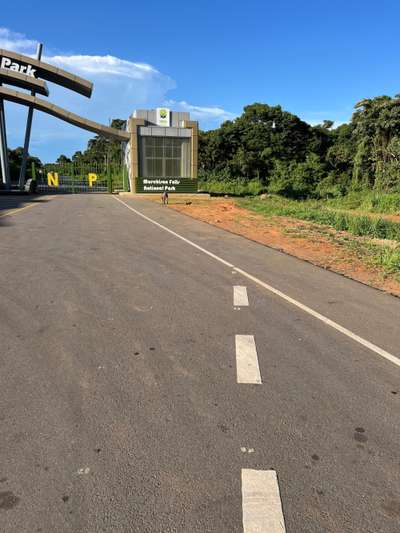
The freshly paved road leading to the entrance gate of Murchison Falls National Park was, in itself, a statement. During my visit in October 2024, I pulled over for a brief stop at the park’s entrance — a new building sitting at the end of a smooth asphalt road with crisp white markings stretching into the distance. The road was immaculate, the kind of surface you might associate with a newly built highway rather than an approach to a national park deep in rural Uganda. It was a concrete sign of a country investing in its infrastructure, and that investment extends well beyond tarmac. Uganda’s digital infrastructure — its mobile networks, internet backbone, and the connectivity that reaches safari lodges and tourist destinations — is undergoing a parallel transformation, one that directly affects every traveller who arrives expecting to share photographs, check email, or simply stay in touch with family back home.
I photographed that moment at GPS coordinates 1.4462°N, 32.0787°E, and the image captures more than road construction. It records a pattern visible across the country: modern infrastructure is reaching places that were, until very recently, effectively disconnected. Mobile phone towers now stand at intervals along the route to Murchison Falls. Data signals reach into corners of Queen Elizabeth National Park that had no coverage five years ago. Lodges that once had no means of offering guests a connection to the outside world now advertise Wi-Fi on their booking pages. The question for travellers is no longer whether Uganda has internet, but rather how reliable it is, where it works well, where it struggles, and what precautions are necessary to use it safely.
Across eight documented visits to Uganda between October 2024 and June 2026, I have tested mobile signals along highways, connected to lodge Wi-Fi networks from the shores of Lake Victoria to the slopes of the Virunga foothills, and experienced the full spectrum from fibre-speed connections in Kampala to complete silence inside Bwindi Impenetrable Forest. This article draws on those first-hand experiences — and on official data from Uganda’s Bureau of Statistics and regulatory bodies — to give an honest, ground-level picture of digital connectivity for tourists visiting Uganda.
Mobile Network Coverage Across Uganda’s Tourist Routes
Uganda’s telecommunications landscape is dominated by two operators: MTN Uganda and Airtel Uganda. Between them, they account for the vast majority of mobile subscriptions in a country of approximately 46 million people. For tourists, the practical question is not which network is technically superior in laboratory tests, but which one delivers a usable signal at the places you will actually visit — along the highway from Entebbe to Kampala, on the drive to Murchison Falls, at the trailhead in Buhoma before a gorilla trek, or at a lakeside lodge on the Ssese Islands.
From my own experience driving these routes repeatedly, MTN tends to hold a signal longer as you move into rural and semi-rural areas. On the road from Kampala toward Masindi and onward to the southern entrance of Murchison Falls National Park, MTN maintained a 4G or strong 3G signal through most of the journey, dropping to 2G only in a few stretches between Masindi and the park boundary. Airtel was comparable through the first half of the journey but faded earlier on the approach to the park. Inside the park itself, both networks become patchy — there are spots along the Nile where you can send a WhatsApp message, and long stretches where your phone shows no service at all.
The route from Kampala to Bwindi Impenetrable Forest, which passes through Mbarara and Kabale, is better served. The Kampala-Mbarara highway is one of Uganda’s busiest corridors, and both MTN and Airtel provide reliable 4G coverage along most of it. South of Kabale, as the road climbs into the hills toward Buhoma, Ruhija, Rushaga, or Nkuringo, signal quality degrades significantly. At the gorilla trekking trailheads, you may get one or two bars of 2G on a good day. Once inside the forest, there is no signal at all — the combination of dense canopy, steep terrain, and the sheer remoteness of the mountain gorilla habitat means you will be offline for the duration of your trek, which can last anywhere from two to eight hours.
Queen Elizabeth National Park, in the western Rift Valley, benefits from its proximity to the towns of Kasese and Katunguru. The Mweya Peninsula, where several prominent lodges are located, gets a workable signal from towers on the mainland. The Ishasha sector in the south, famous for its tree-climbing lions, is less well served — coverage is thinner and more intermittent. For visitors heading to the remote Kyambura Gorge or into the depths of the Maramagambo Central Forest Reserve, known for its python cave and large bat colonies, mobile connectivity should be treated as unavailable.
Uganda’s six wildlife zones — Sango Bay, Kafu, Muzizi, Aswa, Central, and Kyoga, as documented in the State of Wildlife Resources in Uganda 2026 report — offer a useful framework for understanding regional infrastructure differences. The Central zone, which includes Kampala and the areas surrounding Lake Victoria, has the most developed telecommunications infrastructure. The Aswa zone in the north, which includes parts of the corridor near Murchison Falls, is undergoing significant expansion but still has gaps. The Muzizi zone in the west, covering the area around Kibale National Park and its protected chimpanzee populations, has seen new tower installations in recent years, improving coverage for tourists visiting Kibale and Fort Portal. Mount Elgon Protected Area, in the east, remains one of the more challenging areas for connectivity, with the mountainous terrain creating persistent dead zones even relatively close to towers.
Wi-Fi at Safari Lodges: What to Realistically Expect
The presence of Wi-Fi on a lodge’s booking page does not tell you very much about the actual experience of using it. This is not a criticism of Ugandan lodges specifically — it is a reality of remote hospitality worldwide. But the gap between expectation and reality can be wide enough to cause genuine frustration for travellers who need to work remotely, upload high-resolution photographs, or make video calls during their trip.
In Kampala and Entebbe, hotels and guesthouses generally offer Wi-Fi that is fast enough for video streaming, video calls, and large file transfers. The Ugandan capital sits on the national fibre backbone, and the international submarine cable connections that land on the East African coast provide bandwidth that was unimaginable a decade ago. A mid-range hotel in Kampala will typically deliver download speeds of 5 to 20 Mbps, which is more than adequate for most purposes. Luxury properties in the city may exceed this.
Move outside the capital, and the picture changes substantially. Safari lodges in national parks source their internet through one of three methods: mobile data routers connected to the nearest cell tower, VSAT satellite connections, or, in rare cases, a dedicated fibre line run from a nearby town. Each method has distinct characteristics that affect the guest experience.
Mobile data routers are the most common solution at lodges within range of a cell tower. They are relatively inexpensive to operate and can deliver usable speeds when the tower is not congested. During my visits in January 2026, several lodges in the Queen Elizabeth National Park area were using this approach, and the connection was sufficient for email, messaging, and social media uploads of modest-sized images. Video calls were possible but unstable, with frequent dropouts during peak evening hours when multiple guests were competing for the same bandwidth.
VSAT satellite connections are the fallback for lodges that are too remote for cellular coverage. These systems provide a connection independent of terrestrial infrastructure, but they come with high latency — the round-trip time for data to travel to a geostationary satellite and back introduces a delay that makes video calls difficult and real-time gaming impossible. Speeds are typically low, often capped at 1 to 3 Mbps and shared among all guests. Lodges that use VSAT frequently impose fair-use policies or time limits on individual connections. For a traveller who needs to send a few emails and browse the news, VSAT is adequate. For anyone expecting to work remotely with large file transfers or video conferences, it is not.
A practical tip based on repeated experience: if connectivity is important to your trip, ask your lodge directly about their internet setup before booking. Ask specifically whether they use mobile data, satellite, or fibre, and whether the connection is available in rooms or only in common areas. Some of the finest lodges in Uganda — properties that excel in every other aspect of hospitality — have Wi-Fi that barely functions, simply because of their remote location. This is not a failure of the lodge; it is a consequence of geography. Knowing this in advance allows you to plan accordingly.
Buying a Local SIM Card: A Practical Guide for Visitors
One of the most valuable things a tourist can do upon arriving in Uganda is purchase a local SIM card. The cost is negligible by international standards, the process is straightforward, and the independence it provides from lodge Wi-Fi networks is significant. A local SIM card gives you your own mobile data connection, which works wherever there is cellular coverage — on the road, at trailheads, in towns between parks, and at lodges where the shared Wi-Fi is overwhelmed by other guests.
Both MTN and Airtel have official retail points at Entebbe International Airport, in the arrivals hall. Registration requires a valid passport, and staff will set up the SIM and an initial data bundle while you wait. The process takes approximately ten to fifteen minutes. If you miss the airport outlets or arrive at a time when they are closed, SIM cards are sold at thousands of small agent shops in every Ugandan town. Look for the yellow MTN branding or the red Airtel signage — they are impossible to miss.
Data bundles are priced in Ugandan shillings, and the value is remarkably good. A monthly bundle providing several gigabytes of data typically costs between 10,000 and 30,000 Ugandan shillings, which translates to roughly 3 to 8 US dollars. Daily and weekly bundles are also available for shorter stays. Top-up credit, known locally as airtime, can be purchased at roadside kiosks even in very small villages, and can also be loaded via mobile money — Uganda’s widely used digital payment system.
A practical consideration: Uganda’s mobile network uses standard GSM frequencies, and most modern unlocked smartphones from Europe, North America, and Asia will work without issue. If your phone is locked to a specific carrier, you will need to arrange unlocking before you travel. Phones purchased on contract from some US carriers may be locked by default. Check with your provider before departure.
I have carried an MTN SIM card on every visit since October 2024, and it has consistently been my most reliable connection — more dependable than lodge Wi-Fi in every location except central Kampala, where hotel broadband was naturally faster. The ability to pull up Google Maps on a long drive, send a WhatsApp message from a park boundary, or upload a photograph from a lakeside restaurant without depending on a shared network has made each trip substantially smoother. If you take one piece of digital advice from this article, let it be this: buy a local SIM card on arrival.
Digital Safety and Online Security for Travellers
Connecting to the internet while travelling in Uganda carries the same security considerations as connecting anywhere else in the world, with a few local specifics worth noting. The risks are not unique to Uganda, but the combination of unfamiliar networks, shared Wi-Fi in lodges, and the temptation to use whatever connection is available can lead travellers to take shortcuts they would avoid at home.
The single most effective precaution is to use a Virtual Private Network — a VPN — whenever connecting to any Wi-Fi network that you do not control. Lodge Wi-Fi networks, even those protected by a password, are shared among all guests and staff. A password on the network prevents outsiders from joining, but it does not encrypt traffic between individual users on the same network. A VPN creates an encrypted tunnel for all your internet traffic, rendering it unreadable to anyone who might be monitoring the local network. There are many reputable VPN services available, and most offer apps for both phones and laptops. Install and configure yours before you leave home.
Avoid accessing sensitive financial accounts — online banking, investment platforms, cryptocurrency wallets — over shared Wi-Fi networks, even with a VPN running. For these transactions, switch to your own mobile data connection via your local SIM card. The direct cellular connection between your phone and the mobile tower, while not impervious to sophisticated attacks, is substantially more secure than any shared Wi-Fi network.
Uganda has regulations governing data protection and electronic transactions, and the country’s National Environment (Waste Management) Regulations and related statutory instruments reflect a broader governmental push toward formalising regulatory frameworks across sectors, including digital governance. The Uganda Communications Commission oversees telecommunications regulation, and licensed operators are required to comply with data handling standards. For the average tourist, the practical implication is that the telecommunications infrastructure you are using is regulated and overseen, which provides a baseline level of institutional accountability.
A less obvious security consideration relates to physical device safety. Smartphones and laptops are valuable items in any country, and Uganda is no exception. Keep devices out of sight when not in use, use your lodge’s safe if one is available, and avoid displaying expensive electronics conspicuously in crowded public areas. This is standard travel advice worldwide, but it bears repeating: the device itself is a target, not just the data on it.
For travellers concerned about government surveillance or content restrictions, Uganda has at various times imposed temporary restrictions on social media platforms, particularly during election periods. These restrictions, when they occur, typically affect platforms like Facebook, Twitter, and WhatsApp. A VPN allows you to circumvent such blocks, though the legal status of doing so can be ambiguous. During my visits in 2024, 2025, and 2026, I encountered no social media restrictions, and all major platforms functioned normally on both mobile data and Wi-Fi connections.
The Future of Digital Connectivity in Uganda’s Tourism Sector
Uganda’s digital infrastructure is improving at a pace that is visible from one visit to the next. The new road and entrance gate at Murchison Falls that I photographed in October 2024 was part of a broader wave of infrastructure investment that includes telecommunications towers, fibre-optic cable extensions, and rural electrification projects that power those towers. The connection between road building, electricity supply, and digital connectivity is direct: a mobile tower needs power, and it needs a maintenance road for engineers to reach it. As Uganda extends its road network and electricity grid — a process documented in detail in other articles on this site — the mobile network follows.
Tourism itself is a driver of this expansion. The tourism sector generates employment, revenue, and investment across Uganda, and connectivity is increasingly understood as a component of the tourism product rather than a luxury extra. Travellers expect to be able to book their next lodge online, share photographs from a game drive, and communicate with tour operators via WhatsApp. Lodges that cannot offer any form of internet access face a competitive disadvantage, particularly among younger travellers and those combining safari trips with remote work — a category that has grown substantially since 2020.
The STEM initiatives operating in Kampala, focused on science, technology, engineering, and mathematics education for young Ugandans, point toward a future workforce that is digitally literate and equipped to build and maintain the infrastructure that tourism depends on. These programmes, which engage school students in innovative science and technology projects, are creating a pipeline of technical talent that will eventually serve sectors from agriculture to hospitality. Patrick Okello, the Commissioner for Refugees in Uganda, has highlighted the importance of digital access for displaced populations — a perspective that underscores how connectivity is viewed as essential infrastructure across Ugandan society, not merely a convenience for tourists.
Low Earth Orbit satellite internet services, which are beginning to operate in East Africa, represent a potential step change for remote lodges. Unlike traditional geostationary VSAT systems, these newer satellite constellations promise lower latency and higher bandwidth, which could make reliable video calling possible even from the deepest corners of Bwindi or the most remote stretches of the Kidepo Valley. The cost remains high, but early adoption by a handful of high-end lodges could set a new baseline expectation for digital connectivity at premium safari properties.
The agricultural sector provides an instructive parallel. The Uganda Agricultural Atlas Survey (AAS) conducted in 2021/22 and the Uganda Harmonized Integrated Survey documented the spread of mobile technology into rural agricultural communities across all of Uganda’s regions — from Serere and Nabuin in the east to Abi in the northwest. Farmers are using mobile phones for market information, mobile money transactions, and access to extension services. This same mobile infrastructure that serves agricultural communities serves the tourism corridors that pass through them. The backbone is shared: the tower that helps a coffee or cassava farmer in the Muzizi zone check market prices is the same tower that gives a tourist in Fort Portal a signal to call their lodge.
For the immediate future, the practical advice remains the same as it has been throughout my visits: carry a local SIM card, install a VPN, manage your expectations about speed and reliability outside Kampala, and treat the periods of disconnection — deep in the forest, high on the mountain, out on the savannah — not as inconveniences but as part of the experience. Some of my most memorable moments in Uganda have been the ones where the phone had no signal at all, and the only thing to look at was a silverback gorilla sitting six metres away, paying no attention whatsoever to the absence of Wi-Fi.
[QUOTE: local guide on first impressions of connectivity changes in rural Uganda]