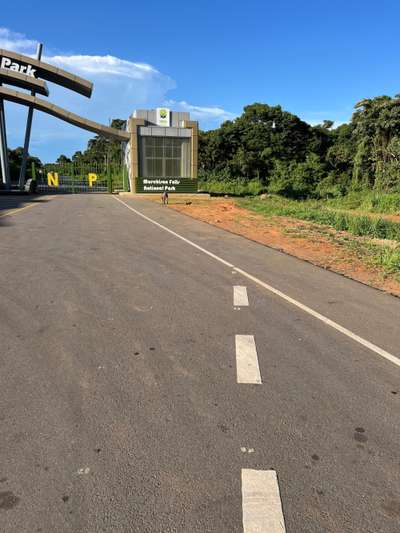
The road leading to the entrance gate of Murchison Falls National Park was not what I had expected. During my visit in October 2024, I made a brief stop at the park’s entrance and found myself standing on a stretch of asphalt that was unmistakably new — smooth, well-marked with white lines, and wide enough for two lanes of traffic in each direction. The entrance building itself was a recent construction, clean-lined and functional, sitting at the end of this freshly paved road that cut through green, open countryside under a clear sky. It was a small but telling detail: Uganda’s infrastructure, including its roads and its electricity networks, is being rebuilt and extended into regions that were, until recently, largely off the grid.
That moment at the Murchison Falls gate, documented in a GPS-tagged photograph at coordinates 1.4462°N, 32.0787°E, captured something broader than a new road. It spoke to the pattern of infrastructure investment that is gradually reshaping how tourism operates across Uganda. Roads, power lines, and solar installations are reaching deeper into the countryside, and the effect on safari lodges and tourist accommodation is direct and measurable. Electricity, in particular, is a subject that most travel guides treat as an afterthought — a brief note about bringing an adapter plug. But for the lodges themselves, and for the communities that host them, the question of where power comes from, how reliably it arrives, and what happens when it does not is central to everything from room pricing to guest satisfaction.
Across seven documented visits to Uganda between October 2024 and June 2026 — totalling eleven days on the ground in locations ranging from Kampala to Bwindi, from Murchison Falls to Lake Victoria — I have stayed at lodges where the lights never flickered, and at places where the generator coughed to life at sundown and went silent at ten. The variation is enormous, and it correlates directly with the electricity infrastructure serving each region. Understanding that infrastructure is, I would argue, as useful as knowing which lodges have hot water or which parks charge the highest permit fees. This article covers the electricity supply landscape across Uganda’s main tourist regions, the operators who provide it, and what it means in practical terms for anyone booking a safari lodge.
Uganda’s Electricity Grid and the Geography of Tourism
Uganda’s electricity supply system is shaped by a fundamental geographic tension: the country’s main generation capacity is concentrated at hydroelectric plants along the Nile, particularly at Bujagali, Isimba, and the large Karuma dam project, while the places that tourists most want to visit — national parks, forest reserves, and lakeside destinations — are scattered across remote regions where the transmission grid has historically not reached. Kampala and the central corridor between Jinja and Entebbe enjoy relatively consistent grid electricity. Move west toward Queen Elizabeth National Park and Bwindi, or north toward Murchison Falls, or out to the islands of Lake Victoria, and the picture changes fundamentally.
The Electricity Regulatory Authority (ERA) oversees the sector, with generation, transmission, and distribution handled by separate entities. Umeme Limited has been the largest distribution company for grid-connected areas, while off-grid regions are served by smaller operators under specific licences. For tourist accommodation, the practical question is straightforward: is the lodge connected to the national grid, or does it generate its own power? The answer determines not just whether the lights work but also whether the lodge can run refrigeration for food storage, power water pumps for hot showers, charge vehicles for game drives, and maintain communication equipment that guests and staff both depend on.
The expansion of the grid has been steady but uneven. Rural electrification programmes, funded by a combination of government budgets, World Bank loans, and bilateral aid, have brought transmission lines to many trading centres along major roads. But the last-mile problem — getting power from a trading centre to a lodge that sits inside or on the border of a national park — remains significant. A lodge may be only fifteen kilometres from a grid connection point, but running a line through forest or across difficult terrain can cost more than the lodge’s entire annual electricity budget. This is why so many properties, even relatively upmarket ones, have invested in their own generation capacity.
During my visits in January 2026, I observed this contrast repeatedly. Lodges along the main highway corridors — the Kampala-Masaka-Mbarara route, or the Kampala-Masindi route toward Murchison Falls — generally had grid connections. Properties deeper inside park boundaries or on secondary roads were running on solar, generators, or both. The quality of the guest experience at these off-grid lodges was not necessarily lower; in many cases, the opposite was true, because the isolation that makes grid connection difficult is the same isolation that makes the location attractive for wildlife viewing. But the electricity arrangements were different, and guests benefit from knowing what to expect.
WENRECO and West Nile: Powering the Northern Safari Corridor
The West Nile Rural Electrification Company Limited — WENRECO — is the leading off-grid electricity distributor in Uganda’s northwestern region. Operating under a licence from the Electricity Regulatory Authority, WENRECO serves towns and communities in the West Nile sub-region, an area that includes the districts of Arua, Nebbi, Pakwach, and surrounding areas. This region sits north of Lake Albert and the northern sector of Murchison Falls National Park, making WENRECO’s service area directly relevant to the tourist corridor that connects Kampala with the park’s Pakwach entrance and the Nile Delta area where some of Uganda’s best boat safaris operate.
The West Nile region has a complicated recent history that directly affects its infrastructure. For decades, it was among the most underserved parts of Uganda, with limited road access, minimal government investment, and a long period of insecurity that discouraged private enterprise. The arrival of large numbers of refugees from South Sudan and the Democratic Republic of Congo in recent years has brought international attention and humanitarian funding to the region, which has had indirect benefits for infrastructure including electricity. WENRECO’s distribution network, while not comparable in scale or reliability to the grid supply in Kampala, represents a step-change for communities that previously had no access to any formal electricity supply.
For tourists, the practical implications of WENRECO’s presence are modest but real. Guesthouses and small lodges in Pakwach, which serves as a staging point for visits to the northern bank of Murchison Falls, can now offer basic electrical services — lighting, phone charging, fans — that would not have been available a decade ago. The supply is not constant; outages occur, and voltage fluctuations are common. But the existence of any grid-like service in these towns has enabled a level of accommodation provision that supports tourism. Without WENRECO, the only option for guesthouse operators would be individual diesel generators, which are expensive to run and noisy — two qualities that directly conflict with the expectations of safari visitors.
The larger, more established safari lodges in the Murchison Falls area — those on the southern bank, near Paraa and along the river — do not typically depend on WENRECO. They are either connected to the national grid via the Masindi corridor or operate their own generation systems. But the budget and mid-range accommodation that has grown up on the northern side, catering to visitors who cross the Nile by ferry and explore the northern game tracks, benefits directly from WENRECO’s distribution. This segment of the market is growing as more travellers seek alternatives to the most heavily visited southern circuits, and reliable electricity is one of the enabling factors.
Kalangala and the Ssese Islands: Off-Grid Tourism on Lake Victoria
Kalangala is the largest settlement on Bugala Island, which is itself the largest of the Ssese Islands in Lake Victoria. The island is reached by ferry from Bukakata, south of Masaka, and has developed a small but distinct tourism economy built around lake beaches, forest walks, primate viewing, and the kind of unhurried atmosphere that attracts visitors seeking a deliberate contrast to the pace of Kampala or the intensity of a gorilla trekking itinerary. The electricity supply on Bugala Island is provided by Kalangala Infrastructure Services (KIS), a project that delivers power through a combination of solar generation and diesel backup.
The KIS project is notable because it represents one of Uganda’s more ambitious attempts to provide multi-service infrastructure to an island community. In addition to electricity, KIS was designed to provide water supply and transport infrastructure on Bugala Island. The electricity component uses solar panels supplemented by diesel generators, creating a hybrid system that can operate independently of the mainland grid. For the hotels, guesthouses, and restaurants in Kalangala town and along the island’s beaches, this means a level of power supply that is functional but not equivalent to what grid-connected establishments enjoy.
The tourism implications are significant. Kalangala’s accommodation ranges from basic guesthouses charging under twenty dollars per night to mid-range lakeside lodges with their own solar arrays and backup generators. The KIS supply provides a baseline — enough for lighting, basic appliances, and phone charging — but properties that want to offer air conditioning, consistent hot water from electric heaters, or reliable Wi-Fi typically need their own supplementary generation. This creates a visible quality gradient on the island: the difference between a guesthouse that relies solely on KIS and a lodge that has invested in its own solar-battery system is immediately apparent to guests, particularly after dark.
Visitors to Kalangala should expect power interruptions and plan accordingly. The island’s charm lies partly in its remoteness — it takes roughly four hours to reach from Kampala, including the ferry crossing — and that remoteness is inseparable from the infrastructure limitations. Bicycle hire is available in Kalangala town, and exploring the island by bicycle is one of the more enjoyable ways to spend a day there. None of that requires electricity. But charging camera batteries, running a laptop, or expecting a hot shower at a predictable time does require it, and managing those expectations is part of planning a trip to the Ssese Islands realistically.
How Safari Lodges Generate and Manage Their Own Power
The electricity arrangements at Uganda’s safari lodges fall into four broad categories, and understanding them helps explain both the pricing and the guest experience at different properties. The first category is grid-connected lodges, found primarily along major road corridors and near larger towns. These properties receive power from the national grid, typically through a local distribution transformer, and supplement it with a diesel generator that kicks in automatically during outages. The grid supply costs less per kilowatt-hour than self-generation, so these lodges have a structural cost advantage that is reflected in their room rates or, alternatively, in the amenities they can afford to offer.
The second category is diesel-only lodges, which are increasingly rare at the mid-range and above but still found at some older properties and budget guesthouses in remote areas. Diesel generation is expensive: the fuel must be transported to locations that are, by definition, hard to reach, and the generators require regular maintenance. The noise is also a factor. A generator running fifty metres from a guest room is audible, and in environments where the primary attraction is natural silence — the calls of forest birds, the distant rumble of a waterfall, the sounds of elephants moving through bush — engine noise is a direct quality detractor. Many lodges that once relied solely on diesel have transitioned to hybrid or solar systems precisely for this reason.
The third category is solar-powered lodges, which have become the standard for new construction in Uganda’s national parks and forest reserves. A well-designed solar installation with lithium battery storage can provide 24-hour electricity to a lodge of ten to twenty rooms, powering LED lighting, water pumps, refrigeration, and device charging without any generator noise. The capital cost is significant — a system large enough for a mid-sized lodge can cost tens of thousands of dollars — but the operating cost is minimal once installed. Solar has the additional advantage of aligning with the sustainability narrative that many tourists, particularly those from European and North American markets, find important. Several lodges in Bwindi and Queen Elizabeth now advertise their solar-powered status as a selling point.
The fourth category is hybrid systems, which combine solar panels with battery storage and a diesel generator for backup. This is arguably the most common arrangement at quality lodges in remote locations. The solar system handles the base load during daylight and into the evening, the batteries carry the property through the night, and the generator runs only when battery levels fall below a threshold — typically during extended periods of cloud cover or when occupancy is unusually high. From a guest perspective, the hybrid approach offers near-continuous power with minimal noise. From an operator perspective, it balances capital investment against fuel costs and provides a safety net that pure solar cannot always guarantee, particularly during the heavy rain seasons when cloud cover can persist for days.
What this means for travellers is that the question of electricity at a Ugandan lodge is not a binary yes-or-no matter. It is a question of degree, timing, and source. At a luxury lodge in Queen Elizabeth National Park, you may never think about electricity at all; it will simply work, quietly, around the clock. At a community-run guesthouse near Bwindi, you might find that power is available from 6pm to 10pm, provided by a generator that the community operates on a shared schedule. Both experiences are valid, and both are part of the spectrum of accommodation that Uganda offers. The key is knowing which end of the spectrum a particular property occupies before you arrive, so that your expectations match the reality.
Practical Advice for Travellers: Electricity, Charging, and Preparedness
The single most useful piece of equipment related to electricity that a traveller can carry to Uganda is a portable power bank. A unit rated at 20,000 milliamp-hours weighs roughly 350 grams, fits in a daypack, and will fully charge a modern smartphone three to four times. For a three-day gorilla trekking itinerary based at a lodge in Bwindi or Mgahinga — where mornings start before dawn and the trek itself consumes most of the day — having a power bank means not having to worry about whether the lodge has charging available at the specific time you need it. It removes a variable from the equation, and on a trip where the permit alone costs several hundred dollars, removing unnecessary variables is worth the modest investment.
Uganda uses the British three-pin plug, designated Type G, at a voltage of 240 volts and a frequency of 50 hertz. Travellers from continental Europe, North America, Australia, and most of Asia will need an adapter. Universal travel adapters that cover multiple plug types are widely available and inexpensive. It is worth bringing two: one for the power bank and one for a second device, since lodge rooms at budget and mid-range properties sometimes have only a single outlet. Some lodges provide adapters at reception, but availability is not guaranteed, and relying on this is not recommended.
For photographers, the electricity question intersects directly with equipment planning. Mirrorless cameras and DSLRs consume battery power at different rates depending on usage — continuous autofocus during a game drive, video recording, and image review on the rear screen all draw heavily on a single charge. Carrying at least two camera batteries per body is standard practice for any safari, but in Uganda specifically, where some lodges offer charging only during certain hours, a third battery provides a margin of comfort. Battery chargers that accept USB input are available for most camera systems and can be powered from a power bank, which creates a charging chain that does not depend on wall power at all.
Solar charging panels marketed to hikers and travellers are a tempting option but perform inconsistently in Uganda’s forest environments. In open savannah — Murchison Falls, parts of Queen Elizabeth, Kidepo Valley — a foldable solar panel can produce meaningful charge during a midday rest stop. Under the canopy in Bwindi or Kibale, where tree cover is dense and cloud cover is frequent during the wet seasons, the same panel may produce very little. The October visit during which I photographed the Murchison Falls entrance was characterised by clear skies and strong sunlight, conditions under which portable solar works well. The January trips to Bwindi were frequently overcast, and any solar panel left out on a lodge veranda would have struggled.
Voltage fluctuations are worth noting. Even at grid-connected lodges, the supply voltage can vary enough to pose a risk to sensitive electronics. A laptop power supply or camera charger with built-in voltage regulation — which most modern devices have — handles this without issue. Older or cheaper chargers without proper regulation may overheat or fail. Surge protectors are not commonly provided by lodges, so travellers carrying expensive equipment may want to bring a compact surge protector strip, which doubles as a multi-outlet adapter and costs very little.
Finally, it is worth noting that electricity availability affects lodge operations in ways that are invisible to guests but shape the overall experience. Refrigeration determines what food can be served and how fresh it is. Water pumps determine whether hot water is available on demand or must be heated in advance. Communication equipment — radios, satellite internet terminals, mobile signal boosters — all depend on continuous power. A lodge that has invested in reliable electricity infrastructure is, in most cases, a lodge that can offer a higher standard of service across every dimension, not just the ability to charge a phone. When evaluating lodges, asking about the power source is a surprisingly effective proxy for overall operational quality.