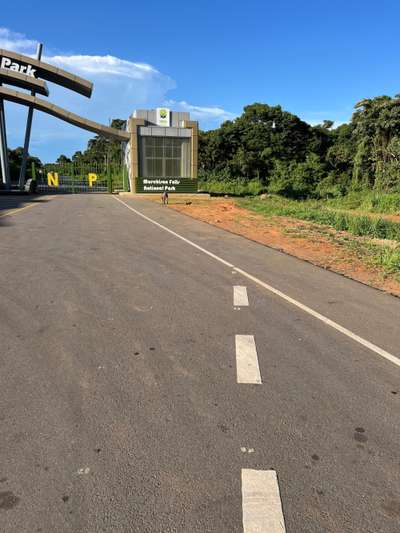
The gate appeared ahead — a clean, modern structure flanked by a visitor centre that looked as though it had been finished weeks rather than years ago. During my visit in October 2024, I made a brief stop at the entrance to Murchison Falls National Park and found myself standing on a stretch of asphalt that would not have been out of place on a European regional highway. The road was freshly laid, the white lane markings crisp, the surface smooth and unblemished. It was a far cry from the potholed laterite tracks that had once defined access to Uganda's largest national park. That single image — GPS-tagged at 1.4462 degrees north, 32.0787 degrees east — captures something broader: Uganda is investing in tourism infrastructure at a pace and standard that many visitors do not expect.
That scene at Murchison Falls illustrates a pattern I have observed across eleven documented visits to Uganda between October 2024 and June 2026, totalling twenty-two days on the ground in various parts of the country. Roads are being rebuilt, park entrances modernised, and accommodation standards formalised through a national grading system. Yet this progress is unevenly distributed. The western safari circuit — Bwindi, Queen Elizabeth, Murchison Falls — receives the lion's share of investment because that is where the international tourists go. Eastern Uganda, and border towns like Busia in particular, tells a different story: one of unrealised potential, transit-focused economies, and infrastructure that serves commerce far more than it serves tourism.
This article examines the state of tourism infrastructure in and around Busia — Uganda's second-busiest land border crossing — and places it in the context of nationwide developments in road construction, hotel standards, and service quality. The information draws on official data from the Uganda Tourism Board and the Statistical Abstract 2025, combined with my own observations from repeated visits across the country.
Busia: Uganda's Second-Busiest Land Border and Its Tourism Implications
Busia sits at the southwestern tip of Kenya's Western Province, directly facing its Ugandan namesake across a border that functions less as a barrier and more as a membrane. Traders, truckers, and travellers cross daily in both directions. In 2014, the border post processed 192,042 tourist arrivals by road — 15.17 percent of all road-based entries into Uganda that year. This made Busia the second most important land crossing point in the country, behind only Malaba, which lies roughly 50 kilometres to the north along the same international highway.
The significance of these numbers is easy to overlook. Nearly one in six overland visitors to Uganda passed through Busia. Yet the town itself has not developed the kind of tourism infrastructure that such volumes might justify. The reasons are structural. Most travellers arriving at Busia are in transit — heading to Jinja, Kampala, or the western parks. They do not stop overnight. They do not eat at restaurants that market themselves to tourists. They do not browse craft markets or book guided walks. Busia functions as a gateway, not a destination, and its infrastructure reflects that reality.
The border town is connected to Tororo district to the east, a region that has begun to appear on the tourism map. Tororo hosted Uganda's World Wildlife Day celebrations in 2023, which brought national attention and official visitors to the area. The event signalled that the government recognises eastern Uganda's potential, even if private investment in tourism facilities has not yet followed in meaningful volume. For travellers arriving from Kenya — perhaps after climbing Mount Elgon or visiting Kakamega Forest — the Busia crossing offers the most direct route into Uganda's eastern corridor. The question is whether the infrastructure along that corridor can convert transit visitors into staying guests.
The physical border facility itself has seen incremental improvements over the years, consistent with East African Community efforts to streamline cross-border movement. One-stop border post initiatives have reduced processing times at several Uganda-Kenya crossings. However, the traveller experience at Busia remains shaped by congestion from commercial truck traffic, the presence of informal traders, and facilities that are functional rather than welcoming. There is no dedicated tourist information desk, no onward booking service for safari operators, and no conspicuous signage directing visitors toward accommodation or attractions in the surrounding area. Compared to Entebbe International Airport, where the Uganda Tourism Board maintains a visible presence and visitor orientation materials are readily available, Busia's border post offers little guidance to arriving tourists.
Road Infrastructure: What Uganda's Investment Programme Means for Eastern Regions
Uganda's road network has undergone substantial transformation in recent years, driven by government investment and international development funding. The improvements are most visible around national parks and along the primary highways connecting Kampala to major tourist destinations. The scene I witnessed at Murchison Falls in October 2024 — that immaculate entrance road — is not an isolated case. Similar upgrades have been carried out or are underway at park access points across the country.
The Uganda National Roads Authority (UNRA) has been the primary implementing body for these projects. Along major routes, UNRA has developed designated viewpoints and rest stops, following a model first implemented on the Kisoro-Kabale and Budibugyo-Fort Portal corridors. These are the roads that carry the highest volumes of safari traffic — connecting Kampala to Bwindi Impenetrable National Park and Queen Elizabeth National Park respectively. The viewpoints, while a step forward, remain basic. As noted in the 2019 Ankole Region Tourism Report, most sites lacked viewing platforms in adequate condition, and amenities such as restaurants, cafes, standard toilets, and rest facilities were either absent or in poor repair. The report recommended that UNRA engage with UTB to develop these stops more systematically, but progress has been incremental.
For the eastern region, road conditions are a mixed picture. The main highway from Jinja through Iganga to Busia is a tarmac road that carries heavy commercial traffic — fuel tankers, container trucks, and buses serving the Kenya-Uganda trade route. This road is functional but not designed with tourism in mind. There are no scenic rest stops, no interpretation panels explaining the landscape, and limited options for food or refreshment outside of the towns along the way. The stretch from Busia to Tororo is similarly utilitarian.
What distinguishes Uganda's current infrastructure push from previous efforts is the quality of construction. During my twelve-day visit in October 2024, I observed new road surfaces in multiple locations that were genuinely well built — proper drainage, clearly painted lane markings, and smooth asphalt that suggested adherence to international construction standards rather than the quick-deteriorating surfaces that had characterised earlier road projects. Whether this standard of construction will be maintained through regular upkeep is an open question. Uganda's climate, with its heavy rains and intense sun, is demanding on road surfaces, and maintenance budgets have historically lagged behind construction budgets.
For travellers planning to enter Uganda through Busia, the practical reality is this: the road from the border to Jinja (approximately 140 kilometres) is paved and passable year-round. Traffic congestion in towns like Iganga can slow progress, particularly on market days. From Jinja onward, travellers heading to Kampala face the notorious Jinja-Kampala highway traffic, while those heading north toward Mount Elgon or Sipi Falls will find reasonable tarmac for most of the route. The infrastructure exists to move people through the eastern corridor efficiently, but it does not yet encourage them to linger.
Hotel Standards, Grading, and the Accommodation Gap in Eastern Uganda
Uganda's accommodation sector is governed by a grading and classification system administered by the Uganda Tourism Board in collaboration with multiple government agencies. The partnership includes the Ministry of Tourism, the Ministry of Local Government, Tourism Police, East African Community certified hotel assessors, and the Directorate of Industrial Training. By the end of 2025, according to the Statistical Abstract 2025, a total of 117 accommodation facilities had been graded and classified nationwide. Of these, 77 are town hotels, 23 are safari lodges, and the remainder includes tented camps, apartments, and motels.
These numbers reveal two important realities. First, the grading system is voluntary — facilities are assessed upon request, not by mandate. This means that the 117 graded properties represent only a fraction of the total accommodation stock in Uganda. In fiscal year 2022/23, the UTB registered 59 new accommodation facilities and inspected 43, but none were graded that year. The gap between registration and grading suggests that many operators either do not see sufficient commercial benefit in obtaining a formal grade or cannot meet the standards required. Second, the geographic distribution is heavily skewed. Sixty-five percent of all graded infrastructure — 76 facilities — is clustered in the central region, which encompasses Kampala, Wakiso, and Entebbe. This leaves the remaining 35 percent distributed across the entire rest of the country, including the eastern region where Busia is located.
For travellers arriving in Busia, the accommodation landscape is shaped by the town's identity as a border and trading centre rather than a tourist hub. Hotels in Busia cater primarily to cross-border traders, long-haul truck drivers, and government officials on administrative business. Room standards vary widely. Some properties offer clean, functional rooms with running water and electricity. Others are basic in ways that would surprise a visitor expecting anything resembling international hotel norms. Air conditioning is rare. Wi-Fi, where advertised, may be intermittent. Hot water is not guaranteed.
This is not a criticism of Busia's hospitality sector — it is a reflection of the market it serves. When your primary guests are Kenyan businesspeople making a day trip and Ugandan traders who need a bed for the night, the incentive to invest in the kind of amenities that attract leisure tourists is limited. The occupancy rates in Uganda's eastern hotels are moderate at best, and the seasonal patterns that drive investment in the western safari circuit — high season from June to September and December to February — do not apply in the same way to a border town whose traffic is driven by trade cycles rather than wildlife viewing seasons.
The UTB's grading efforts, while commendable in intent, have not yet reached deeply into regions like Busia. The focus has understandably been on properties that serve international tourists — the safari lodges of Bwindi, the lakeside resorts of Lake Bunyonyi, the hotels along the Murchison Falls corridor. For eastern Uganda to develop a viable accommodation sector for tourists, a different approach may be needed: one that recognises the region's potential for agro-tourism, cultural tourism, and cross-border itineraries rather than attempting to replicate the safari lodge model that works in the west.
During my visits across Uganda between October 2024 and June 2026, I have seen the accommodation spectrum from end to end — from basic guesthouses where the shower is a bucket and a jug, to professionally managed safari lodges with linen tablecloths and trained sommelier staff. The difference is not merely one of budget. It reflects fundamentally different stages of tourism development, and Busia sits firmly at the earlier stage: functional, honest, and without pretension, but not yet oriented toward the expectations of international leisure travellers.
Tourism Infrastructure Development: What Exists, What Is Missing, and What Could Change
Tourism infrastructure encompasses more than roads and hotels. It includes the walking trails within national parks, the toilet facilities at visitor centres, the camping grounds, the signage that directs travellers to attractions, the interpretation materials that explain what they are seeing, and the communication networks that allow them to stay connected. Uganda has made progress on all of these fronts, but the progress is concentrated in the areas that already attract visitors.
The national parks have received the most attention. Trail maintenance in Bwindi and Kibale has improved. Visitor centres have been constructed or upgraded at several park entrances. The Murchison Falls entrance gate I photographed in October 2024 is one example, but similar projects have been completed at other parks. These investments are funded through a combination of park entry fees (which are substantial — gorilla trekking permits alone cost $800 per person), government allocations, and international development partnerships.
Outside the national parks, the picture is less consistent. The Uganda Tourism Board's 2022/23 annual report documented 818 registered tourism businesses across the country — tour operators, guides, and accommodation facilities combined. Of these, only 293 were licensed, and grading stood at zero for that fiscal year. The gap between the number of registered businesses and the number that meet formal licensing and grading standards points to a sector that is growing faster than the regulatory framework can absorb. This is not unusual for a developing tourism economy, but it has direct consequences for service quality — particularly in secondary destinations like Busia where oversight is thinner and market pressure to meet international standards is weaker.
The equator tourism development initiative offers an interesting parallel. Uganda's equator line passes through several districts, and the UTB has identified equator monument development as a priority for experiential tourism. A 2019 assessment of potential equator sites in the Ankole region found a "total lack of standard tourist accommodation" at several locations, with "no facilities to cater for transit tourists or overnight visitors." The assessment recommended the development of medium-sized eco-lodges to serve both leisure visitors and the MICE (meetings, incentives, conferences, exhibitions) market. This same prescription could apply to Busia and the eastern corridor: the need is not for luxury resorts but for competent, clean, well-managed mid-range properties that give travellers a reason to stop rather than pass through.
One area where eastern Uganda could differentiate itself is agro-tourism. The region's agricultural landscape — rice paddies near Butaleja, sugarcane plantations around Kakira, fish landing sites on Lake Victoria near Busia — offers experiential tourism opportunities that the western safari circuit cannot replicate. The equator assessment explicitly recommended agro-tourism partnerships with dairy farms and plantations as a way to diversify the tourism product. Applied to the eastern corridor, this approach could create itineraries that combine a Kenya border crossing at Busia with agricultural experiences, Lake Victoria shoreline visits, and onward travel to Mount Elgon or the Sipi Falls. The infrastructure needed for such itineraries is modest — decent roads (which largely exist), reliable accommodation (which needs improvement), and organised activity providers (which are currently absent).
[QUOTE: local guide on first impressions of Busia for visiting travellers]The Radisson Hotel Group's engagement with the Uganda tourism market, documented at the Africa Hotel Investment Forum (AHIF) in 2023, suggests that international hotel chains are watching Uganda's growth trajectory. Their interest has so far focused on Kampala and Entebbe, where business travel and conference tourism generate reliable occupancy rates. For a brand like Radisson or its competitors to consider a property in a secondary town like Busia, the fundamentals would need to change: higher and more predictable visitor numbers, improved transport links, and a clear demand signal from the MICE or cross-border business segment. That signal does not yet exist, but the growth of East African Community economic integration could create it over time.
Practical Information for Travellers Passing Through Busia
For travellers entering Uganda through Busia, preparation is more important than in Kampala or Entebbe, where the tourism infrastructure anticipates your needs. At Busia, you are entering a working border town, and you should plan accordingly.
Currency exchange is available at the border, but rates from informal money changers should be compared carefully. Banks in Busia town proper offer more reliable rates. Ugandan shillings are the only practical currency once you leave the border zone — do not assume that Kenyan shillings will be accepted further inland.
If you need to stay overnight in Busia, ask locally for the most recently refurbished hotel rather than relying on online reviews, which are sparse and often outdated for properties in this area. Hotel standards change quickly in Uganda — a property that was run-down two years ago may have been renovated, and vice versa. Budget between $20 and $50 per night for a functional double room with en-suite bathroom.
Onward transport from Busia is straightforward. Matatus (shared minibus taxis) run frequently to Jinja and Kampala. For those heading north to Tororo, Mbale, or Mount Elgon, direct connections are available from Busia's central taxi park. If you have pre-arranged a safari with an operator, confirm whether your pickup point is at the border itself or in Busia town, as the two are close but not identical, and misunderstandings about collection points are a common source of frustration.
Mobile phone coverage in Busia is reliable on both MTN and Airtel networks. Purchasing a Ugandan SIM card at the border is possible and advisable if you plan to spend more than a few days in the country. Data costs are low by international standards, and having a local number simplifies communication with safari operators, lodge managers, and drivers.
Health facilities in Busia are limited to a district hospital and several small clinics. For anything beyond basic treatment, you would need to reach Jinja or Mbale, both of which have better-equipped hospitals. Carry a basic travel medical kit and ensure your travel insurance covers medical evacuation — this is standard advice for all of Uganda, not specific to Busia.