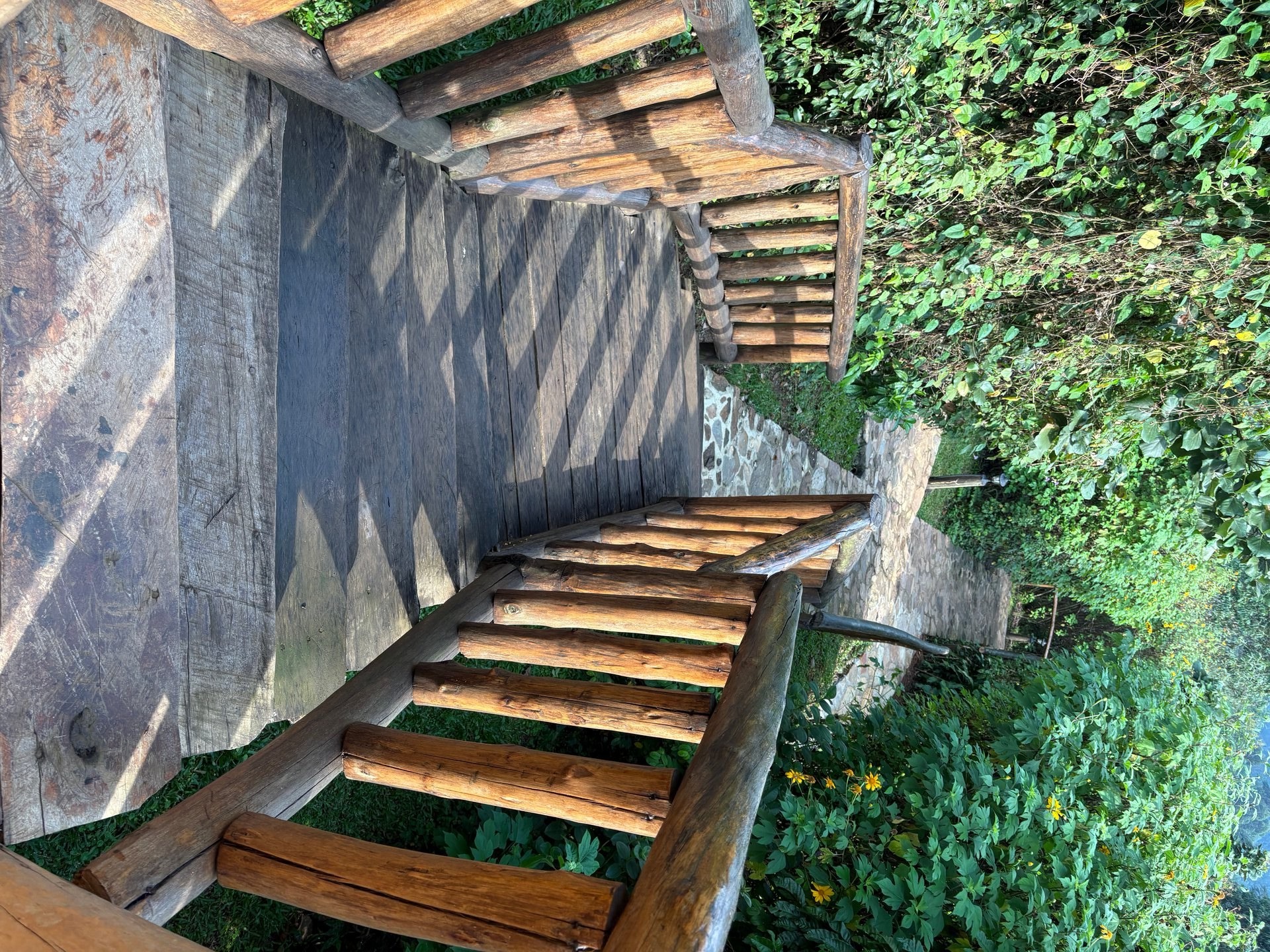
The wooden steps were rougher than they looked. During my visit in January 2026, I stood at the bottom of a hand-built timber staircase at Gorilla Bluff Lodge in Buhoma, looking up toward the main house. Each step had been cut from a solid log and set into the steep hillside at an angle that required both legs and concentration. The lodge sits on a mountainside above Bwindi Impenetrable Forest, and every piece of its infrastructure -- from the stairs to the water pipes to the guest rooms themselves -- had to be engineered around terrain that does not cooperate. It was a physical reminder that building hospitality facilities in western Uganda is not simply a matter of obtaining a business licence and hanging a sign.
That particular staircase, which I photographed at GPS coordinates -0.9794 degrees north, 29.6168 degrees east, captures something that statistics alone cannot convey. When Uganda's district planning documents report that Kyenjojo District had exactly one formally registered hospitality facility as of 2023, the number sounds impossibly low. But once you have walked the terrain, seen the logistics of construction in these hills, and spoken with the people who run small lodges and guest houses across the region, the figure begins to make sense. Registration is not merely paperwork. It represents a threshold of formality that most small accommodation providers in rural Uganda have not yet crossed.
I have visited western Uganda eleven times over the past two years, spending a combined twenty-two days on the ground across the region. These visits have taken me through Kyenjojo District repeatedly -- it sits on the main highway between Kampala and Fort Portal, making it impossible to bypass when travelling to Kibale National Park, the Rwenzori Mountains, or Bwindi. Over these journeys, I have watched the district's hospitality landscape evolve firsthand, from roadside rest stops to emerging guest houses that serve both domestic travellers and the occasional international tourist.
The Baseline: One Registered Facility in an Entire District
According to the Kyenjojo District Development Plan IV, which covers the fiscal years 2025/26 through 2029/30, the district recorded just one formally registered hospitality facility at its 2023 baseline. This figure comes from the district's own planning documents, sourced from local government records and cross-referenced with Uganda Tourism Board data. The plan sets phased targets: two registered facilities by 2025 and three by 2027, with continued growth anticipated through the end of the planning period in 2030.
To understand what "one registered facility" means in context, it helps to know what Kyenjojo District actually looks like on the ground. The district covers an area of roughly 4,200 square kilometres in the Tooro sub-region of western Uganda. Its population, estimated at over 500,000, is predominantly rural and agricultural. The district town of Kyenjojo sits along the Kampala-Fort Portal highway, approximately 260 kilometres from the capital. Tea plantations, subsistence farming, and small-scale trading dominate the local economy.
The hospitality sector in Kyenjojo exists in a form that official registration numbers do not capture. During my twelve-day visit in October 2024 and subsequent trips through the district in January and May 2026, I observed numerous small guest houses, roadside lodges, and informal accommodation options that cater primarily to Ugandan domestic travellers. These establishments provide basic rooms, sometimes with attached bathrooms, at prices that typically range from 20,000 to 50,000 Ugandan shillings per night -- roughly five to thirteen US dollars. They serve truck drivers on the Fort Portal route, traders visiting the weekly markets, and government workers posted to rural sub-counties.
What these establishments lack, in most cases, is formal registration with the relevant government bodies. The process of registering a hospitality facility in Uganda involves multiple steps: business registration with the Uganda Registration Services Bureau, a trade licence from the local authority, compliance with health and safety standards verified through inspection, and tourism licensing through the Uganda Tourism Board. For a small guest house owner in a rural district, this process carries both direct costs -- fees, compliance upgrades, documentation -- and indirect costs in time and administrative effort. The perceived benefits of registration, particularly for establishments whose clientele consists almost entirely of domestic walk-in guests, often do not justify the investment.
This pattern is not unique to Kyenjojo. Across rural Uganda, the gap between informal hospitality operations and formally registered facilities is wide. Districts such as Alebtong, Kapelebyong, and Busia face similar dynamics, where the number of registered facilities vastly underrepresents the actual accommodation available on the ground. The difference in Kyenjojo is that the district sits along a major transit corridor and within reach of several significant tourist destinations, creating both the need and the opportunity for formalisation.
Why Registration Matters: Infrastructure, Standards, and Traveller Safety
The formal registration of hospitality facilities is not a bureaucratic abstraction. It serves as a proxy for a broader set of conditions that directly affect anyone staying overnight in a district. Registered facilities have, at minimum, passed a baseline inspection that covers structural safety, basic sanitation, and operational legitimacy. For travellers, this means a degree of accountability: a registered property exists within a system where complaints can be filed, standards can be enforced, and licences can be revoked.
In Kyenjojo District, the move from one to three registered facilities over a four-year period represents a deliberate effort by the district local government to bring its hospitality sector into the formal economy. The District Development Plan IV frames this within a broader strategy of infrastructure development that spans education, health, agriculture, and transport. The plan explicitly acknowledges that Kyenjojo's progress during the previous planning period (DDP III, 2020/21 to 2024/25) was constrained by resource limitations and climate-related shocks, but that notable gains were made across several sectors.
During the DDP III period, Kyenjojo District expanded access to primary and secondary education through classroom construction and rehabilitation, improved health service delivery by upgrading selected facilities, and strengthened road infrastructure. These investments, while not directly targeting tourism, create the enabling environment without which hospitality development cannot proceed. A guest house cannot operate reliably if the road leading to it becomes impassable during the rainy season. A lodge cannot attract international visitors if the nearest health facility is hours away by unpaved track.
I witnessed this interdependence firsthand during my January 2026 visit. The photograph I took at Gorilla Bluff Lodge -- which lies in the broader Bwindi region south of Kyenjojo -- illustrates how hospitality infrastructure in western Uganda is inseparable from the physical landscape. The lodge's timber staircase, built from locally sourced hardwood and set into a steep, forested hillside, is not merely decorative. It is a solution to a genuine engineering problem: how do you provide comfortable accommodation on terrain where flat ground is scarce and heavy machinery cannot reach the building site? Similar challenges face any accommodation provider operating in Kyenjojo's more remote sub-counties, where elevation changes and seasonal flooding complicate even basic construction.
The annualised budget allocations in the DDP IV reflect the district's investment priorities. Health infrastructure alone is budgeted at 3,000 million Ugandan shillings per year across the five-year planning period, totalling 15,000 million shillings. Education infrastructure follows a similar pattern, with phased construction of classroom blocks, sanitation facilities, and furniture procurement. Veterinary services and livestock health management receive 700 million shillings annually. These are not tourism budgets, but they are tourism prerequisites. A district that cannot provide basic health services, clean water, and passable roads will not sustain a growing hospitality sector, regardless of how many facilities it registers.
The Bigger Picture: Kyenjojo's Position in Uganda's Tourism Corridor
Kyenjojo District occupies a strategic position in western Uganda's tourism geography. It sits between Kampala and Fort Portal, the gateway city for three major national parks: Kibale National Park (known for chimpanzee tracking), Queen Elizabeth National Park (famous for its tree-climbing lions and Kazinga Channel boat safaris), and the Rwenzori Mountains National Park (a UNESCO World Heritage Site). Every overland traveller heading to these destinations passes through or near Kyenjojo District.
This transit position creates a natural demand for hospitality services. During my multiple drives through the district, I observed a clear pattern: travellers stop in Kyenjojo town or its outskirts for meals, fuel, and occasionally overnight stays, particularly those arriving from Kampala in the late afternoon who prefer not to drive the remaining stretch to Fort Portal after dark. The Fort Portal-Kampala highway, while generally in reasonable condition, passes through areas where nighttime driving is complicated by heavy truck traffic, pedestrians, and limited road lighting.
Yet despite this natural advantage, Kyenjojo has not historically developed as a tourism destination in its own right. The district lacks the marquee wildlife attractions that drive international tourism to neighbouring areas. There are no national parks within its boundaries, no gorilla families habituated for tracking, and no signature safari experiences that would justify a multi-day stay. Its tourism potential lies instead in its agricultural landscapes, its cultural heritage as part of the Tooro Kingdom, and its role as a convenient stopover point on the western Uganda circuit.
The registration targets in the DDP IV should be understood in this context. The goal is not to transform Kyenjojo into a safari destination overnight, but to formalise the hospitality services that already exist and to create a foundation for gradual growth. Three registered facilities by 2027 is a modest target, but it represents a tripling of the formal sector from its 2023 baseline. If those three facilities achieve and maintain registration, they serve as demonstration cases for other accommodation providers in the district, showing that formalisation is achievable and beneficial.
[QUOTE: local guide on the hospitality outlook in Kyenjojo District]
The comparison with other districts is instructive. Kampala, with its concentration of international hotels and well-established registration systems, operates in an entirely different context. But even mid-sized districts in western Uganda, such as those surrounding Fort Portal and Kasese, have registration numbers that significantly exceed Kyenjojo's. The gap reflects differences in tourism demand, institutional capacity, and the presence (or absence) of a critical mass of hospitality businesses that normalises the registration process.
Practical Implications for Travellers Passing Through Kyenjojo
For anyone planning a trip through western Uganda, the low registration numbers in Kyenjojo have practical consequences. First, it means that pre-booking accommodation in the district through international platforms is largely impractical. The registered facilities may appear on booking platforms, but the majority of available accommodation is found through local inquiry, roadside signage, or recommendations from other travellers. This is typical of rural Ugandan districts but can be disorienting for international visitors accustomed to researching and reserving hotels online.
Second, the absence of a formal grading system for most Kyenjojo properties means that room quality varies significantly. During my October 2024 visit, I encountered guest houses along the main highway that ranged from clean, adequately furnished rooms with reliable hot water to basic concrete structures with minimal amenities. The price difference between these extremes was often marginal, which means that visual inspection before committing to a room is advisable whenever possible.
Third, travellers should consider Kyenjojo's position within their broader itinerary. If you are driving from Kampala to Fort Portal, Kibale, or onward to Queen Elizabeth National Park, Kyenjojo is best treated as a lunch stop or brief rest point rather than an overnight destination, unless you specifically wish to explore the district's tea landscapes or Tooro cultural sites. The accommodation options improve substantially once you reach Fort Portal, which has a much more developed hospitality sector with multiple registered and graded properties.
That said, the district's evolving hospitality landscape deserves attention. The targets set in the DDP IV suggest that by 2027 and beyond, travellers will have more formally vetted options available. The district government's parallel investments in road infrastructure, health facilities, and education also signal a trajectory of general improvement that will benefit visitors as well as residents. When I visited in January 2026, road conditions on the main highway through Kyenjojo were noticeably better than during my earlier October 2024 trip, consistent with the district's stated commitment to road maintenance and upgrade.
For those interested in off-the-beaten-path experiences, Kyenjojo offers something that more tourist-saturated districts do not: authenticity. The guest houses here are not designed for the international market. They are Ugandan establishments serving Ugandan travellers, and staying in one provides a window into domestic travel culture that is increasingly difficult to find in places like Buhoma, Jinja, or Entebbe, where the hospitality sector has been shaped by international expectations and pricing.
Looking Ahead: The 2027 Target and Beyond
The Kyenjojo DDP IV sets clear milestones for hospitality registration through the end of the decade. The trajectory from one facility in 2023 to a target of three by 2027 may seem incremental, but it reflects a realistic assessment of the district's capacity and resources. Each new registration requires not only the willingness of the property owner but also the administrative infrastructure to process applications, conduct inspections, and issue licences. In a district where government resources are stretched across health, education, agriculture, and transport, tourism formalisation competes for attention with more immediately pressing needs.
The DDP IV implementation plan follows a phased approach that mirrors the district's strategy across other sectors. Year one focuses on identification and planning, year two on initial construction and compliance, year three on continued development and procurement, year four on expansion and training, and year five on full operationalisation and monitoring. Applied to hospitality registration, this suggests that the district is not merely counting registered facilities but attempting to build a sustainable system for ongoing compliance and quality improvement.
Several factors could accelerate or delay progress. On the positive side, Uganda's national tourism strategy increasingly emphasises geographic diversification, encouraging development beyond the traditional safari circuits of Murchison Falls, Queen Elizabeth, and Bwindi. Kyenjojo, with its proximity to Fort Portal and the emerging tourism corridor of the Rwenzori foothills, stands to benefit if national policy translates into targeted support for districts along the western route.
On the negative side, the same resource constraints and climate vulnerabilities that affected DDP III implementation remain relevant. The plan itself acknowledges that previous progress was achieved "despite resource constraints and climate-related shocks." Flooding, crop failure, and competing demands on public funds could all slow the pace of hospitality sector formalisation. The annual budget allocations in the DDP IV, while substantial in aggregate, must be distributed across dozens of competing priorities.
What gives me cautious optimism, based on my repeated visits to the region, is the visible trajectory of improvement in basic infrastructure. Roads are better maintained than they were two years ago. New construction is visible in Kyenjojo town and along the highway. Small businesses, including guest houses and restaurants, are opening at a pace that suggests growing confidence in the local economy. Whether this translates into formal registration at the rate the DDP IV envisions remains to be seen, but the underlying conditions for growth are present.
For the traveller planning a trip through western Uganda in 2027 or later, Kyenjojo District is worth watching. It may never rival Fort Portal or Bwindi as a destination, but its strategic location and improving infrastructure position it as an increasingly viable stopover point. And as registration numbers grow, the gap between what exists on the ground and what appears in official statistics will narrow, giving travellers better information and more reliable choices.